


 1 Photo
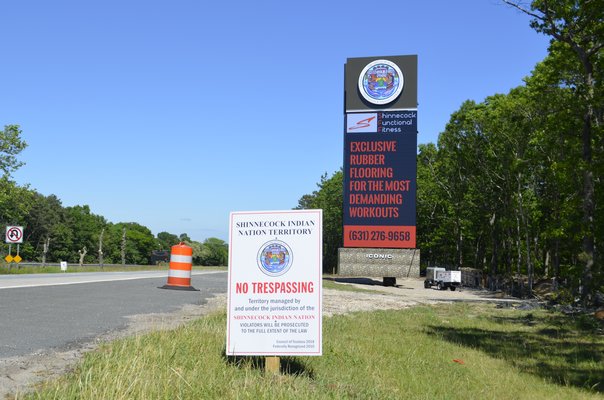
The Shinnecock billboard on the south side of Sunrise Highway on Thursday, June 6. It has been operational since the day the temporary restraining order was issued almost two weeks ago. ANISAH ABDULLAH
Shinnecock Indian Nation leaders and the billboard company the Nation hired to build the 61-foot signs on Sunrise Highway say that enforcement actions by New York State and the Town of Southampton to try to halt the project have taken a toll on both the project and the tribe.
Larry Clark, a manager of the billboard company Iconic Digital Displays, LLC, filed an affidavit in State Supreme Court on June 6 alleging that the state’s and the town’s stop work orders caused advertisers, vendors, banks and subcontractors to express concern over the status of the project, resulting in financial losses and a damaged reputation for his firm.
Tribal Council Chairman Bryan Polite said this week that the interference and resulting delays forced the Nation to postpone for months some public assistance programs that were scheduled to start soon, to be funded by proceeds from the billboards.
Mr. Clark claimed that workers abandoned the site because they were afraid of being arrested and fined, forcing Iconic to hire new workers at a cost of $60,000. State Troopers threatened workers with jail time when serving the state’s third and final stop work order in May, the document stated.
The document also stated that over $1 million in advertising revenue was lost because the number of advertisers dropped from 15 to two, and that financing entity Valley National Bank put its $3.3 million investment on hold.
“The actions taken by the Town of Southampton and the State of New York have damaged and will continue to damage the reputation of Iconic within advertising and outdoor display industries,” Mr. Clark wrote.
Mr. Polite confirmed the allegations. “They were threatening them with lots of jail time, not just minimal jail time. They gave a whole bunch of tickets to a whole bunch of people,” he said of the troopers, adding that “big-dollar advertisers” were lost.
The day after the state served its final stop work order, Shinnecock Indian Reservation residents were at the construction site with chainsaws to cut down trees themselves, picking up where the workers left off.
Workers returned several days later when the Nation posted its own work permit. Shinnecock residents stationed themselves at the site in the following days to protect workers from more summonses and arrest threats, Mr. Polite said.
He said that the Nation’s public safety and affordable housing programs, scheduled to start later this month, were pushed off. “These were things that were about to take place, and now the delays and the harassment have basically stopped us from providing services to our people,” he said.
In the affidavit, Mr. Clark additionally sought to remove Idon Media and Digital Outdoor Advertising as defendants in the suit and replace them with his company, Iconic Digital Displays—the name displayed on the completed billboard’s base—stating that Iconic is the “exclusive agent for the Nation on this project.”
Tribal Trustees filed a motion to dismiss the case from State Supreme Court on June 10, stating that the tribe has sovereign immunity from the suit, and that Congress must waive the immunity for the case to proceed, which it has not done, according to court documents.
The State Department of Transportation commissioner and the State of New York filed papers in State Supreme Court against tribal leaders and their contractors more than two weeks ago. Papers included a request for a temporary restraining order, which was granted later that day.
The TRO, issued by State Supreme Court Justice Cheryl Joseph, prevents the tribe and its contractors from “conducting any and all activities relating to the construction, maintenance and operation” of the pair of billboards along Sunrise Highway in Hampton Bays—simultaneously on tribe-owned land and a state highway right-of-way—until the court makes a determination on the case.
Tribal leaders made it clear that they refuse to acknowledge the TRO, nor the state court’s jurisdiction, as they continue to operate the completed digital billboard and are proceeding with plans for the second one.
On the same day that papers were filed in state court, on May 24, the Nation filed papers in federal court against the DOT and the State of New York, over their efforts to stop construction, including three stop work orders and a cease-and-desist letter. Because of the tribe’s status as a federally recognized tribe, tribal leaders have ignored all authoritative attempts from the state.
“We don’t recognize the DOT’s authority or the state’s authority, and we have sovereign immunity from suit,” Mr. Polite said on Thursday, June 6.
The Nation’s federal complaint made the same claims described in Mr. Clark’s affidavit, outlining the chronology of the state and town stop work orders and their damaging effects on the project. The Nation removed its complaint from federal court about a week after it was filed and plans to resubmit an amended version soon, Mr. Polite said.
The tribe completed its first 61-foot-tall electronic billboard in late May and had it operational the day the TRO was issued. Construction on the second, identical, billboard, directly across the highway, began over a month ago but has not advanced past the initial foundation work. Plans for further work will likely begin in a few weeks, according to Mr. Polite.
Regardless of whether or not the tribe acknowledged the state TRO, Mr. Polite said that they were waiting for materials to arrive, so construction on the second billboard was not scheduled for a while anyway.
A hearing was scheduled on Friday, June 7, but Mr. Polite said that it later changed to a case conference, in which attorneys for both parties discussed matters related to the planning and arrangement of future court dates.


 on Jun 6, 2019