


 1 Photo
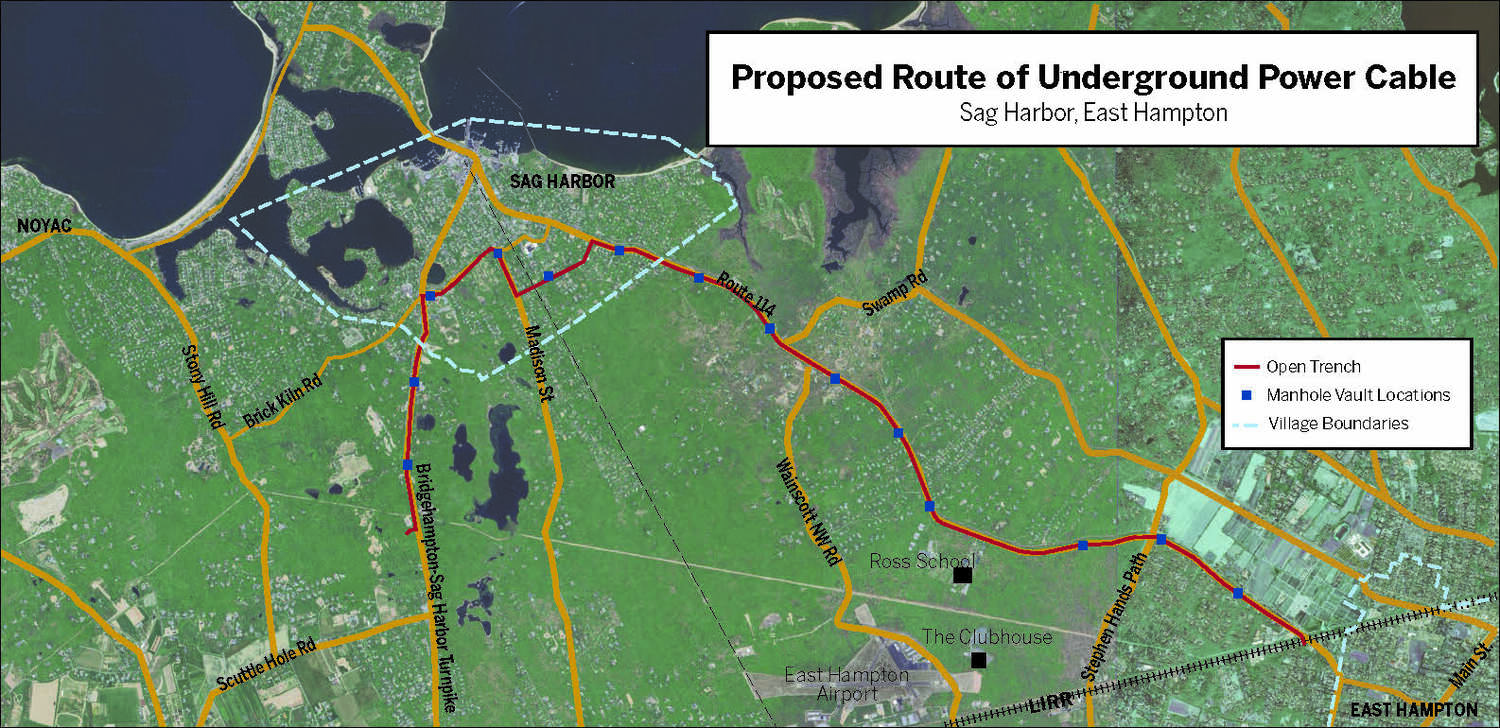
The proposed route of the underground power cable.
Two years ago, when PSEG Long Island proposed to bury a power line running from its Bridgehampton substation to East Hampton, under its right-of-way bisecting the Long Pond Greenbelt, the reaction was swift and unanimous from environmentalists and residents — they packed informational meetings on the project to demand that alternative routes be explored.
When PSEG held a similar informational meeting at LTV Studios in Wainscott on November 20, to unveil the new route, which will take the line north through Sag Harbor and down Route 114, avoiding the environmentally sensitive greenbelt, the response was decidedly more low-key, with more than a dozen PSEG representatives on hand to answer questions from the handful of people who trickled in to see their presentation.
The new route will run the 69-kilovolt line north from the substation on the Bridgehampton-Sag Harbor Turnpike into Sag Harbor, where it will follow Jermain Avenue to Madison Street. From Madison Street, the line will head south to Harrison Street, where it will head east to Route 114 and southeast to East Hampton, where it will be connected to the Buell substation.
The total cost of the project is $65 million, according to Katy Tatzel, PSEG’s director of communications, who said the original budget for the project through the greenbelt would have been only $47 million. The cost will be shared by all ratepayers.
Project manager Anthony Carullo said PSEG plans to begin work on laying the cable in January 2025, with a December 2025 completion date. No work will take place between Memorial Day and Labor Day due to the seasonal population swing.
Workers will be on the job from 7 a.m. to 7 p.m., except on Route 114, a state road, where they will only be allowed to work between 10 a.m. and 3 p.m.
No night work is planned in Sag Harbor, but PSEG says if there is a need to work in the evening, residents along the route will be notified in advance.
Trenches will be opened along the route, allowing construction crews to lay conduit pipe between a series of vaults. Once the conduit is in place, crews will snake the power lines through the conduits to the vaults, where they will be spliced together.
The new cable will bring additional capacity to East Hampton because the South Fork has seen its demand for electricity increase by 1.75 percent annually since 2009, and it’s projected to continue to increase at that rate through 2033.
Although the South Fork Wind Farm is operational, the amount of electricity it generates is not constant, and there are times when the South Fork will need additional power, especially during peak periods on hot, sunny summer days.


 Stephen J. Kotz on Nov 25, 2024