


 5 Photos

Some Sempervivums, or hen and chicks, have a very intricate and amazing geometric pattern of filaments that can go from leaf to leaf or across the entire plant. ANDREW MESSINGER
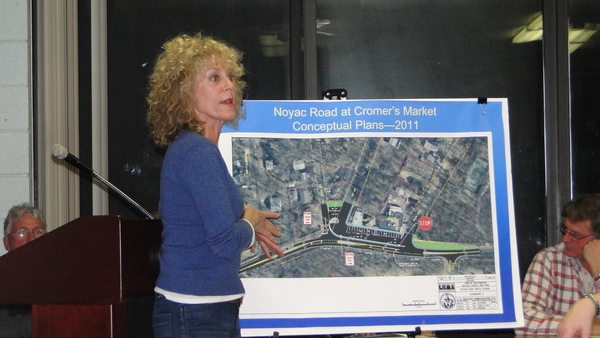
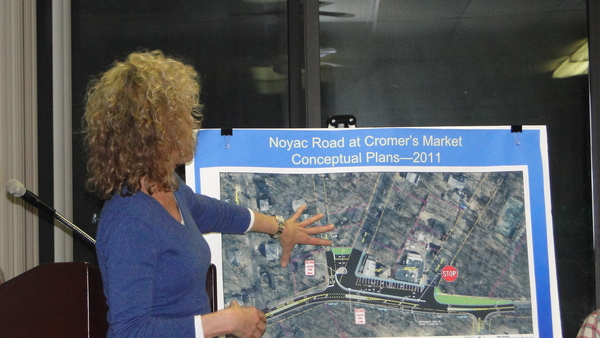
Forget trying to tame a perilous stretch of Noyac Road in Noyac by widening the street, adding medians, curbing and turn lanes, and condemning a piece of private property nearby to put in loading zones—the people want a simpler solution.
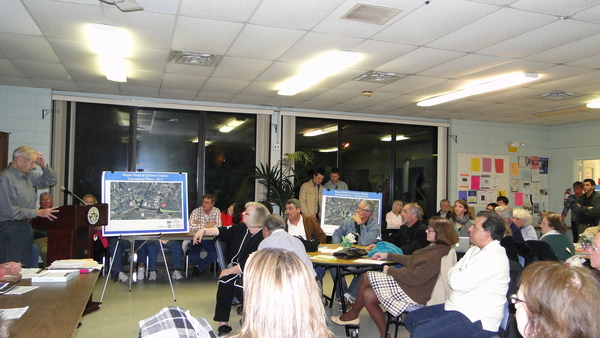
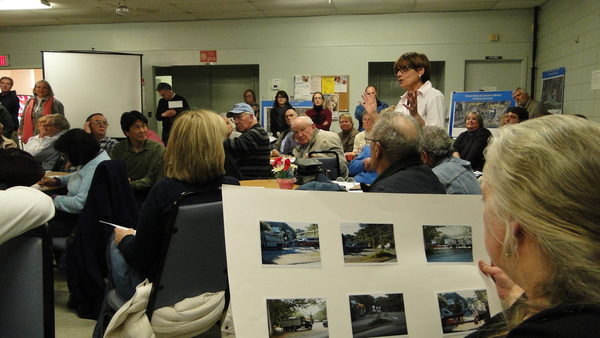
The public’s main message at an open forum hosted last week by the Noyac Civic Council was that the bend of Noyac Road by Cromer’s Market and the Whalebone General Store needs to be made safer, and soon, but Southampton Town’s most recent plan under consideration is excessive. Residents suggested low-speed zones, rumble strips, speed bumps and maybe even a ban on commercial through-traffic instead of a restructuring of the roadway planned by the town.
At least 80 people, many of whom live in the Pine Neck neighborhood of Noyac, near the curve in question, turned out for the forum on March 28 at the Bridgehampton Senior Center, possibly the largest community meeting that Southampton Town Supervisor Anna Throne-Holst said she has been to in her more than four years in office. The turnout seemed to convince the supervisor that a new approach is required. All four of her fellow Town Board members also attended the forum.
Yet, Town Highway Superintendent Alex Gregor—who did not attend the meeting, but has been calling for traffic calming measures, such as curbing and medians, to segregate the parking area from Cromer’s and other nearby businesses from the road—said this week he was “confused” by the supervisor’s change of mind to go back for more community input.
“I know the public doesn’t want to see the curbing,” Mr. Gregor said in a phone interview on Monday. “Ninety-nine percent of your shopping experience is in a parking lot that has curbs and a sidewalk. We’re not putting [anything] new here, nothing outrageous, but the folks in Pine Neck and one or two of the business owners think otherwise.”
Indeed, last week’s forum elicited an outpouring of discontent with the latest plan.
A series of plans to calm traffic at the curve, where the posted speed limit is 30 mph, have been drafted over the years, in various versions, each with new costs, dating back to a 2003 hamlet study. The latest plan, drafted by L.K. McLean Associates P.C., calls for widening Noyac Road and constructing a hard backstop median that’s intended to prevent cars from backing out of the Cromer’s and Whalebone parking lot directly onto Noyac Road. A median would curve around the Whalebone, cutting off Bay Avenue from Noyac Road, and a 6-inch-high median would separate the eastbound and westbound lanes of traffic.
The plan also calls for a loading zone to be placed near the Whalebone on a triangular piece of private property that the town would have to buy or condemn, although the property owners have opposed that. Rather than backing out directly into traffic, cars in the lot would have to turn right at the Whalebone onto Bay Avenue and left onto Elm Street to return to Noyac Road. A 3-foot-wide shoulder—not a designated bike lane—would accommodate bicyclists and pedestrians on Noyac Road. Additional medians along Noyac Road would narrow the lanes in a traffic-slowing effort.
Tom Neely, the town’s public transportation and traffic safety director, said the plan also would include drainage improvements, a common feature in virtually all roadway designs of late.
The town has budgeted $480,000 for the traffic-calming efforts along Noyac Road. If any money is reallocated from the project, it must go back into the highway road improvement fund for other highway purposes since it is bonded money specifically for said purposes.
Residents harshly criticized the plan as being too busy, drawing unfavorable comparisons to the Long Island Expressway, industrial areas and the remodeling of the Sagg Pond bridge between Sagaponack and Bridgehampton, for example.
“I’m in favor of a low-tech approach, whether you look at this as conflict points or potential bumper cars,” said Karen Hensel, a Crescent Street resident. “I think we are all in agreement that the demographics on Long Beach and Noyac roads have really changed.
“I mean, it’s become Montauk Highway revisited. I looked at this with horror,” she said of the current plan, adding, “I look at maybe $100,000 spent on studies, then I look at the potential of putting in four stop signs.” The audience applauded her comments.
“When I look at this, I think of that thing that they always say about when you see a doctor,” said Judy Carmichael, a Noyac Road resident who lives along the curve. “You go to see a surgeon, and they always recommend surgery. This seems way too complicated.”
“I think it’s a dangerous plan,” added longtime Noyac resident Ed Drohan. “I think you can get around this plan with speed bumps, stop signs, things like that, that don’t cost a million dollars.”
According to the results of a survey announced by the Noyac Civic Council that night, most respondents said they opposed the plan, noting that it would change the rural character of Noyac, adversely affect the businesses situated along the curve in terms of traffic flow and accessibility for patrons and delivery trucks, and would adversely affect homeowners bordering the proposed construction site. The survey had 84 respondents, the council announced.
Ms. Throne-Holst told attendees that she found their comments helpful. “I think what we’re hearing, first and foremost, is, this is overkill,” she said of the current plan. “We need to take a giant step backward and look at a slow approach.”
Striping and rumble strips, for example, could be installed quickly and without great expense, the supervisor said. The idea of banning commercial through-traffic is also very intriguing, Ms. Throne-Holst added.
Mr. Gregor said he told the supervisor via email about a month prior that he would not attend the forum. “I had concerns,” he said on Monday, explaining his absence. “You know, we wanted to try to have a format that would be friendly to show what we’re trying to do. I didn’t want to have an environment where the people from the community would just come and gang up and say, ‘We want something, but we don’t want what you want to do.’”
Mr. Gregor said he would support lowering the speed limit along that stretch of road, but noted that motorists will still go fast unless there is a police car planted there all the time. Speed bumps, he continued, cannot be installed on roads in New York, and rumble strips do not work well in residential areas.
He added that he was not sure how banning commercial through-traffic would work, as Noyac Road is not a cut-through but a major route, along with Montauk Highway.
“It’s not a real popular thing,” he said of the town’s latest plan, “but it’s a dangerous spot, and eventually something’s going to happen there.”
He said 47 accidents were reported at the curve between 2007 to 2010, including one or two fatalities. A traffic count done four years ago measured an average of 13,000 cars passing that curve during the summer. Mr. Gregor said he is working on a current traffic count. “We’ll do something before Memorial Day,” he added.


 Colleen Reynolds on Mar 29, 2012