


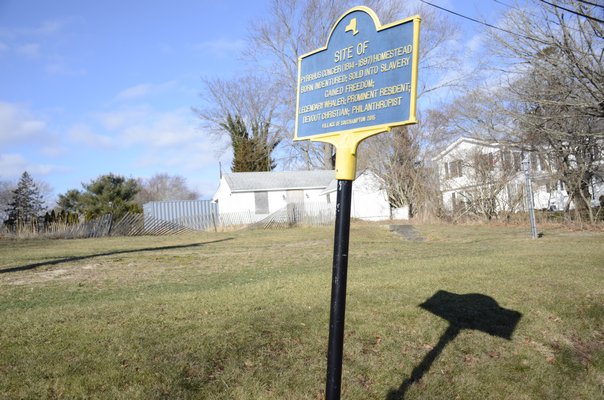
 1 Photo
A project to reconstruct the home of Pyrrhus Concer is going out to bid for the fourth time. GREG WEHNER
Southampton Village officials are ready to open up bidding on the reconstruction of a home owned by Pyrrhus Concer in the 19th century, but this is not the first time the project has been placed out to bid.
In fact, this will mark the fourth time since 2016 — and third village administration — in which the project has been reworked to attract a general contractor.
Mr. Concer was a former slave and a whaler in the 19th century who made Southampton his home. He was also a member of a whaling crew who saved Japanese sailors who were stranded on an island. When the sailors were taken home, he became one of the first, if not the first, person of color to visit Japan.
Original plans for the property, which was purchased by the Town of Southampton for $4.3 million using Community Preservation Fund money in 2015 — called for a museum, amphitheater, walkways, a water feature and lighting. But when bids for the project came back in 2016, they were much higher than the village planned to pay for the project.
Paul Rogers, an architect with Chaleff & Rogers went back to the drawing board after failing to get a successful responsible bid, and in 2017 proposed reconstructing the 16-foot by 30-foot house using portions of the original frame that were salvaged from the property before previous owners demolished it.
After one failed attempt, a bid was finally awarded to restore the historic home for $437,600, but things fell apart when the contractor, William Proefriedt, was accused of falsifying documents during the bidding process — Mr. Proefriedt is facing criminal charges in Suffolk County District Court.
On Thursday, Mr. Rogers presented a new plan for the property, which still includes using the old frame to build the house, but breaks the project into two phases.
During the first phase, he said, the entire exterior will be constructed and will be installed to supply water to the site. Plumbing, on the other hand, will not be done during the first phase, he said.
Electrical will also need to be done, but according to Mr. Rogers, Superintendent of Public Works Gary Goleski offered to have his crew do the electrical if they have enough manpower.
Mr. Rogers said during the second phase, the interior will be completed and windows will need to be made to appear as they did in the 19th century, and materials such as lime plaster and milk paint will need to be used — all of which add to the cost of the project.
In order to cut costs, Mr. Rogers said Jay Andreassi offered construction management services to the project under a pro bono basis.
Joining Mr. Andreassi in offering their services for free are Sam Rogers of Diversified Services, who will do the excavation work on the site, Chaleff & Rogers, who will provide the labor to install radiant tubing in the basement so they can educate younger members of their staff on the procedure.
Mr. Rogers said he did not know what the bids were going to look like this time around, noting that this was a complicated process.
“This is a 32-foot by 16-foot building that you would think could be built for less work,” he said, adding that prevailing wages and the fact that the work is being done for a municipality drive costs up.


 Greg Wehner on Sep 16, 2019