


 5 Photos
Lance Gumbs, who is vice chairman of the Shinnecock Nation Council of Trustees. JOSEPH SHAW
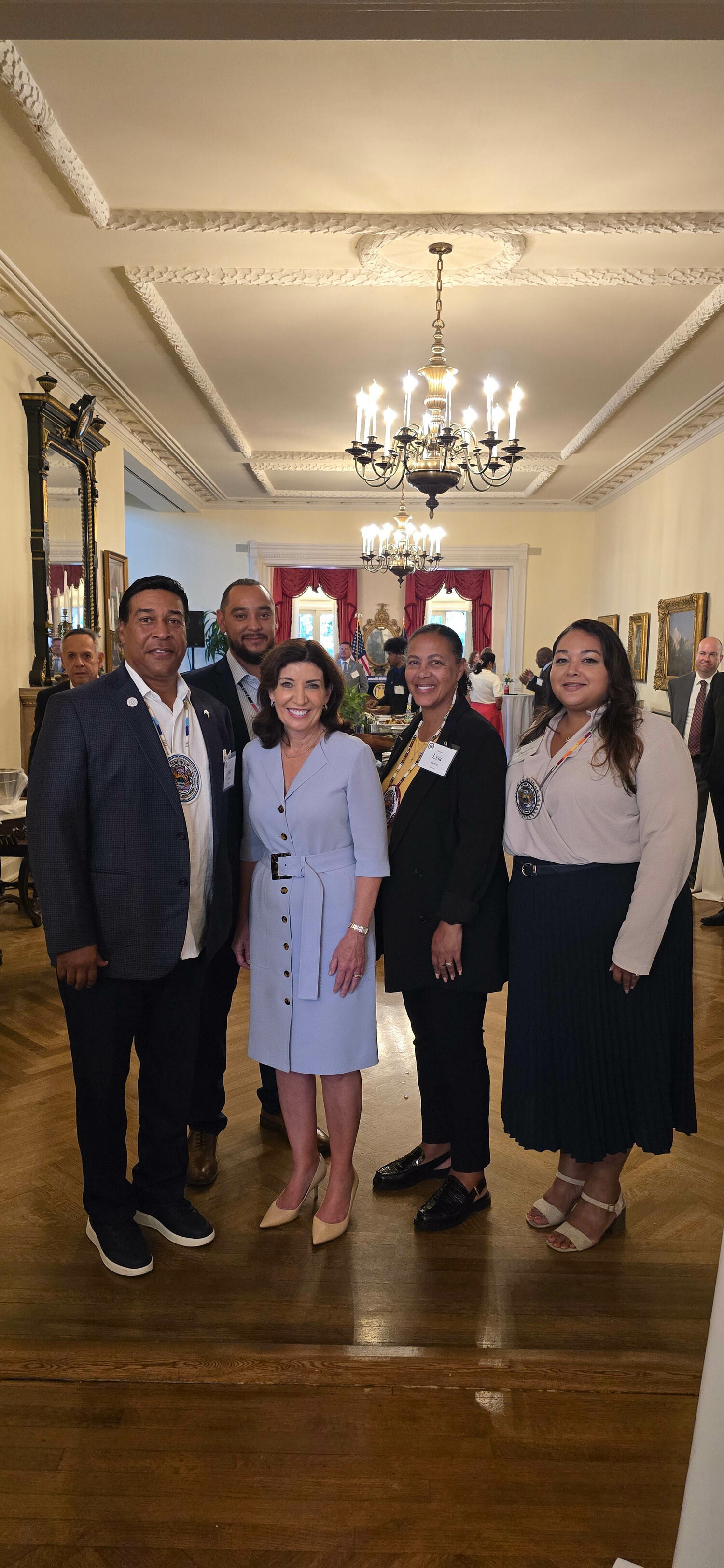
Shinnecock Council of Trustees Vice Chairman Lance, Treasurer Seneca Bowen, Governor Kathy Hochul, Shinnecock Council of Trustees Lisa Goree and Secretary Bianca Collins. COURTESY LANCE GUMBS
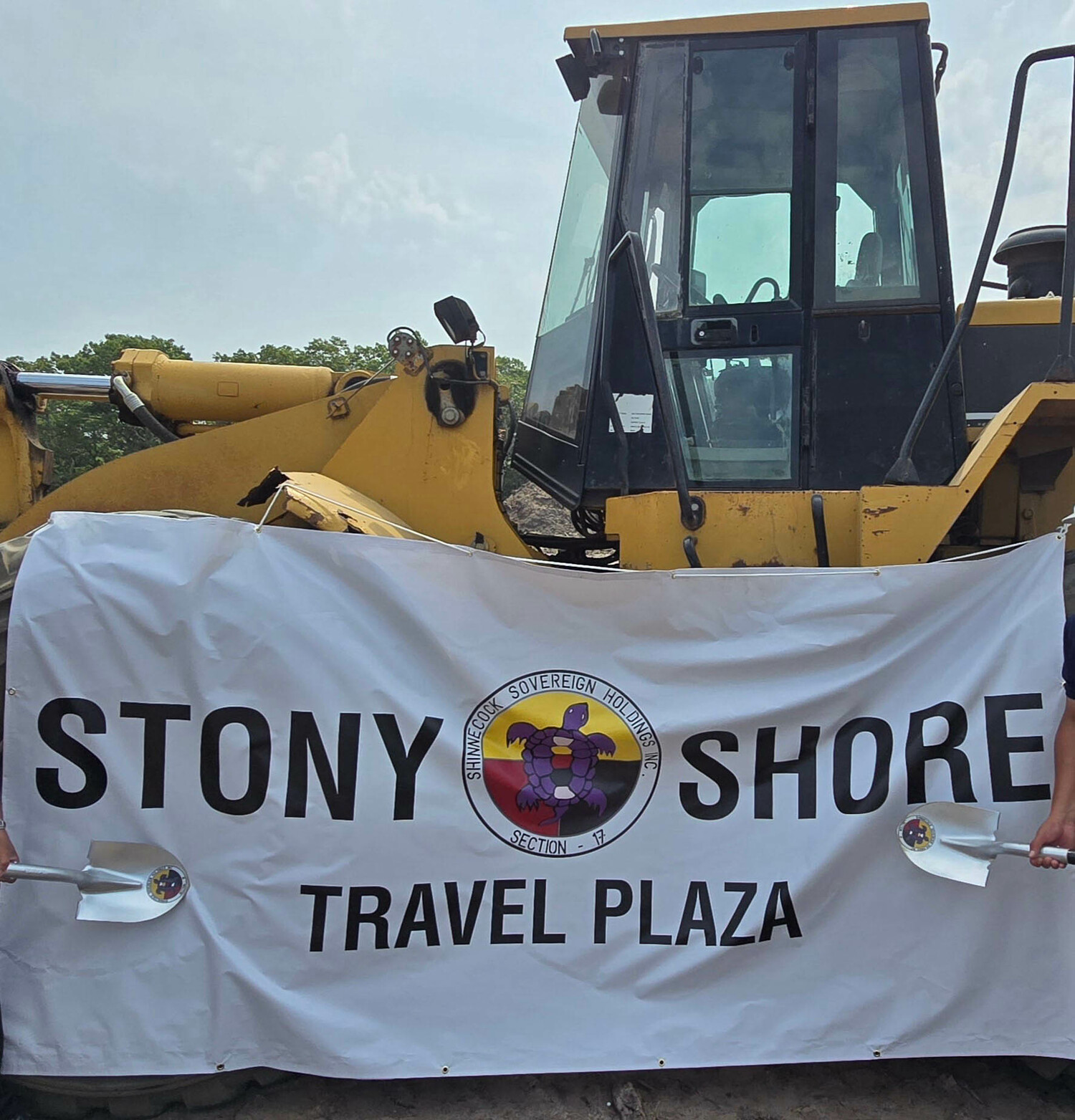
Groundbreaking at the Stony Shore Travel Plaza. COURTESY LANCE GUMBS
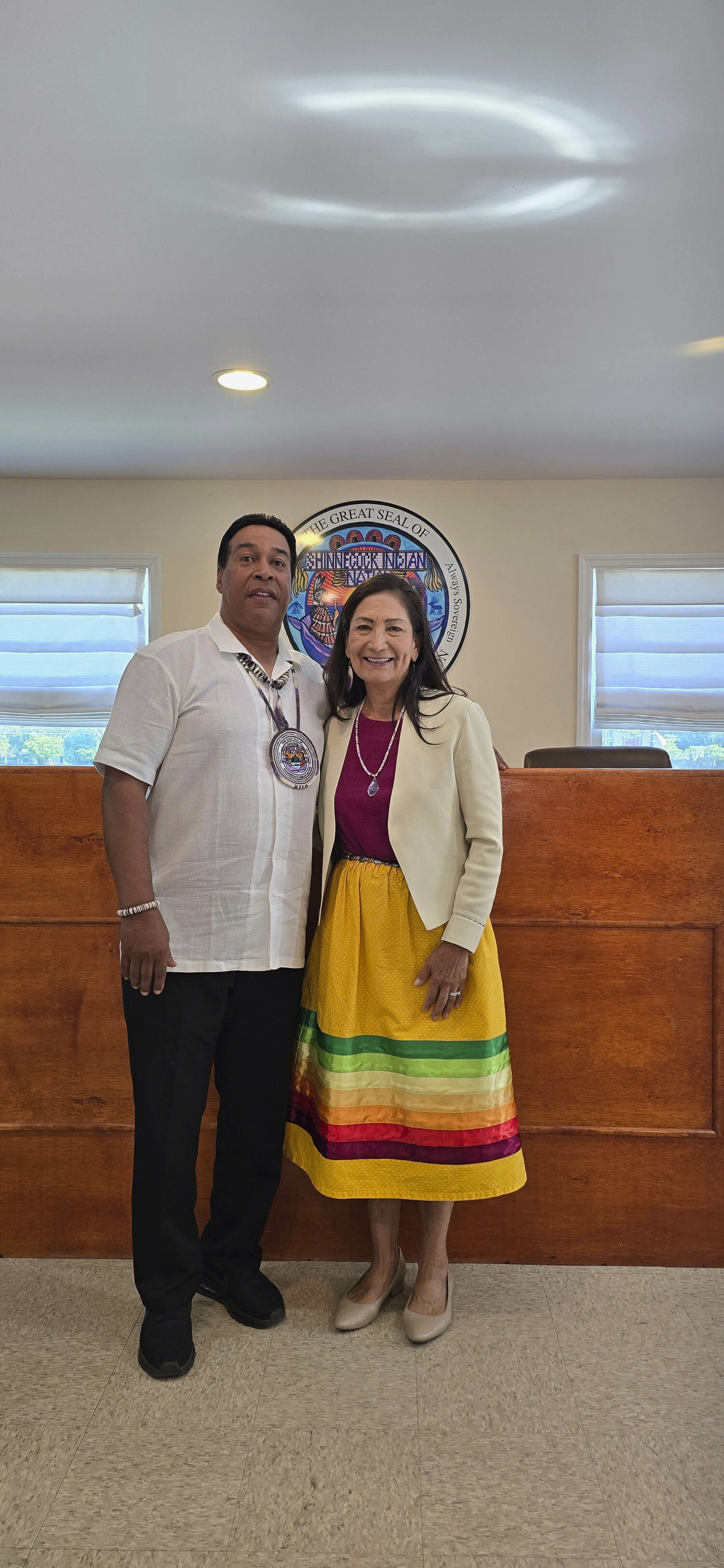
Lance Gumbs with Secretary of the Department of Interior Deb Haaland. COURTESY LANCE GUMBS
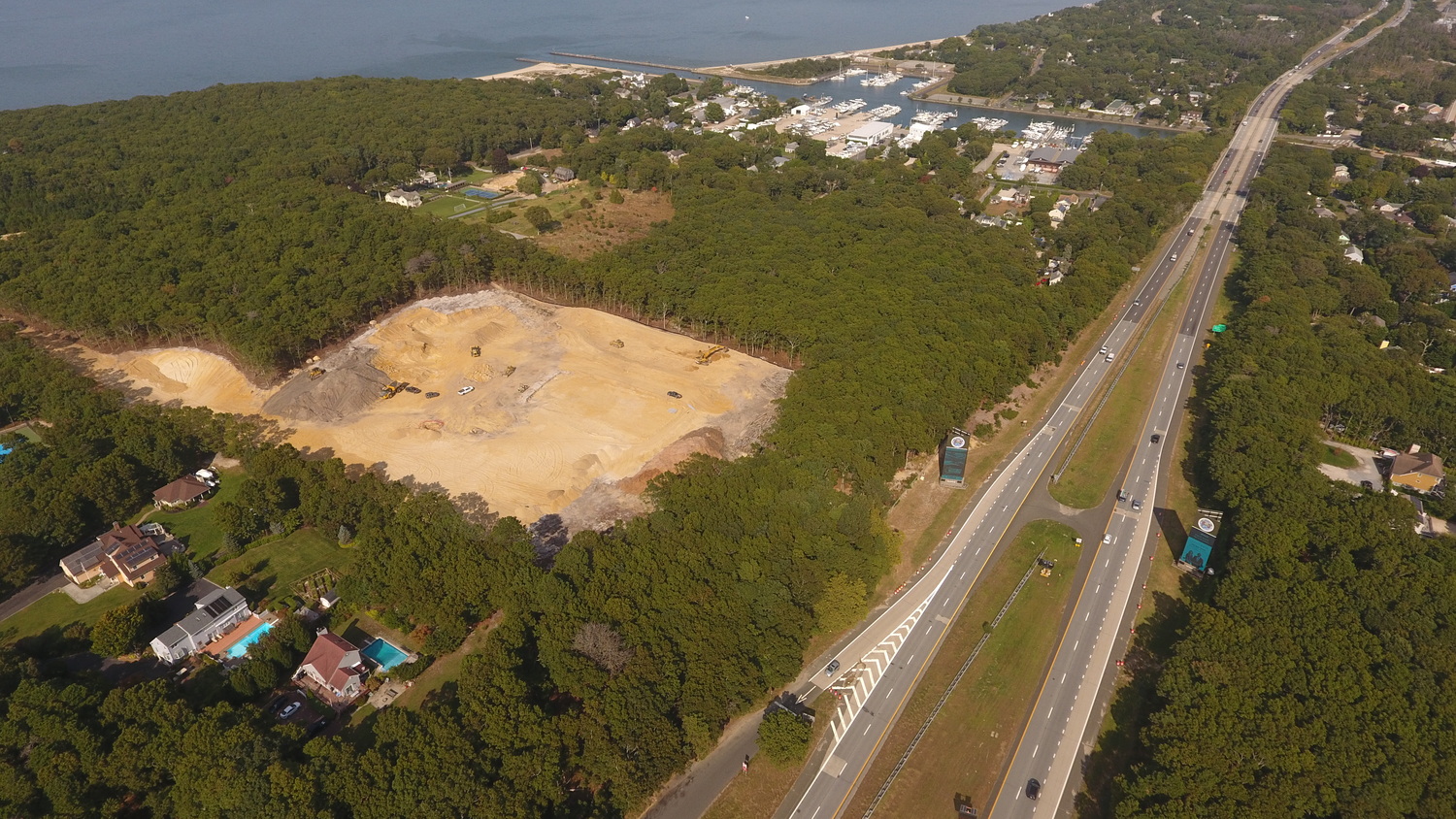
The gas station project underway in Hampton Bays.
In the 1600s, Dutch traders began trading for wampum made by the Shinnecock Nation, one of the first forms of currency in the region.
Today, a link to the Netherlands might have an impact on a project in Hampton Bays.
It’s a tenuous link, for certain, but at a gathering at the governor’s mansion in June, King Willem-Alexander and Queen Máxima of the Netherlands met with Governor Kathy Hochul — and Shinnecock leaders were invited to participate.
At the gathering, Lance Gumbs, who is vice chairman of the Shinnecock Nation Council of Trustees, and a longtime tribal leader, who also serves as the vice president of the National Congress of American Indians, said he delivered a message to Hochul.
“I said, ‘Look, we are not the enemy. … I go all over the country to various states and various tribal communities. And I see the partnerships and the way things are done in some of these states that have great relationships with their tribes.’ And I said, ‘Since the inception of New York State, New York has had an adversarial relationship with the tribes here in the state.’”
What he wanted was a government to government relationship between the sovereign Shinnecock Nation and New York State, which would both resolve existing disputes — a legal battle over the electronic “monuments” the nation erected along Sunrise Highway in 2019, for one — and pave the way for future projects.
First on the list: a proposed “travel plaza” now under construction just west of the Shinnecock Canal on the nation’s Westwoods property, which could benefit from direct access from nearby Sunrise Highway.
This summer, the result was a summit of sorts, with New York’s tribes meeting for the first time with the governor and a panel of state officials — including Marie Therese Dominguez, the commissioner of the State Department of Transportation, who had a constructive conversation with Gumbs and other Shinnecock leaders.
Last week, while driving to Gracie Mansion for another confab with state officials, Gumbs spoke by phone about the Hampton Bays project, in an interview that is edited for length and, lightly, for clarity.
Q: A lot of neighbors have expressed anger about the situation with the development of the property at Westwoods. Is there anything you’re angry about?
Well, we’re angry, clearly, about the encroachment that has transpired on the western side of our tribal property … and the fact that all of these homeowners knew when they were purchasing these properties that they were bordering up to tribal lands.
And so for them to have this expectation that we would never, or should never, develop our lands for the benefit of our nation is just ludicrous.
And it’s very frustrating for us to sit there and listen to this rhetoric from neighbors — and the fact that we know now that the town actually violated its own code with that housing development on Quail Run there, where there was supposed to be a 30-foot buffer between our property and the homeowners’ properties. That wasn’t done. And the town attorney and one of the council members has acknowledged that the town dropped the ball in that area.
So had that buffer been in place, they probably wouldn’t have seen the openings or the clearings that they do now. But because the town dropped the ball, that’s of great concern to us, because it’s a violation of town code.
Q: Let me try and clarify that. You’re saying that the town should have had a 30-foot buffer between you and the neighboring properties?
Correct. Between our actual line and the ability for that subdivision to be built under town code, there’s supposed to be a 30-foot buffer where there is no building.
Q: And you’re saying —
And that’s not what happened.
Q: — there is building within that 30-foot buffer?
Correct. We actually have a map [of] where that 30-foot buffer should be, and it actually goes through several of the neighbors’ pools — literally where that buffer should have started.
And they don’t know how. The town now has acknowledged to us that they don’t know how that happened. But that is deeply concerning, because now the neighbors are coming at us as if we did something wrong, when at the end of the day the town didn’t follow its own code, which would’ve resulted in that minimum 30 feet of trees and woodlands between us and the neighbors.
Q: Do you think 30 feet would’ve made a difference, as far as the impact on neighbors?
Absolutely. Because I know that once we finish with what we’re doing, we’re going to have a minimum of a 30-foot buffer — so you’re talking about a 60-foot buffer between their line [and ours]. Because our line right now, we have actually more than 30 feet between where the road is and their property line.
But the issue is, there would’ve been quite a bit of foliage and trees and stuff. … I spoke with CBS over there, and CBS went into one of the lady’s houses, and she opened her window shades and could look right into our property. Well, there’s a problem there, because that house is one of the houses that is encroaching on our property!
Q: Something I’ve heard from some of the neighbors is that they were fully aware that it was tribal land when they purchased their properties, but they were under the impression that it was not to be developed — that it was solely for the use of collecting firewood, that type of thing. What’s the response to that?
We have no idea where they would get that notion from. That has never been stated by anyone within the tribe, that that was never going to be developed or used, especially given the fact that, where we are at the Neck, or what we call “rez proper,” we’re out of space now for really anything, including housing.
So there was always the idea that [Westwoods] was going to be developed — it’s just in what context. And with the advent of gaming back in 1983 and the 1980s, there was always the consideration that that piece would be utilized at some point in the future for gaming.
I’m at a loss as to where they would get that from. The only thing that I can say to that is that maybe the real estate brokers lied to them when they were in the process of buying the house.
But what is interesting is that most real estate transactions that occurred had an “Indian clause” in it that talked about holding the real estate companies harmless if there was an Indian claim — so the real estate companies clearly knew that that was tribal land. They knew it was tribal land.
And so for them to have this expectation that they were going to be able to buffer up to our land and enjoy a forest was just unrealistic expectations.
Q: Can you sympathize at all with property owners who are now concerned that their property values might plummet because of a development going up right next to them?
To be honest with you, I cannot sympathize with them. They knew that they were buying property that was adjacent to Indian land. Unless they’re living in a box, they know that most tribes across the country have, in some ways, some form or fashion, developed economic development for their tribes, whether it’s gas stations, gaming, hotels, resorts, or whatever the situation may be.
For them to have the expectation that there was never going to be anything, and that we were never going to do anything with our tribal lands? I can’t even fathom it. I can’t understand how they would think that.
Q: And just let me be clear now: The tribe’s position is that this land does not fall under the town’s jurisdiction in any way, as far as zoning?
That is correct.
Q: And you’ve been working directly with the federal government through the EPA, right?
That is correct. We just recently met with the Region 2 EPA director and all of them, they came out to Shinnecock. And we had extensive conversations about the gas station — not just the gas station, because there’s a lot of issues that are concerning the tribe with water runoff from the highways and the asphalt, the pollution that’s obviously going into the water from the runoff, from the roads. So there’s a lot of issues that concern the nation.
But, obviously, the most pressing one was the gas station. And then just making sure that we were following all EPA guidelines permitting based on what has transpired in other tribal communities around the country that have gas stations.
All you got to do is go right to Connecticut. You look at the Mashantucket Pequot, they have a gas station. The Mohegans have a gas station on their tribal territory. I think it’s four, now, gas stations up at the Unkechaug Reservation right here on Long Island. So we look at those. Oneida Nation upstate has nine gas stations — and they’re all in areas that would or could be considered residential.
Q: Your concern about the environmental impacts: Is that influencing the design of the project in any way?
Oh, absolutely.
Q: Are you doing anything different with the tanks, or with the idea of the road runoff from the actual station itself?
Absolutely. We have a spillage drain in the back. We are absolutely looking at all areas of runoff. One of the permits is for water spill-off. … The other one is air quality. These are all permits that we’ve been seeking. The tanks that we’re using are state-of-the-art tanks, they’re the newest type of tanks. So all of those things are what we’re looking at.
And even with putting the tanks in, there’s going to be a lining underneath them that’s actually already in the ground, where the tanks will sit. So there’s a number of things that we’re doing to prevent any type of spillage or leakage.
Q: Let’s take a step back and talk a little bit about the project itself. How many underground tanks does it involve, and how many pumps will be involved?
It’s only two tanks that are going in. They’re split tanks, so it’s only two tanks that are in. And there’s going to be approximately 36 pumps. We may revisit that based on the scale of things, but at this point, that’s what’s in the plans.
Q: And you have the tanks already on site, right?
The tanks are on site and in the ground, but they are not covered yet. We are awaiting the EPA permits so that we’ll be able to fully cover them.
… One of the things that has disturbed all of us greatly in the community, in the Shinnecock community, is this story, the storyline that’s been out there, talking about “the construction started in the middle of the night.”
And that’s absolutely false. And I do have to say that whenever one of the reporters talk to us, they’ve always got to confirm what we’re saying with someone else, whether it be us or the EPA or someone else. And we’re upset that that was not done with this situation — that a storyline was put out there that we started construction of the property in the middle of the night, and no one confirmed with the nation or spoke to the nation about that or spoke to the company. And that was absolutely false.
Q: Well, the tanks were clearly delivered at night, right?
Well, the tanks, everything [is] delivered at night on eastern Long Island, period! Let’s not just put it on the tanks. When you see the houses coming out, the modulars and all of these things, they’re all done at night to avoid traffic. So that is just a situation that is a norm for delivering anything of that size.
Q: I think some of the neighbors have suggested that the clearing of the site also began in the …
And that’s what I’m referring to — there was absolutely no clearing that started in the middle of the night.
This company is a professional company. Nobody’s going to go in and start in the middle of the night. And one of the people who said it doesn’t even live in that area … doesn’t even live in that area to know that it started, or would’ve started, in the middle of the night.
Q: You’re saying there was absolutely no intention of doing that?
No intention? It didn’t happen! It’s not a question of intention. It did not happen. There was no construction started in the middle of the night.
Q: Do you have some idea of the amount of traffic that will go through this travel plaza once it’s up and operational? Do your studies suggest how many vehicles are going to visit?
Well, the problem that we have right now is that the study wasn’t done, really, for [access from] Newtown Road. The study was actually … When we did the study, it was based on the highway. So we do not have an accurate number.
And that is something that me, personally, I’m worried about, because it is difficult to get into there from Newtown Road. So that is something that is concerning to a lot of us. And one of the reasons why we’re pushing so hard to get this access from the highway itself.
Q: Where does that stand? What will have to happen for you to get access from the highway?
Well, there’s a permit that has to be done, and the permitting itself is very extensive. It’s not just going in and filling out a couple of pieces of paper. You’ve got to give them the logistics of it, the concept of it, drawings of it. It’s quite an extensive process to do an off-ramp off a highway.
Q: Would you need state land? Is that part of the issue, too?
We would need a little of the state land, yes. That’s what we’re actually permitting for, is that parcel. We don’t need a permit for our land. We need it to make sure that we have the length of the off-ramp that is needed.
Q: What’s been the state’s willingness to have that conversation so far?
Well, we’ve had the conversation with the Department of Transportation commissioner. We did have that conversation with her when we met with the governor and all of the commissioners up in Albany. And then there was also a follow-up call that was done.
She was unaware of a number of things, which actually go back to the sign itself that she had not been briefed on, so …
Q: Can you say more about that?
She didn’t know, for instance, that we had actually met with the Department of Transportation seven times in preparation for putting up the signs. This is going back to the signs itself, which obviously is having an effect right now on the current opportunity for us to get the offramp, because, locally, they’ve said that they wouldn’t even entertain the permit while we were still in litigation with the state over the sign.
She did not confirm that to us. So, again, it seems as if there was a little bit of a disconnect between the regional office out here and the commissioner’s office in Albany.
And to that point, even when we were in court, listening to the arguments, one of the state’s attorneys made the statement that we had absolutely refused to allow them to inspect the signs, and told the judges this. And that was an absolute lie! We have never refused them.
They never asked! You can’t refuse something that there was never a question for. They never asked us to inspect the signs or any of that. So the lines that were given to the judge in the case was really false and misleading once again.
Q: If you aren’t able to work out access from Sunrise Highway … and, by the way, it would just be for westbound traffic, correct?
At this point, yes. We have a plan, as the development of the property continues, we do have a plan for a flyover so that the eastbound traffic will be able to go into the property as well.
Q: But that’s not part of the initial plan?
No, that’s not part of the initial plan. That would probably be part of the second phase, because that has to be paid for by the tribe itself. That would be part of any secondary plan that we had getting into the property. So, right now, it would just be the westbound side.
Q: If you are unable to get access to the site via Sunrise Highway westbound, you’re still committed to opening the facility just with access from Newtown Road?
That is correct. We have a target date to open, and we’re going to stick to that target date.
Q: What’s the target date?
It’s April. In April. In April.
Q: This travel plaza, you’re going to have a retail aspect to it. Are you going to be selling cannabis products there?
There’s going to be a smoke shop there, haven’t decided whether there’s going to be cannabis there or not. But I know that there’ll definitely be a smoke shop component to it.
Q: You’re leaving open the option of cannabis possibly being sold there?
Yes.
Q: A lot of the neighbors say their concern about this is that it’s just the next step along a path to a larger development of Westwoods. That’s not actually even in question — you’ve been fairly open that this is all leading toward the idea of another development of a resort-type hotel on Westwoods, on the bluff, right?
Absolutely. Let’s not beat around the bush with this. The tribe is looking to do economic development on that property. And I think that we’ve been pretty much straightforward on it. We did have the discussions with a number of congressmen, starting back with Congressmen Tim Bishop and others, concerning gaming at Westwoods. … We’ve had these conversations with our congressmen about moving gaming out of that area. And there was always going to be this help for us to acquire additional lands, or to look for additional lands that we could utilize for gaming, and not have it be at Westwoods. And each time, no one ever came through.
… There’s this real misconception out there among people that, somehow or other, we were told that we couldn’t do gaming at Westwoods — and that is not the case. We were never told that we couldn’t do gaming at Westwoods. And most know that they could never stop us from doing gaming at Westwoods. That was an internal decision. That was not an external decision. That was an internal decision to hold off on moving forward with gaming after we were federally acknowledged.
Q: You’re talking about a gaming facility at Westwoods, not just a resort hotel?
We’re talking about economic development at Westwoods, and the resort that we’re talking about right now that was put before the nation for a vote, there is no gaming in it, it’s simply a resort.
Q: But you’re saying at some point down the line, gaming could be an aspect of what goes on at that property?
Absolutely. There is no question that we have to look at what is the biggest bang for our limited land base. In all of the economic studies across the Indian country, with all of the different types of businesses that tribes own and are a part of, there is nothing that even remotely comes close to gaming.
And it really goes back to the limited amount of space that we have. And being realistic, we have to look at what we have to work with. And then what does the options then with the limited amount of land base that the tribe has.
Obviously the gas station was one of them, but that’s still not going to be enough to sustain the nation in any major way. And, again, this is not about tribal members or individuals becoming rich or being able to buy mansions and fancy cars and stuff.
This is about the operation of our programs. We have 16 different programs, and only about half of them are actually funded under the government administration monies or grants. The rest are pretty much funded by the tribe. And so that’s where the difficulty comes in — it needs to have a revenue base or a revenue stream to really sustain these programs.
Q: And the federal government has decided that that revenue stream should be gaming.
The federal government … well, that was a court decision, the Cabazon court decision [California v. Cabazon Band of Mission Indians], which said that the tribes had a right to do that. And, believe it or not, … Richard Nixon is the one that started the whole sovereignty and self-determination situation. It was under his administration that tribes were finally, the shackles were taken off tribes, and they were actually able to start economic development, their economic development engines.
And we all know why that is.
Q: In order to cut down on federal spending, right?
Yeah, exactly. We all know why that is. But nonetheless, it’s something that tribes wanted. It’s something that tribes had been trying to do for years and years and years. You go back to that movie, “Killers of the Flower Moon,” and the Osage, and what transpired with their oil and how it was controlled, because the Indians weren’t considered competent enough. And that’s exactly what happened throughout time and across the country.
Q: Is a gaming facility at Shinnecock Neck still on the table, or is that no longer something that appeals to the tribe?
I can’t really say. Again, we’re looking at all of our options.
Q: Has it been ruled out? Let me ask it that way.
No, it has not been ruled out. It has not been ruled out.
Q: Where do you think this all ends? Is there an opening here for conversations with some of the neighbors immediately around you at least to try and address some of their concerns? Do you think there’s a way out of this that’s a little more amicable?
Well, we started with the town on that because of the fact that the town did not follow its own code. One of the things that we discussed with a couple of the council members was them putting up a barrier between us and them. It’s their fault that the barrier is not there, so they should own that and put up a … Now, whether that barrier is trees or an actual wall … I’m riding on the LIE here right now, and you see these big walls that they’re putting up along the LIE now.
But I think that the town has to own some of this as well for not following their own code. And the onus should not only just be on the tribe but on the town as well. That’s one of the ways that we see this.
And, obviously again, the neighbors and the town working with us when we were at the Shinnecock Heritage Day that the town honored us with. Ed Romaine, the county executive said some very powerful words in our favor as well. And so in terms of trying to do a letter to the state to get us that off ramp? So the more help and support we get with dealing with this on/off ramp, the better it’ll be for everybody. It’ll alleviate 90 percent of the traffic … by just having that off ramp. County Executive Ed Romaine said he was supportive of that. The town has said they are supportive of it. So we have to use that political power to move the Department of Transportation as well.
There are some things, and obviously we don’t want to utilize that road, the narrow roads. … And the only feasible way to do that for any real profits is to have it come off the highway where they can come right off and go right back on.
… And I think a lot of this, you alluded to it earlier, though, and I think a lot of this has to do with the notion of future projects — and if they can stop this one, then that puts the kibosh, in their minds, on future projects. And I think that is playing a big factor into this as well. … And it’s pretty clear that you’re involved in this and pushing this envelope because of what you think or feel about something that may be pending or maybe coming.
Q: I feel that both sides feel that way — that both sides look at this as the gas station is a first step. And I think you’re right. I think neighbors figure, we’ve got to stop this to avoid that. And I feel like the tribe is saying, we have to accomplish this to get to that. Is that fair?
We don’t typically think we look at it like that.
Q: You could argue that the monuments were a first step, and then this is a second step, and then there’s a third step.
I am not going to confirm or deny that.
Q: It’s sort of how it looks from the outside. … And I would understand if the nation’s position is: We’ve got momentum and we can’t lose that momentum, and it’s got to keep going forward, and the minute we pause from moving forward, you run the risk of it stopping altogether. And I think you’re right — I think the neighbors feel that way too, that this is a train that’s moving, and we have to stop the train or it’s going to keep going. I think that is the heart of this whole thing.
Well, that’s a possibility. From our standpoint, though, we paused already. We paused several times on this. The gas station didn’t just come up now in these last couple of years. We’ve talked about a gas station over there since the late 1990s. So this is not something that all of a sudden, oh, we just came up with this idea to do a gas station. That has been on the table for multiple councils and multiple years.
And so, again, we look at it as — we did pause, we paused on the gaming, so we have paused on things. … When we’re looking at it from our perspective, we have paused numerous times, and at what point do we say enough is enough? And we’ve reached that point.


