


 2 Photos

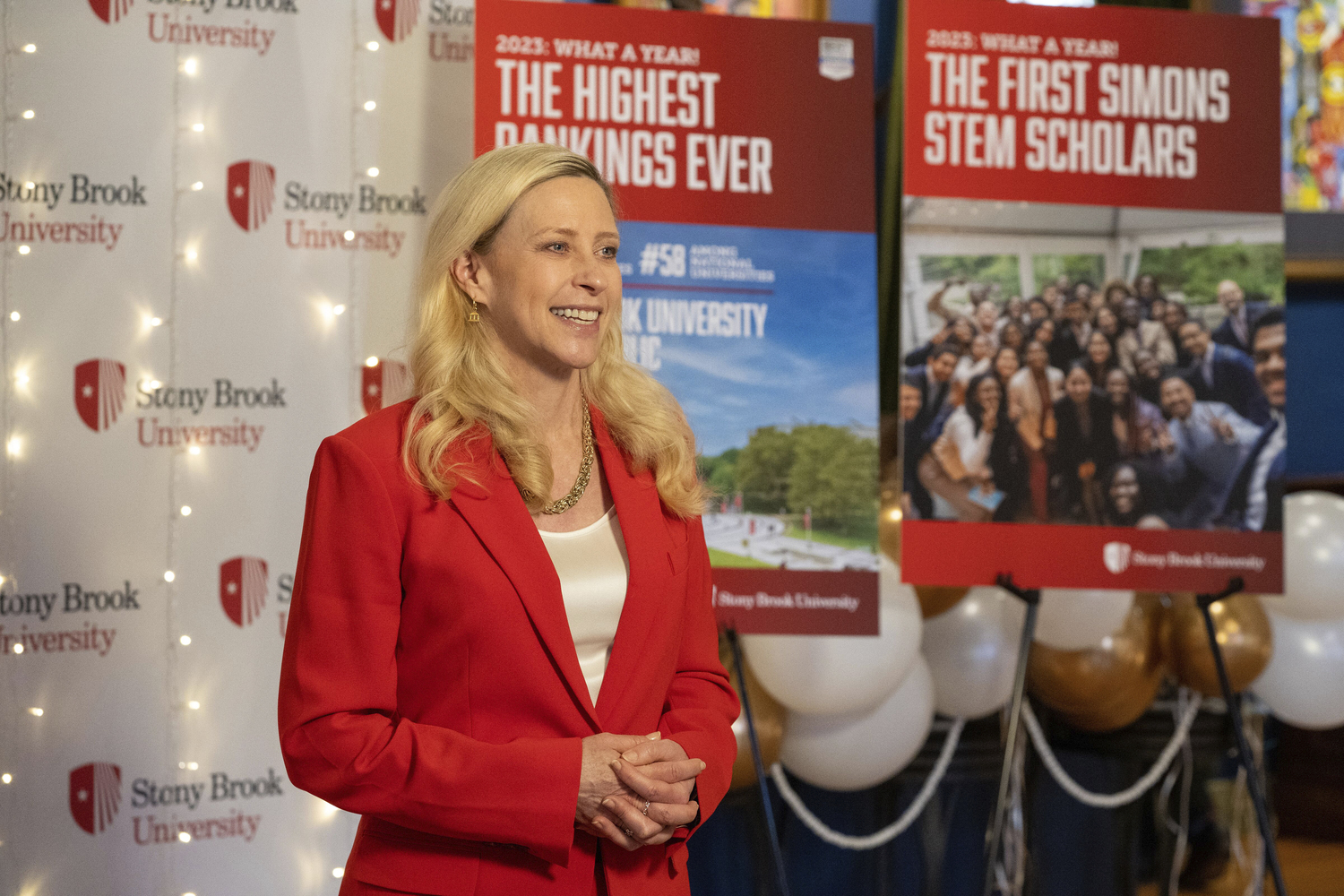
Dr. Maurie McInnis, president of Stony Brook University on campus with students. COURTESY STONY BROOK UNIVERSITY
Dr. Maurie McInnis, president of Stony Brook University. COURTESY STONY BROOK UNIVERSITY
It’s an exciting time for Stony Brook University, Dr. Maurie McInnis is happy to point out.
The sixth president of the university, who arrived in July 2020, spent most of the first part of her new tenure simply guiding the campus through the COVID pandemic and all the unique challenges of the time. Today, she’s ready to think about the future.
That includes the future of Stony Brook Southampton, which is very much on her mind, and the minds of other leaders at the college. In December, McInnis spoke via Zoom for a conversation that’s been edited for length and clarity, outlining the moment for the Southampton campus and how its future fits into the larger vision for Stony Brook.
She began the conversation, unprompted, by talking about Stony Brook University and the University at Buffalo, both schools in the State University of New York system, being named by Governor Kathy Hochul as “flagships” for New York State.
And so what does that mean? That means that [Hochul] recognizes that we are the two universities in the state that are leading the state in research, in economic development, in educating students and driving socioeconomic opportunity for diverse students in New York State.
And in the last year, in the last budget cycle, both the governor and the legislature, for the first time in more than a decade, significantly increased funding for SUNY. And, of course, some of that money also came to Stony Brook University. There was a real focus on making sure that we can continue to hire the faculty that drive research, innovation and discovery, and educate our students, and that we can do the kind of research that really is going to change the world for the future.
So in addition to the blanket funding that she provided for SUNY, she also provided money targeted toward research facilities at both Stony Brook and at the University of Buffalo. We are very excited about this new commitment from New York State, and it has enabled us to continue to drive the work that we are doing at Stony Brook University.
And that crosses many areas, many of which also have an impact on the work that we are doing at Southampton. But, of course, we are a large university with a lot of different pieces.
So in addition to the support from the governor, we were named as the anchor institution for a major project in New York City called the New York Climate Exchange. This was a competition for really, in many ways, a partnership with the trust for Governor’s Island and the City of New York to create a climate science solutions center based on Governor’s Island.
We were such an obvious anchor institution for that because of two reasons. One, we have long been driving climate research — and a great example of that is the work that we have done over the last decade to clean up Shinnecock Bay, so that the bay is healthy once again and the mussel and clam populations are thriving, but the water is clean, that we no longer have algal blooms. In fact, it was named as an International Hope Spot for the planet because of the dramatic change.
And that change has been driven by a Stony Brook faculty member based in the Southampton campus, Dr. Christopher Gobler, who’s been working on cleaning up water on the East End and elsewhere on Long Island for more than a decade. … It has been an extraordinary decade of work, and none of that would’ve been possible without the research behind what has led to the success of being able to reestablish those communities.
Q: You feel like the efforts at Stony Brook Southampton had something to do with Stony Brook winning the New York Climate Exchange?
Absolutely. We have been leading in climate work and a lot of our leadership in climate work has been taking place in the research that our faculty are doing right on Southampton campus. And part of the appeal for us in establishing this idea of the New York Climate Exchange is the research we need to do spans all of New York from Governor’s Island and the harbor of New York City all across Long Island to our campus on Southampton in the East End, and really understanding the impact of climate change on the shores and on the waters that surround New York City and Long Island are an important piece of that.
And then, thirdly, the governor put in place a challenge match as part of the budget, where the state would match 50 cents to the dollar of what could be raised at the university centers: Stony Brook, Buffalo, Binghamton and Albany.
So she put aside a $500 million pot, and in the first two years, the most that one school could get was $200 million. We quickly began working with our great donors, Jim and Marilyn Simons and the Simons Foundation, to help us meet that opportunity. And they pledged $500 million unrestricted — making it the largest unrestricted gift in American higher education and one of the largest gifts ever to be given to a public institution.
And their gift is structured in such a way that in the first two years, $200 million of their $500 million gift is a challenge grant itself. So it ends up being kind of a double challenge. And so they are helping us go out to other philanthropists and say: Look at this amazing opportunity for Stony Brook — won’t you partner with the Simons Foundation, with Stony Brook University and the State of New York to help build an endowment to help ensure excellence for Stony Brook’s future?
Q: Exciting times, right?
It is very exciting times.
And so, from all of that, there’s a lot of really exciting work that is going on, a lot of momentum at Stony Brook University, and, of course, across some really important initiatives that include Southampton, as well.
Q: When I last spoke to you back in 2022, you said that the university was beginning, that semester, a universitywide strategic planning process — and you said Southampton was going to be a big part of that. Did that process yield anything?
Yeah, so we have a new strategic plan. You can find it on our website. As most strategic plans do, it lives at a pretty high level. And then the next stage is asking each of the units to prepare their unit-specific plans that link to the higher-level goals of the university’s strategic plan.
So it is that work that is now underway as the different units and entities work to build their own strategic plans.
For us, an important piece of that is that we have a new leader on our campus in the position of vice president for strategic initiatives, a woman named Wendy Pearson. She just began work with us about two months ago, but she has in her portfolio — as really her top priority at the moment — to really begin engaging with the Southampton community, very broadly defined.
So it’s not just about the campus — it is much more about how are we serving our community on the East End. And so it encompasses what we’re doing in health care, which extends well beyond the hospital. In fact, in the last year or so, we have added nearly two dozen providers in health care to the East End outside of our work for the hospital.
So the ways in which we serve the community through health care, through education and through public engagement, she is beginning that work and therefore will be helping to build what will be the kind of more unit-specific strategic plan that links into the university’s strategic plan.
Q: Obviously, it’s an ongoing process, and Ms. Pearson will be leading the conversation going forward. But when we spoke in 2022, you had said that the strategic planning process was a chance to talk about what the “unique alignments were for the campus and the community and how it fit into the larger idea of Stony Brook.” Was there any conclusion out of the strategic planning process about Southampton’s strategic planning, specifically, and what role it would play in the Stony Brook system?
The universitywide strategic planning did not get to that level of specificity. It was focused on, broadly, what our mission and values and priorities for the institution and now the unit-level plans are intended to link to that.
So I would say the best way to understand this is that the university strategic plan is ongoing and will never really be a finished thing. We have designed this so that it is a living strategic plan that gets updated every year at the unit level, so that we are constantly adjusting to new opportunities and as opportunities arise, have the flexibility to adjust and attend to those.
Q: Almost from the time it was founded in 1963 as Southampton College under Long Island University, this campus has always been problematic for whichever educational institution has tried to make a go of it there. It closed several times. It’s always posted financial losses. And it feels like there’s never really been a solid vision for how to make that college unique and, frankly, viable. When it started with LIU, the idea was for the Southampton campus to be sort of a standalone institution. It was meant to be Southampton College, part of LIU. With Stony Brook, I think from the beginning the idea has been that it’s an extension of Stony Brook University and the main campus. And I wonder if you think that, as a campus serving the needs of the larger university with a much more limited scope, it might help moving forward rather than trying to make it a standalone institution?
I can’t even speak to the full scope of time. Remember, I just began as president in July 2020 and, inevitably, in 2020 and 2021, and even into 2022, we had to be primarily focused on caring for our community through COVID, both in the health care space as well as in the educational space.
So what we had been doing prior to that, and continue doing, is supporting the programs that have been thriving at that campus. And the programs that have been thriving at that campus have been predominantly in three areas. And that is our School of Marine and Atmospheric Sciences, where, both from a research standpoint as well as an educational standpoint, we have really robust and thriving programs. And they’re enormously important to the work of that school.
Being on the South Shore greatly expands the research work that we can do in that school from our other location on the North Shore, and we’ll now have a third location on Governor’s Island. So it really gives us this much broader research base.
We also have been expanding our programs in the health professions. One of the things we have been learning on the East End is the struggle the East End has with getting the kinds of health care providers that the community so desperately needs. And a big piece of that is both being able to have more of our students be able to get placements in the East End, so that also becomes a goal of where they wish to be professionally for the rest of their lives.
So our health care and our health profession programs have been expanding there, as well as a deeper integration with placing students not only in the hospital, but in clinical settings throughout the East End.
In addition, we have for a long time now had really thriving arts programs, which are delivered at that location as well. As we all know, the East End has long had a really rich tradition in the arts, in the visual arts, but also especially the creative and writing arts, as well. And so those programs have been thriving in that space, as well.
So for us, it’s been about thinking about what are the unique opportunities that that campus provides and really developing the kinds of academic programs that make sense for that special and unique opportunity.
Q: In those three areas that are already existing on the campus?
For right now. And further engagement may help us identify and uncover something else, but that is the work that is ongoing. We are committed to the programs that are there and making sure that they are healthy and thriving. But we’re also asking questions about, is there anything else that would make sense to be doing at this location?
Q: About half of the buildings at the Stony Brook Southampton campus are condemned. Why let the property get to that point? Why let the infrastructure fall into disrepair like that?
Well, when we got the campus, many of those buildings were in considerable states of disrepair. That is actually part of the financial reason why Long Island University made the decision that they made. They did not have the financial resources to bring those buildings to a level that would’ve made them viable. So we inherited that.
And when we inherited that, it’s really important that you understand that we, Stony Brook University, do not have any control over the amount of capital, the money that we have to spend on buildings — that is entirely directed by the state. And across the SUNY system, we have the most deferred maintenance of any of the campuses by more than threefold.
So we have about $2 billion in deferred maintenance.
Q: Are you talking about … this is on the main campus?
I’m talking about all of main campus, plus Southampton, $2 billion in deferred maintenance.
Q: Billion with a “B.”
Billion with a “B.” This year, we got $29 million — with an “M” — toward maintenance.
Q: About 1 percent of what you need.
I have laboratories on this campus that should be where our faculty are doing cutting-edge research that have been closed, and where they’re storing boxes because there is mold growing, because the hoods won’t draw chemicals — where they are basically condemned spaces.
So, across a $2 billion deferred maintenance problem, we are trying to keep the lights on, we’re trying to keep the leaks from happening. And it thus means there isn’t much money to spend on Southampton’s campus. And when we spend the money there, we are going to spend it on academic and educational priorities.
So, for example, I mentioned that the governor made a $100 million commitment to Stony Brook and a $100 million commitment to Buffalo to support renovation of research laboratories. And of that, $100 million, we’re spending 25 percent of it on Southampton’s campus in support of the research that Chris Gobler and others are doing at Southampton. That is a priority that serves our academic and our research mission.
There are other buildings, many of the ones that there is some noise about, that don’t have the same academic purpose. And so in a very limited pot of money, we unfortunately have to make choices.
I would love nothing more than for the state to give us the kinds of capital resources that we could make further investments on that campus and on the main campus, as well.
Q: Regarding a new hospital on the campus: Nothing much has happened since [former Stony Brook Southampton Hospital Chief Administrative Officer] Bob Chaloner left; he was going to take charge of fundraising. I don’t even know that anybody’s been named to take up that mantle yet. And what’s the status of the hospital? I think a lot of people are watching with a little bit of worry about that.
So, first, let me set the stage, because it’s really complicated and I suspect most people in the community don’t understand this.
We operate the hospital, and our charge when this new relationship came into place was that we would improve quality and fully integrate it into Stony Brook Medicine. And we have been working hard on that. And there are so many measures by which the quality of the health care that is delivered at the hospital has increased.
Q: This is at Stony Brook Southampton Hospital, at the existing hospital?
At Southampton Hospital, at the existing hospital. We also have a commitment to the East End to provide for our patients in other ways. The new emergency department that is being built in East Hampton is a piece of that, as well, as are the many providers that we have hired in the community-based practices.
Southampton Hospital Association is responsible for the fundraising for a new hospital facility, and through the Southampton Hospital Foundation, that is where they are supposed to be raising the money. We have offered our assistance. We have raised a billion dollars since I’ve been here. We know how to raise money. We have offered our assistance, and conversations are ongoing.
Q: Are you still optimistic that a new hospital at the college campus is going to happen?
I am still very optimistic. We would love that.
In addition, we are talking to the state about how can we get permission to build workforce housing on some of the land of that campus that would be available, especially for health care providers. Because one of the biggest challenges in recruiting great health care providers to the East End to work in the hospital, to work in other clinical settings, is the cost of living in that community.
So we want to be able to see a new hospital facility on the campus, as well as workforce housing, all of which we think supports the health and well-being of the East End.
But fundraising for the hospital is the responsibility of the Southampton Hospital Association. And I would encourage you to reach out to them and ask them about the progress of the fundraising.


