


 4 Photos
Michael Pope
Remsenburg Veteran Michael Pope has earned his fourth degree at 92 years old. BY ERIN MCKINLEY
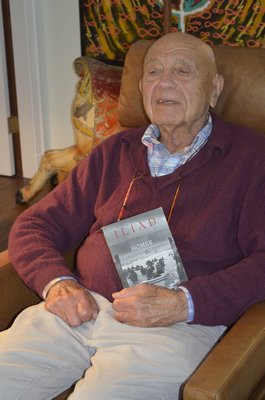
Remsenburg Veteran Michael Pope has earned his fourth degree at 92 years old. BY ERIN MCKINLEY
Remsenburg Veteran Michael Pope has earned his fourth degree at 92 years old. BY ERIN MCKINLEY
Michael Pope vividly recalls watching as a group of seamen mocked an 18-year-old “kid” peeling potatoes on the deck of a ship traversing the Atlantic Ocean.“They also serve who only stand and wait,” the young sailor replied.
Mr. Pope, who was a 20-year-old senior ranked lieutenant at the time, remembers being struck by the beauty of the quote that was seared in his memory, only later learning it is the final line of the sonnet “When I Consider How My Light Is Spent” by John Milton.
“You don’t have to be at the front lines to serve,” Mr. Pope said of the experience. He explained that phrases like that—paired with common expressions first penned by the prolific poet—make Milton his favorite writer, a distinction he decided over the past year while the now 92-year-old Remsenburg resident worked toward his fourth degree, this one at St. Joseph’s College.
“I have gone through my life using so many Miltonian expressions and not knowing they came from him,” he laughed. “Like ‘all hell breaks loose.’ Do you know how many times I have said that? It’s from ‘Paradise Lost.’ I read his stuff all the time now.”
The degree—a bachelor’s in English and history—is not the end of Mr. Pope’s education goals. He is already enrolled to take courses in French and the history of Long Island starting in the fall at the Patchogue campus, but only as audit classes. Rather than working toward a grade, by auditing the classes he will simply be working toward gaining knowledge.
“I went back to school for two reasons,” the seasoned academic recalled while sitting in his living room surrounded by an eclectic collection of artworks—several of which were designed by himself or his grandson, Isaac. “First, my mother taught me to never stop learning and I never did. Second, I missed out on the humanities. I never really read Milton or Homer, or Virgil or Shakespeare. There is a difference between doing it on your own and being in a classroom with exchanges.”
Mr. Pope was born on May 19, 1924, in Manhattan. He often cites his mother, Anna, as being an inspiration for his constant reading and desire to learn. When he was 19, he earned his first bachelor’s degree, this one in electrical engineering, from The City College, which would eventually go on to become part of the City University of New York. Because he was in college when World War II started, Mr. Pope was not drafted into the military, but was told he would be forced to enlist as soon as he graduated.
As promised, two days after the final class in his first bout as an undergraduate, Mr. Pope found himself on a ship as an enlisted member of the Merchant Marine—a civilian mariner fleet and division of the U.S. Navy designated during war times to transport troops and supplies to the front lines. Because of his education, he was immediately made an officer, eventually becoming a senior ranking lieutenant. During his two-and-a-half-year stint as a mariner, he was a part of seven successful round-trips across the North Atlantic, one of the most dangerous routes at that time.
After returning to New York at the conclusion of World War II, Mr. Pope joined a small Manhattan engineering firm called Myers and Addington, where he specialized in creating energy-efficient technologies. He would leave the company to create his own firm, an international agency that eventually bought his former employer and became Pope and Evans.
In 1983, Mr. Pope moved to Remsenburg with his wife, Sally. And in 2000, at age 76, he decided to make his first foray back into the world of education, earning a degree from the Cardozo School of Law in Manhattan. He followed up that degree in 2015 with an honorary doctorate in science from the City College of New York. The Bachelor of Art in English and history, which was successfully completed this month, marks the fourth and most likely final degree from Mr. Pope, who said he has no desire to ever write another college paper again.
He said one of his favorite parts of going back to school was seeing how history is being taught to classmates, many of whom are more than 70 years his junior.
“I read the papers every day and so it was fascinating to read how it is being taught,” he said. “You need time to study history. You can’t just read the daily newspaper, you need primary documents that come out years later to get the true picture of what the heck went on.”
One of his favorite professors was Marc Ricciardi, who has been at the St. Joseph’s Patchogue campus for almost two decades. Mr. Pope was so infatuated with the educator’s style of teaching—he said he could tell how passionate Mr. Ricciardi was about literature—that he made sure all six of his required English courses were taught by Mr. Ricciardi.
“He was like having a shaman in the class,” Mr. Ricciardi said this week. “He has tales and narratives that could draw all of the students together. Sometimes I would wonder who was the teacher and who was the mentor because he brought such a history with him that, literally, he is a living archive. He was the heart of the class in many ways.”
In the week before he graduated, though, he chose not to attend the commencement ceremony—he said he has had enough caps and gowns in his life.
Mr. Pope said he constantly encourages everyone around him to keep reading to gain as much knowledge as possible, a sentiment shared by Mr. Ricciardi.
“He is a living embodiment of a time traveler,” he said. “I have never seen such a depth of knowledge and the ability to apply it to the classroom scenario. He is like a sage.”


 Erin McKinley on May 24, 2016