


 1 Photo
One of Annie Napoliello's mood boards for ""Little Edie's Boudier." BY COURTESY ANNIE NAPOLIELLO
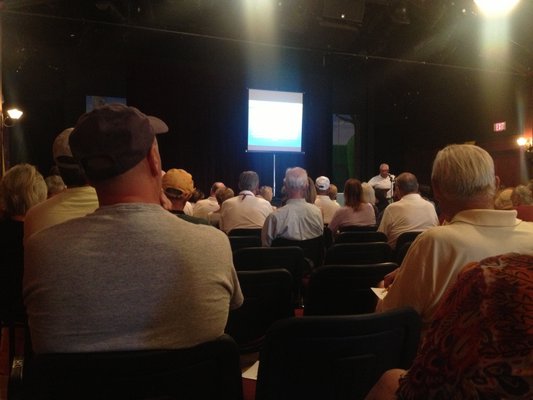
An informational presentation about beach preservation turned into a debate about the role of government in maintaining Southampton Town’s shorelines on Saturday afternoon at the Quogue Community Theater.
The Concerned Citizens of Quogue—a community group focused on protecting the village’s beaches—hosted Dr. Robert Young, a professor at Western Carolina University in North Carolina and the director of the Program for the Study of Developed Shorelines, so he could inform the community about the options for beach conservation.
After Dr. Young gave his hour-long presentation explaining the options communities have for protecting or renovating beaches, and giving examples of both successful and unsuccessful nourishment projects, he fielded questions from the audience of more than 100 residents, and that’s when things became slightly heated.
Town Supervisor Anna Throne-Holst asked Dr. Young whether the Army Corp of Engineers could handle nourishment of all the town’s shorelines as it had done when it rebuilt the barrier beach in the Village of West Hampton Dunes in the early 1990s.
Although Dr. Young tried to speak broadly to avoid commenting on issues specific to Southampton Town or Quogue Village, he tried to discourage such action. “West Hampton Dunes is a federal project, so there was never the issue of determining who’d pay for it,” he said.
Dr. Young later added: “I would disagree with the idea that we should build a project with the hopes that the federal government will pay for it. The federal government cannot possibly continue to renourish every beach along the coast.”
Despite his efforts to keep the discussion neutral, the debate had already commenced as audience members interjected commentary with their questions and interrupted one another. One man even capped off his pointed question about having the federal government pick up the tab for closing off the Shinnecock Inlet by proudly holding a newspaper above his head displaying a headline heralding government funds for Hurricane Sandy relief.
The Concerned Citizens of Quogue paid for Dr. Young to fly up from North Carolina to give this speech as means of educating the community about coastal zone management, Tom Lawson, a member of the group said.
Throughout his presentation, Dr. Young reiterated the significance of having a plan in place for handling beach disasters, as well as the importance of keeping an ongoing conversation about how to handle beach issues as civilly as possible.
“When you do coast zone management poorly it can tear communities apart,” he said. “It can drag people into the courtroom who’d rather not be in the courtroom. It can turn neighbor against neighbor. It can really poison the atmosphere in communities that have been for decades colloquial, casual places to be.”
Mr. Lawson said because Quogue’s 2.7-mile stretch of beachfront is in fairly good condition, the village does not need to make these decisions outlined by Dr. Young—such as choosing between nourishment and building hardened structures to protect beaches. Still, the group wanted to him to visit so community members could be aware of what their beaches could face in the future as sea levels continue to rise.
Mr. Lawson said the Concerned Citizens of Quogue does not have a preferred strategy for handling beach preservation just yet. “Philosophically, our strategy is walk before you run,” he said. “We like Mother Nature very much, we like soft, tactical, proven strategies.”
Peter Vermylen, another member of the concerned citizen’s group formed earlier this year, said Quogue’s coastal zone is in better shape, comparatively, than the beaches to the east that were pounded by storms and suffered severe erosion. Because of this, Mr. Vermylen added, there is no need for Quogue to take drastic measures, such as creating a erosion control tax zone like the one formed in the past year to nourish the beaches in Water Mill, Bridgehampton and Sagaponack. Property owners in that district have agreed to foot a $25 million initiative to rebuild oceanfront beaches in those communities.
“We are far better off than the villages to the east that are moving forward with these erosion control districts,” he said. “It may be well-suited to their situation, but it may not be well-suited to our situation.”
Quogue Village’s policy of granting oceanfront homeowners permission to protect their investments, namely with the installation of giant sand bangs that were buried under the dunes in 2010, raised objections from the Southampton Town Trustees, who sued the village in an attempt to force their removal. The courts, however, have ruled against the Town Trustees who have argued that such action violates their longstanding regulatory authority over all of the town’s beaches, seaward of the crest of the dunes.
In November, following Hurricane Sandy, the Quogue Village Board set aside up to $50,000 to, among other things, pump tons of sand back on the village beach to help conceal hundreds of geocubes, sand-filled casings about 3 feet tall and 3 feet wide, that sit in front of the village beach pavilion and a neighboring house that the village also owns.
Mr. Vermylen said the important thing to do is more clearly define what individual property owners can and cannot do when it comes to protecting their beachfront property. He said he is disappointed that the New York Department of Environmental Conservation hasn’t been more strict with private property owners.
“Right now there’s a ‘wild west’ phase going on where the DEC has apparently declined to intervene and ceded permitting authority to the town level and, in some cases, even the village level,” he said. “That runs counter to the mandate the DEC and villages in the Town of Southampton were to abide by.”


 Kyle Campbell on Aug 20, 2013