


 5 Photos

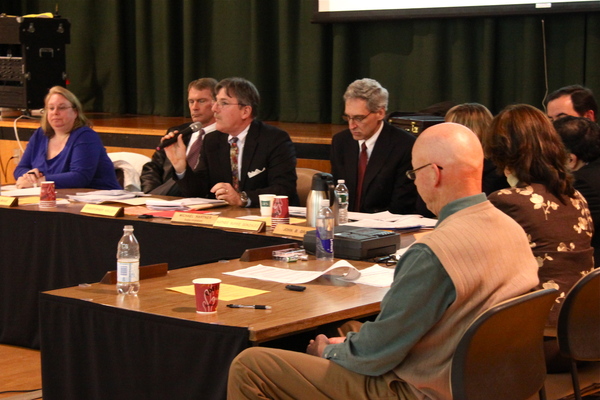
Springs School Board President Christopher Kelley at Monday's budget meeting.
East Hampton Town’s large Democratic Party constituency will be presented with a thoroughly unique set of circumstances at local polls on Thursday, September 13.
Along with the primary runoff for nomination to the November ballot, with the winner running in a rare off-year election for just one year of a seat on the Town Board, Democratic voters will be asked on Thursday to choose from among more than 60 candidates for the party’s committee, with voters choosing two candidates in each of the town’s 19 election districts.
A contested election for committee assignments is all but unheard of, and political veterans say that such a broad contest for nearly every seat on the committee has certainly never taken place in the town before.
To be clear: A voter will not be asked to pick 38 committee people—just two from his or her district. Each voter will cast three votes in the local races—there are also primary races for governor, lieutenant governor, attorney general and a surrogate court judgeship on the ballot—choosing from among the two Town Board candidates, David Lys and David Gruber, and the three or four candidates for the two committee seats, depending on the district.
Driving the bizarre electoral condition is a split within the party between two factions that have put up competing slates of candidates for the committee.
One slate is supported by the leadership of the party and the majority of the current committee. The other slate is supported by the Reform Democrats, a splinter group of committee members that organized following a disagreement about how the chairmanship of the party was being passed down last winter. It is trying to wrest control of the committee from those who have led the party for the last two decades—and overseen its rise to nearly complete political dominance in town offices.
“The committee is run by insiders and … we’re trying to break that system,” said Rona Klopman, a committee member from Amagansett who drove the wedge of the split when she challenged the process of replacing the longtime party chairwoman, Jeanne Frankl, last winter. “People are fed up with cronyism.”
Ms. Klopman filed a lawsuit, alleging collusion by committee members in presenting Cate Rogers, then the Zoning Board of Appeals vice chair, as the favored choice to take over as the head of the party. She then mounted a campaign to be the new chairwoman herself. Ultimately, she lost to Ms. Rogers in a vote of the committee.
But she rallied some committee members around her in opposition to the majority’s choice of Mr. Lys to be its Town Board candidate this year. The splinter group chose Mr. Gruber and set off what has been an increasingly nasty internecine skirmish.
“This is certainly a sign of the times and what comes down from the national dialogue,” Ms. Rogers said. “When the majority of the committee nominated David Lys, David Gruber wrote two letters to [The East Hampton Star] asking people to get rid of the people who didn’t vote for him. It’s just too much like national politics. The vitriol that’s coming from them is very damaging to the community.”
If the deluge of robocalls and mailers that the two sides have been employing in support of their candidates have not helped clarify the contest, Thursday’s ballot will not make it easy for voters to differentiate between which committee candidates are aligned with which group. The slates will be jumbled between the two lines, A and B, on the primary ballot in some districts; since they are all Democrats, there is nothing identifying which committee candidates are affiliated with which faction of the party.
Mr. Lys will be on line A and Mr. Gruber on line B. But the Reform Democratic slate of “county committee” candidates will be on line A in some districts and line B in others.
Both Ms. Rogers and Ms. Klopman called the arrangement of the ballot “very confusing.”
Only registered Democrats will be able to cast ballots tomorrow. Polls will be open from 6 a.m. to 9 p.m.


 on Sep 11, 2018