


 1 Photo
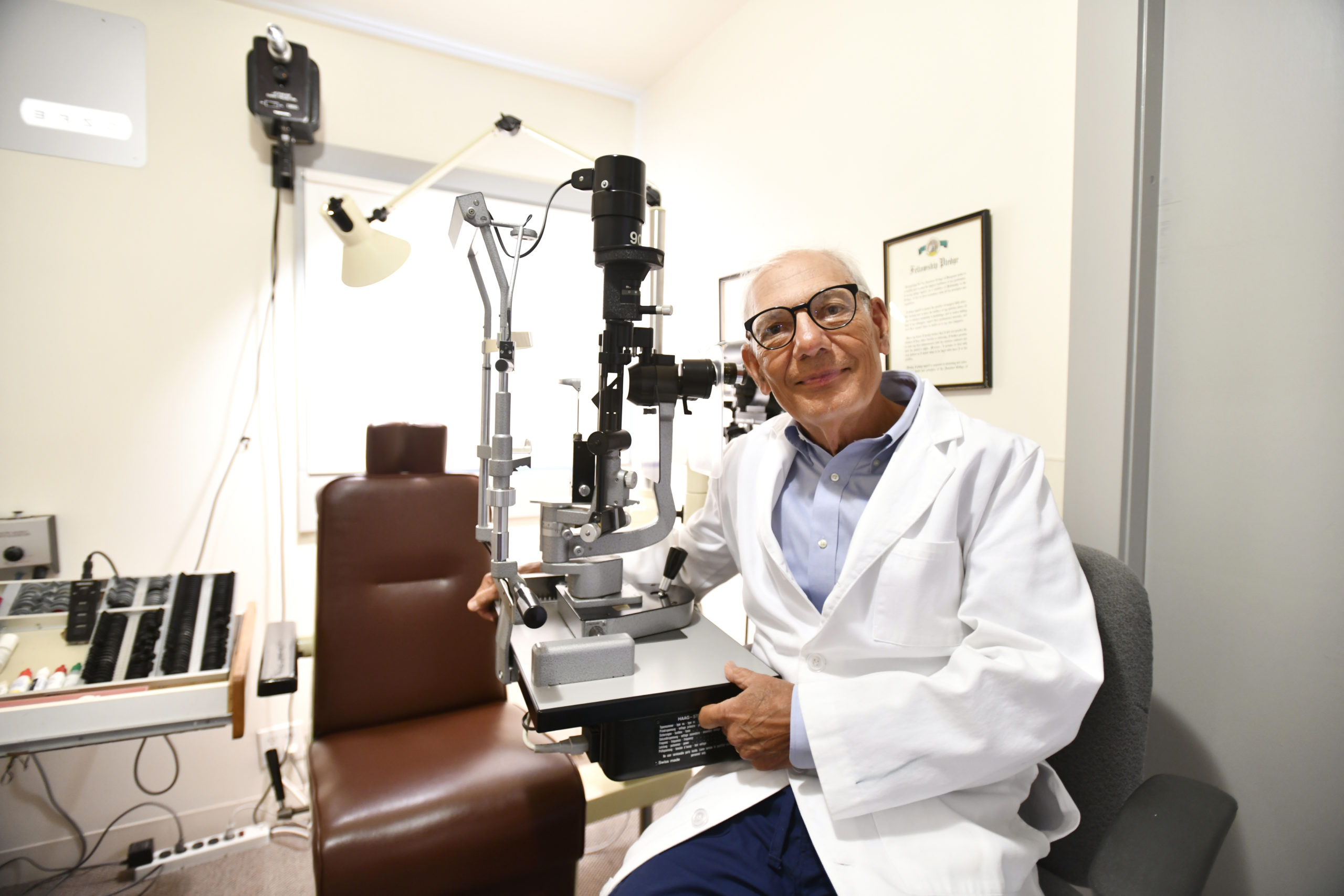
Dr. Louis Pizzarello on Tuesday, his last day in the office. DANA SHAW
When Tim Bishop first met Louis Pizzarello, he knew they would be the best of friends — and that his peer was, by far, the smartest kid in their class at Sacred Hearts School in Southampton.
They were just 6 years old.
It has come as no shock to Mr. Bishop that, in adulthood, Mr. Pizzarello took on the title of Dr. Pizzarello, devoting his life to medicine and practicing ophthalmology for the last 42 years — both domestically in Southampton and Riverhead, as well as abroad — until his retirement this past Tuesday at age 70.
“The fact that he became a doctor and then has flourished as a doctor, but has done so in a way that’s been guided by great humanity, is not at all surprising,” said Mr. Bishop, a former U.S. Representative and Southampton College provost. “It’s wonderful to see him be who he is. He hasn’t just been a guy who’s done his job. He’s been a guy who’s defined his role in the community very broadly, and it goes far beyond medicine.”
Widely regarded as caring, humble and an all-around Renaissance man, Dr. Pizzarello led his team at Peconic Ophthalmology until about two years ago, after selling his practice to a larger group called SightMD in preparation for retirement. He also stepped away from his 53-year affiliation with Stony Brook Southampton Hospital, where he got his start during the summer of 1968 as a lab technician.
Looking back at those origins, a day before his retirement, Dr. Pizzarello said he felt flooded with gratitude.
“I’m feeling very much at peace,” he said on Monday afternoon from his Riverhead office. “I’ve had a very nice 42-year run in practice and my health is good and the one thing I’ll miss are the patients — but it’s time to do the next chapter.”
For the East End native, he has no plans to leave Remsenburg, where he has called home for the past four decades — not far from where he grew up in Shinnecock Hills and his parents, Albert and Carmen, who built and ran the Ocean View Terrace Motel until 1965.
“I just went back to the old neighborhood for someone’s birthday party this past week, and it really brought back a lot of memories,” Dr. Pizzarello said. “It was a very close-knit community, and it was very nourishing. It was like I had a whole bunch of grandparents. It was just a wonderful experience.”
In part, that sense of belonging and community is what drew Dr. Pizzarello back to the East End to practice ophthalmology, after earning his bachelor’s degree at Colgate University, medical degree at the University of Virginia, and a degree in public health from Harvard University.
Continuing his medical training, he completed an internship at the Toronto General Hospital and a residency in ophthalmology at the E.S. Harkness Eye Institute at Columbia University.
But it was the East End that inspired him to pursue this path in the first place — or, rather, two ophthalmologists in particular: Dr. Townley Paton, who gave Dr. Pizzarello his first pair of glasses, and Dr. Nathaniel Bronson, whose lab at Stony Brook Southampton Hospital first employed him.
“At the time, there was an extensive lab that Dr. Bronson had at the hospital, and I used to kind of hang out with them,” Dr. Pizzarello said, “and it got me interested in ophthalmology.”
He found the specialty interesting on many levels, he explained. First was the area of blindness prevention, which his education at Harvard uniquely trained him to address. Second was that ophthalmology required an understanding of the body as a whole, not just the eyes. And third was the fine precision surgery component, which is where he excelled.
And Dr. Paton and Dr. Bronson recognized that.
“When I finished my residency, they asked me to join them in practice and I was really excited about the chance to come back,” Dr. Pizzarello said. “It was just a great experience to come back home to practice, to take care of a lot of the people that I had grown up with and known my whole life.
“And, you know, that’s a real blessing,” he continued. “Not many doctors get to practice in the same small town where they grew up. Now, I’ve taken care of five generations of some of these families. It’s just been a great experience.”
Dr. Pizzarello officially started his private practice on July 1, 1979 — almost 42 years to the day of his retirement — and has treated thousands of patients on the East End, many with complicated eye diseases.
“In his practice locally, no one ever got turned away,” Mr. Bishop said. “If they were people who had zero means at all but needed his care, he provided it, and did so for free — and he did it as a matter of routine.”
Particularly interested in cataract and corneal surgery, Dr. Pizzarello has one of the most extensive surgical experiences on Long Island, as seen by his longstanding relationship with Stony Brook Southampton Hospital, where he often operated on patients.
There, he also served as a board member and president of the medical staff — in those capacities, volunteering his time freely, according to Robert Chaloner, the hospital’s chief administrative officer.
“When you picture the classic, highly trained, old school doctor who was scholarly, gentlemanly and always wore a tie, that was Dr. Pizzarello,” he said. “I think he is a man of very, very high quality and character — very passionate about the practice of medicine. He was the consummate professional. We’re gonna miss him. He’s a real pillar of our medical community, and we’re gonna miss him.”
Recognized by the Castle-Connolly annual awards as one of the best ophthalmologists on Long Island, Dr. Pizzarello authored over 30 scientific papers and worked in nearly 50 countries, bringing eye care to underserved populations.
“I felt a great deal of gratitude that my life had been such a positive one,” Dr. Pizzarello said, “and I decided that I would like to not wait to give back when I was done, but to do it continuously.”
In 1979, Dr. Pizzarello promised himself that he would dedicate 20 percent of his time to charitable causes, and he has kept that promise ever since, from serving as secretary general of the International Agency for the Prevention of Blindness to, in partnership with WHO, implementing a program to eradicate avoidable blindness called “VISION 2020/USA,” which is still ongoing.
Prior to that, he worked as the medical director of Helen Keller International, an agency that provides training and technical assistance to establish nutrition and eye-health programs in needy countries, for 25 years.
“He truly is a missionary,” Mr. Bishop said. “He truly went all over the world multiple times to provide optical care to populations that otherwise would not have received any care.”
In the Philippines, Dr. Pizzarello helped developed a residency program in one of the outlying areas of the country that would provide local specialist care. In coordination with the Vietnam National Institute of Ophthalmology, he kickstarted a program to train and improve the level of cataract surgery throughout the country. Across other regions of Southeast Asia, he provided vitamin A supplements to children as preventative blindness treatment — a deficiency that is often the result of a diet low in protein and green leafy vegetables, which can cause blindness by drying out the cornea.
“I was far more interested in systems development in these countries, so I almost never went and did surgery,” Dr. Pizzarello explained. “I was going to work in an ongoing capacity with the governments to establish ongoing blindness prevention activities, and many of those programs are still going on now.”
Domestically, Dr. Pizzarello helped initiate ChildSight, a project that has provided hundreds of thousands of inner-city children with glasses, and he currently serves as the board vice president of the Lavelle Fund for the Blind.
“Everything I was really interested in was setting up a system that would go on after I was long gone,” he said, “and that’s what I’m the happiest with.”
Outside of his practice, the ophthalmologist sat on the board of East End Hospice for many years and was the first president of the Speonk-Remsenburg Civic Association. He is also involved with his church and rarely says no to a round of golf, a day spent sailing, or an afternoon gardening in his yard.
“He is unbelievably caring, humble, interesting beyond words. He knows everything and he seems to know everyone,” Mr. Bishop said. “He thinks deeply about things, he has informed opinions on an incredible array of issues and subjects. He’s the complete package. He’s smart as hell, but he’s also nice as hell. He’s just a phenomenal human being. I think I’m pretty damn lucky to have him as a lifelong friend.”
Post retirement, Dr. Pizzarello will keep his faculty appointment as a professor of ophthalmology and health management at Columbia University, where he teaches and assists in clinical research — allowing him to be continually involved in the latest developments in his field.
“And then, I don’t know, we’ll see what happens,” he said. “I look back and say, ‘Wow, it’s a great life.’ I’m really happy, I got to live on the East End of Long Island, I got to see my friends and be part of a loving and wonderful community.”


 Michelle Trauring on Jun 29, 2021