


 1 Photo
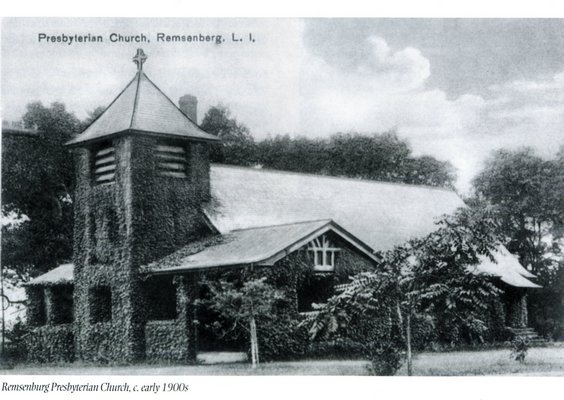
The Remsenburg Presbyterian Church in the early 1900s. COURTESY REMSENBURG ASSOCIATION
The Remsenburg Association is renewing efforts to sell copies of “A History of Remsenburg,” a book that offers an interesting peek into the hamlet’s past, including the “minor civil war” set off when locals adopted the Remsenburg name to separate themselves from those living in Speonk.
In the 1880s, Dr. Charles Remsen, whose family lived in the hamlet for more than 100 years, built and donated a new Presbyterian church that replaced a wooden chapel, according to the book. Grateful community members decided in 1895 to use the name “Remsenburg” to describe the southern area of Speonk, prompting short-lived protests from Speonk residents—and philologist William Wallace Tooker, who feared the loss of Native American nomenclature. As part of his argument, Mr. Tooker explained that the word “Speonk” translates to “a high place,” with the first two letters meaning “to raise high” and the last four letters being a generic term noting location.
“Now, most people hereabout agree that the hatchet has been buried and forgotten,” the book states when describing that battle.
Marsha Kenny, a member of the association and a spokeswoman for Southampton Hospital, explained that proceeds from the sale of the books, which cost $25 each, will benefit The Remsenburg Academy, a historic building off South Country Road that serves as a community center. She led efforts in 2003 to update the book, which was originally published in 1976 by Charles McDermott, who served as the hamlet’s historian.
A self-proclaimed history lover, Ms. Kenny explained that she spent years sorting through scores of photographs sprawled across her living room, as well as anecdotes and historical information all provided to her by past and present Remsenburg residents. The original book, she said, was a tiny yellow hardcover with photographs that were difficult to see. All of the text from that version served as the foundation for the updated book, supplemented with plenty of more recent history, written by Ms. Kenny, and lots of photographs, both old and more recent.
“It was just a labor of love, but it was a lot of fun,” she said, explaining that she felt an urgency to complete the project while the older residents in the area were still around to share their memories. “Everyone was so generous with their stories, and I think that added a lot to the book.”
The book’s roughly 140 pages share information about everything from the hamlet’s earliest settlers and homes to its most notable residents. It also includes a first-hand account from the journal of Doris Royce of the 1938 hurricane that tore across Long Island, killing dozens on the East End and flattening the homes on Dune Road.
“In spite of all I’d heard and all I knew, seeing the place was a great shock,” Ms. Royce wrote. “There was utter wreckage strewn all about. The bay was beautifully calm and blue.”
Ms. Kenny said she hopes the next generation of Remsenburg residents will eventually pick up where she left off and continue to chronicle the hamlet’s history in the book’s pages.
“It was so exciting,” she said. “I loved doing the project.”
Those interested in purchasing a copy of “A History of Remsenburg” can do so by emailing Ms. Kenny at MKenny325@gmail.com.


 Carol Moran on Oct 8, 2013