


 2 Photos
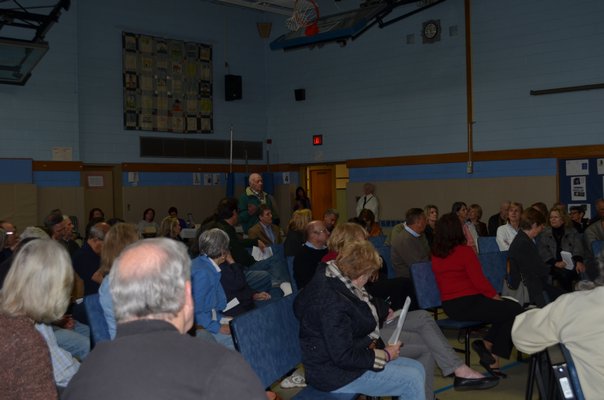
Remsenburg resident Morgan Richardson stood to ask a question at the Remsenburg Association's Deer Management Informational meeting on Sunday. Alexa Gorman
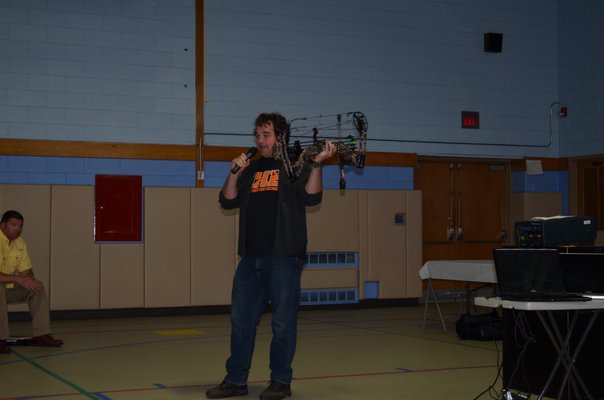
Christian Killoran
By a show of hands, most of the estimated 75 Remsenburg residents attending Sunday’s informational meeting regarding ways to control the deer population are willing to bring in bow hunters to do so.
At one point during the meeting, hosted by the Remsenburg Association and held at the Remsenburg-Speonk Elementary School, the organization’s president, Jim Mendelson, asked attendees to raise their hands if they would be open to permitting licensed bow hunters to help cull the hamlet’s deer.
Though no concrete figures were shared Sunday regarding the hamlet’s deer population—the State Department of Environmental Conservation does not keep such specific records, according to guest speaker and DEC deer biologist Josh Stiller—he explained that the proof of their overpopulation is in the jump in growth rates across Suffolk County.
Mr. Stiller said about 20 percent of the fawns tagged by his agency last year reproduced this year. He added that the jump in population has had detrimental effects on the environment and other animals, not to mention the increasing number of vehicle accidents caused by or involving deer.
The biologist also noted that while the number of deer is increasing exponentially each year, “there is no magic number” when it comes to reducing their figures to achieve a better balance. He said it is up to individual communities, and municipalities, to decide which course to take and if culling is the option they want to pursue.
There are non-lethal options also on the table and they include the fencing in of sensitive areas, using chemicals that deter deer from eating native plants, capturing and relocating deer, and even sterilization. He noted during his presentation that some of the options, namely sterilization, could be very costly; one chemical contraception, for example, could cost up to $3,000 per deer.
He added that the most cost-effective programs typically involve bow hunters, as they are often willing to thin the herds for free, usually taking the venison as payment.
Earlier this spring, sharpshooters hired by the Long Island Farm Bureau began thinning the herd of whitetail deer in Southampton Town, focusing their efforts on 20 undisclosed properties, according to a spokesperson for the U.S. Department of Agriculture. Those killings, however, are being done at night by teams of hunters using bait, night-vision equipment and high-powered rifles with silencers, according to authorities. Opposition to the Long Island Farm Bureau’s proposal halted consideration for a similar program in neighboring East Hampton Town and East Hampton Village. Private property owners, however, can still legally hunt the deer as long as they secure nuisance permits from the DEC first.
Mr. Mendelson, who describes himself as “fortunate” for not having a big deer problem on his land, said the Remsenburg Association has no official stance on deer culling. He said the group called for Sunday’s meeting after some members expressed concerns, stating that the overpopulation of deer is the “number-one” problem in the hamlet.
If homeowners decide to go down that path, bow hunters would be willing to thin the herd for free, according to Christian Killoran, president of the Island Hunting Exchange, who also attended Sunday’s meeting. He added that Quogue Village has had such a program in place for the better part of a decade, and that the deer are culled at no cost to homeowners.
“I would definitely support it,” said Michael O’Hare, whose property on Halsey Road has been damaged this year by deer, about a proposed cull. He added that this year alone, two deer have jumped over his fence and died on his property. “I’ve had problems with the landscaping, shrubs, trees, all of it.”
According to Mr. Killoran, once hamlet residents secure the necessary permits, he would assist them in contacting teams of bow hunters and coordinating logistics. “I know just by the amount of people here the amount of people who want something done,” he said.
This spring marks the eighth year in which Quogue Village has permitted a similar bow hunting program, according to Chris Osborne, the village’s code enforcement officer who also attended the meeting. He added that, in his opinion, the thinning effort in Quogue has been an “incredibly successful” program, noting that the venison is either taken by the hunter, given to the homeowner or donated to a food pantry. “Nothing is wasted,” Mr. Osborne said.
Mr. Osborne said that in their first year, there were about 100 “takes” by the deer hunters. The second year, between 100 and 125 deer were killed, and that number jumped to between 175 and 200 in the program’s third and fourth years. Fewer than 100 deer have been taken annually in the more recent hunts, he added. “That is a success,” he said, “not because of the lack of hunting, but because hunters are doing their jobs.”
He explained that individual landowners must fill out a permission form and turn it in to the village. They must also secure the permission of their neighbors before hunters are permitted on their private property. Looser restrictions this year, namely a reduction in how close a hunter is allowed to stand next to a neighboring property, is expected to make their jobs easier. Up until this year, bow hunters needed to keep at least a 500-foot buffer with a neighboring property; this year, they only have to keep a 150-foot buffer.
Mr. Osborne said the remaining deer population in Quogue Village seems healthier now that there are fewer deer competing for a limited amount of food.
Mr. Mendelson noted that the Remsenburg Association is serving as a point of contact for the bow hunters and individual homeowners in the hamlet.
“We don’t have the infrastructure as a hamlet to address this like the Village of Quogue,” he said. “We’re trying to act as the go-between and facilitate for people who want to do something.”
Mr. O’Hare said after the meeting that he would support such a program in his community.
“I’d like to see them come in and actually do something,” he said of the bow hunters.
Mr. Killoran noted that such a program could not begin until the fall, explaining that bow hunting season runs from October 1 until December 31. He said that will give interested homeowners plenty of time to file the necessary paperwork and hire hunters.


 Alexa Gorman on May 6, 2014