


 1 Photo
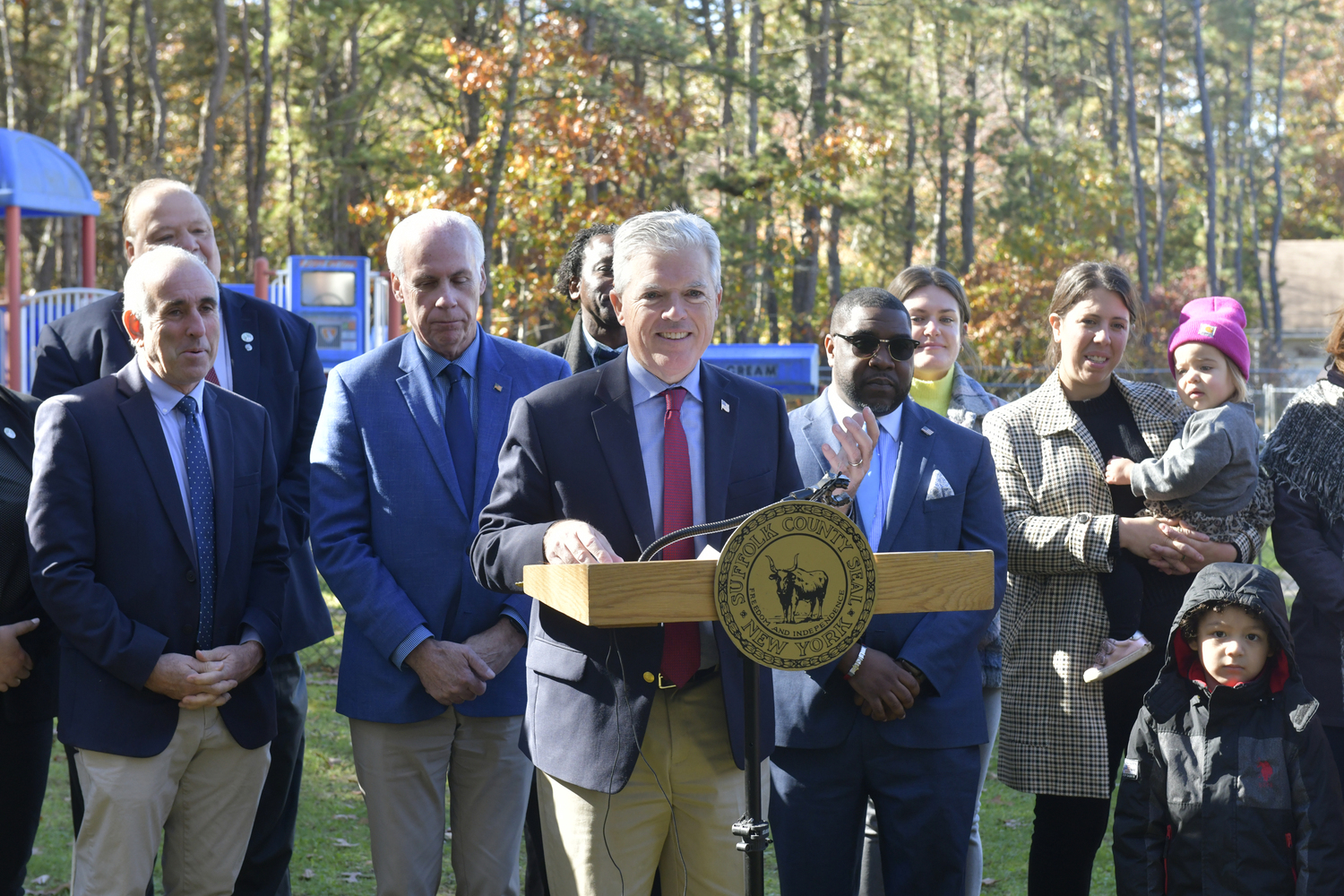
On November 3, Suffolk County Executive Steve Bellone announced a $5 million grant from the county’s Water Infrastructure Fund that will advance an estimated $35 million Riverside sewer system project long considered to be the key to a revitalized Riverside. DANA SHAW
A trifecta of sewer district resolutions pegged to the Town of Southampton’s Riverside Revitalization plans were approved unanimously at the last Southampton Town Board regular meeting and signaled, said Janice Scherer, that the town was more than a third of the way toward completing the multi-layered project and closing in fast on the halfway point.
“This is a moment,” said Scherer, the town’s planning and development administrator, in an interview this week about the proposed $36 million sewer treatment plant that’s a key to residential and commercial development in the hamlet.
The resolutions passed on November 14, she said, open a new chapter in the town’s ambitious plans for Riverside. “Now we’re into the real stuff,” she said, and moving beyond the conceptual plans that have dominated the discourse since a revitalized Riverside became a town priority in 2015.
The revitalization plans were given another boost recently when Suffolk County Executive Steve Bellone announced a $5 million grant from the county’s Water Infrastructure Fund for the sewer district.
One resolution clears the way for a public hearing on a supplemental draft generic environmental statement for the siting and the construction of a community sewage treatment plant and collection and conveyance system in the hamlet, under the State Environmental Quality Review Act, known as SEQRA.
Another authorizes the preparation of a map, a plan and a report “attendant to the establishment of a sewer district” in Riverside in compliance with a Riverside Overlay District created in 2015 that aimed to revitalize Riverside “through a comprehensive economic development strategy.”
The town is required, under state law, to prepare all the financial considerations for the sewer district, a special taxing district, and “articulate under state guidelines what it will cost consumers,” said Scherer, who noted that with anticipated state assistance to build the sewage treatment plant, either through a zero interest, 30-year loan or more state grants, “that the cost for people in the district will be very, very low.”
As such, the town will be subjected to a “quality value review” by the state’s Environmental Facilities Corporation, which both provides a lending arm for projects such as this and a measure of oversight once they’ve committed to a project.
The third resolution is a request for proposals seeking engineering firms to come forward to bid on the project itself. Those RFP packages were available as of this week, and, said Scherer, “will get us to a 100 percent shovel-ready design.”
The SEQRA-related resolution, she said, is reflective of the fact that the town had undertaken the generic environmental study but “didn’t do the full SEQRA, since we didn’t know where the sewage treatment plant was going to go.”
For the past few years, the town has been buying and aggregating land in Riverside for the sewage treatment plant and open space opportunities and will now analyze potential environmental impacts to ensure that the town will be getting the best sewage treatment plant to fit the needs of the environment, the community as it exists, and the eventuality of a robust development era unfolding in the hamlet once there’s an adequate sewage system to accommodate the growth.
“We need a state-of-the-art sewage treatment plant,” she said, “and that will be in the next round of engineering.” That system, she said, would have to be able to treat wastewater and also water contaminated with PFOS and pharmaceuticals, the former of which is known as a “forever chemical” that has a history of contaminating Long Island groundwater.
The plant, when constructed in the hamlet’s Enterprise District located off Flanders Road, will be buffered from public view and would at first tie in existing residents — including those in a nearby mobile home neighborhood — in the first phase. Once it is built, the expectation is that the developers will come — and the hamlet would be shielded by any shift toward gentrification through development mandates enshrined in the revitalization legislation that requires half of any residential development in the designated revitalization area to meet affordable housing criteria.
The increased density, Scherer said, will bring a “different feeling” to the area, a greater sense of safety and commercial vitality while not “totally throwing out all the good things,” including and especially the numerous multigenerational families in the area who want to “reclaim their neighborhood and don’t want the crime and the other nefarious activities” that often characterize the public-facing posture of Riverside. “We want to keep them but encourage development in a precarious spot,” she said, where the Peconic Estuary and the Central Pine Barrens both hold sway as critical components to the natural environment here.
Along the way to the almost-halfway-point, said Scherer, the town used Community Preservation Fund revenues available for water-quality projects to buy up property along the Peconic River that it had initially viewed as a good location for the sewage treatment plant’s outflow, until the New York State Department of Conservation stepped in and said no to that plan.
Those CPF funds were used to leverage matching grants from the state and would become a critical piece, if not the critical piece, in kickstarting the town’s ambitious vision for a future Riverside.
The town’s view of that land purchase, she said, was to “buy it with water quality money and if it didn’t work — we’ll just make it open space. We didn’t want it to be developed.” That piece of the revitalization plan, she said, will “offset some of the increased density now that it will be preserved.”
Ditto the nearby Maritime Trail Park now under construction that will connect Riverside to the Peconic River, “but not in the way of urbanized Riverhead,” Scherer said. “This is so natural and beautiful — it’s more about connecting and sharing resources” between the respective municipalities.
“There are real people, real issues and a real need for revitalization here,” she added. And the “real stuff” is now at hand, she said — decisions over leaching pools, the completion of survey maps, identifying where sewage pipes will actually go. “The resolutions are pointing to that.”


