


 1 Photo
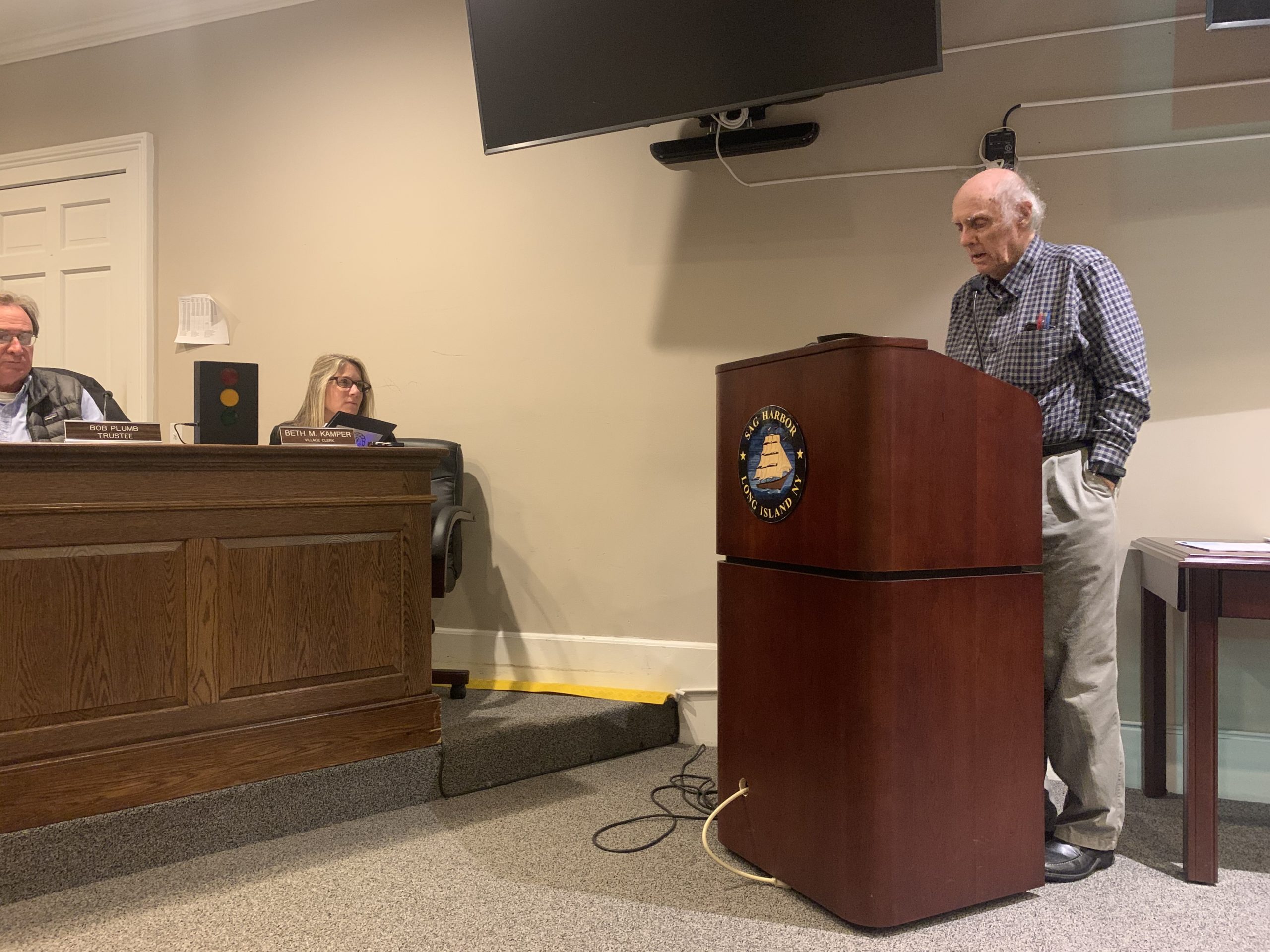
Larry Penny supporting an addition to the Sag Harbor Village zoning code that would limit clearing on vacant lots.
The Sag Harbor Village Board held off on two proposed changes to the village code — one that would limit the amount of clearing of native and natural vegetation permitted on vacant lots, and another that modifies the definition of “height” — after opposition emerged at public hearings on Tuesday night, largely by property owners who said they would be unfairly impacted by the changes.
The first law would limit clearing of native and natural vegetation on vacant lots to 50 percent. According to members of the Village Board and its Tree Preservation Committee, the goal is preventing the clear-cutting of the remaining vacant lots in the village.
“Sag Harbor’s natural setting, a one-of-a-kind combination of marine viewsheds, tree-filled properties and tree-lined historic streets, makes our village beautiful and unique amongst all others on the East End,” said Kate Plumb, reading a letter on behalf of the Tree Preservation Committee and giving the board a petition signed by “hundreds,” she said, supporting the code change.
“We are at a time in Sag Harbor’s history when we can still do something to save the remaining natural environment and mitigate overdevelopment and climate change,” she said. “The proposed legislation helps achieve these goals.”
Local attorney Dennis Downes, representing “a couple of clients who have vacant lots,” said he was not opposed to a limit on clearing but said the board should do it on a “case-by-case” basis. He also questioned how the board could adopt a law that applies only to what he said would be 3 percent of property owners in the village. “You are probably violating the 14th Amendment of the Constitution — but I will let your counsel advise you on that,” said Mr. Downes, referring to the amendment’s ban on depriving “any person of life, liberty, or property, without due process of law.”
He also suggested that flag lots would be jeopardized, since the clearing restriction does not include an allowance for clearing for the long driveway required in that kind of development, and said modular house construction could also be at risk, since clearing and revegetation is often necessary to build those kinds of homes.
Mr. Downes called on the village to ask Village Attorney Denise Schoen to revisit the law and add provisions that allow revegetation when clearing is necessary, and for flag lot development.
Pat Trunzo, a builder who grew up in Sag Harbor and has recently begun discussing a subdivision on Marsden Street that would result in the development of five homes, also opposed the legislation.
He questioned whether the board could legally adopt a new law for its zoning code that he said did not comply with a comprehensive plan or planning study. “There is nothing in any previous planning studies undertaken by the village that addresses the topic of native natural vegetation within village boundaries, or the question of the need for or the desirability of limiting of clearing on residential lots,” Mr. Trunzo said in a statement he read and submitted to the board Tuesday night.
Like Mr. Downes, Mr. Trunzo also questioned whether the village could impose a restriction that applies only to a fraction of the 1,653 residentially zoned properties in the village, calling it “illegal spot zoning.”
“Such selective micro-targeting of a minority of owners has been struck down by the courts, because it is fundamentally unfair, or, to use a legal term, inequitable,” he said.
Mr. Trunzo suggested that, instead of a clearing restriction, the village could consider expanding the jurisdiction of the Board of Historic Preservation and Architectural Review beyond historic trees and plantings or landmark properties or properties in the historic district to the whole of the village, giving that board the ability to weigh in on clearing and revegetation on a case-by-case basis.
Architect Anthony Vermandois said he supported clearing restrictions but not how the current law is drafted. “I feel this 50 percent number is not feasible for some of these smaller lots,” he said, suggesting the village consider a clearing restriction based on the size of a parcel, similar to the gross floor area restrictions in place to limit the size of buildings relative to lot size. “That will make sure smaller properties will not be unfairly punished and bigger properties will not be able to do something that is egregious,” he said.
Laurie Wiltshire, with Land Planning Services, representing Walter Oden, who owns 54 Walker Avenue, called on the board to exempt her client, who just earned variances from the village’s Zoning Board of Appeals for his project but still has to go before the HPARB. “Anyone who has gotten relief should not have to go back to the ZBA if this is adopted,” she said.
Naturalist and former East Hampton Town Natural Resources Director Larry Penny, a Noyac resident, supported the new code. “I would say you are on the right track trying to preserve the old Sag Harbor while the new Sag Harbor tries to assert itself,” he said.
“I do believe in this law, but I also do believe we have to take this on a case-by-case basis,” said Mayor Kathleen Mulcahy, who said she trusted the HPARB and the ZBA to use the law with common sense.
“I would still like to take this to a vote,” she added.
The remainder of the board was not quite ready.
“We heard a lot here tonight, and I heard a lot I need to digest,” said Trustee Aidan Corish.
“I agree,” said Trustee Thomas Gardella, who called on people like Ms. Plumb and Mr. Trunzo to meet and discuss what could be done that is reasonable to everyone. “I think we have enough people here with a vested interest in this community where we can come together and come up with a solution.”
“If we can get together with a couple of people to see where we can find the right balance, we will do that and be back next month,” agreed Mayor Mulcahy.
The second code change-up for hearing was an amendment that would change the definition of “height” for buildings and other structures to “any point of the building to existing grade that may exist around the structure.” Currently, height is determined from only one side of a structure.
The proposed change brought little debate, except from Ms. Wiltshire and her client, who, once again, feared if the code change occurred they would lose the right to move forward with their project as planned, despite already earning approval from the ZBA.
The board agreed to table the hearing while Ms. Schoen looks at what exemptions the board could consider.
The board will take up both hearings again at its January 14, 2020, meeting.


