


 6 Photos
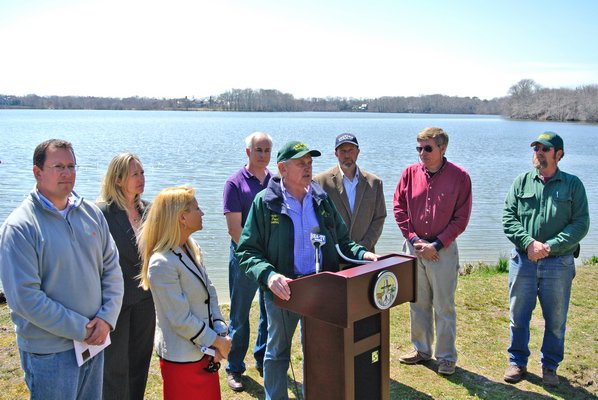
Southampton Town Baord members and trustees at Mill Pond in April 2013. DANA SHAW

Phoslock being spread on Mill Pond last year. DANA SHAW

Phoslock being spread on Mill Pond last year. DANA SHAW
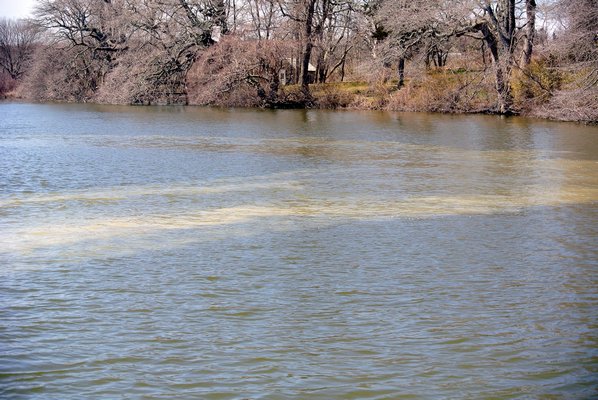
Phoslock being spread on Mill Pond last year. DANA SHAW

Phoslock being spread on Mill Pond last year. DANA SHAW
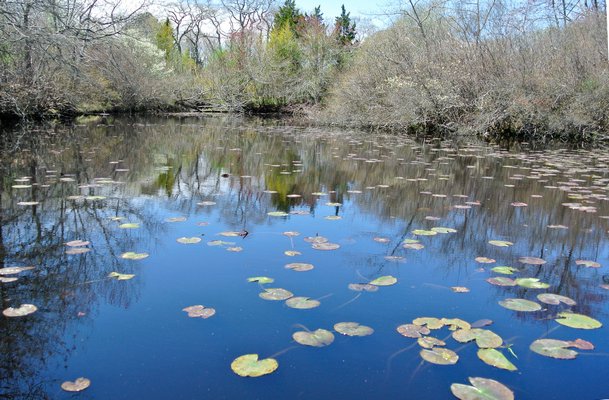
The Phoslock treatment for Mill Pond will not continue. DANA SHAW
Southampton Town officials have shelved efforts to reduce phosphorous in Mill Pond by adding a bonding compound to the Water Mill pond’s waters, for at least a year.
Long delays in a State Department of Environmental Conservation report and concerns about underestimated inputs of new phosphorous from stormwater runoff canceled the planned second application of the compound, known by the brand name Phoslock, initially scheduled for this spring. Members of the Southampton Town Trustees and Town Board, who had co-funded the project, said that some disagreement about the success of the initial application was not to blame for the second phase of the project being put on hold, since without the DEC’s approval it could not have gone forward.
“The DEC told us the report would be ready any day—that was two months ago,” Trustee Eric Shultz said. “We couldn’t put anything in the lake until we get that report, and now it’s past the time you would want to do it, in terms of the time of year it would be most effective.”
The state has also recently asked for additional testing of organisms from the lake bottom to see if there have been any impacts on them from the compound, which bonds with molecules of phosphorous and sinks it to the bottom of the lake.
As they stood by the shore of Mill Pond last spring, officials and hopeful pondfront residents trumpeted the Phoslock application as a quick elixir for the thick, soupy blooms of algae that have choked the pond’s waters for more than a decade and are blamed for a massive die-off of fish in 2008. Officials and experts from the company pitching the use of Phoslock had said that within days of the application the water could be expected to clear of algae, and that the dense blooms of blue-green algae would be all but eliminated as the year progressed.
Neither of those expected effects was readily apparent in the months that followed, which included at least three periods of intense rainfall, and those tracking conditions in the pond have offered somewhat different views of whether there is evidence of the compound having made a significant impact.
Phoslock, a compound engineered by Australian scientists from naturally occurring clay, is intended to remove the phosphorous that algae feed on from ponds and lakes. Applied in small granules sprayed from boats, Phoslock bonds with phosphorous as it sinks to the bottom, trapping the nutrient there and starving algae.
The compound has been used extensively in Australia, Canada and Europe to treat chronic algae blooms, but the Mill Pond application was the first time it had been tried in the United States. Heavy rainfalls just weeks after the first application were blamed for steep spikes in phosphorous levels in the pond that fed some algae blooms.
The town was to pay the company that conducted the application, SePro, a total of about $450,000 over two years for two large applications of Phoslock. The third phase would entail smaller additional treatments on an annual basis as needed, dictated by sampling for additional accumulations of phosphorous from runoff and groundwater carrying fertilizers.
The first phase cost $283,000. The Town Board dedicated $233,000 to the project and the Town Trustees contributed the other $50,000. The Town Board insisted before signing the contract for the work that full payment be contingent on certain performance expectations, and has held back $72,000 while it waits to see the DEC’s assessment of the work. The Town Board has included $101,000 for the second year of Phoslock in its adopted budget for 2014.
Lake specialists who have conducted water sampling for the Trustees say that, overall, the application appears to have done what it was intended to do, remove phosphorous, even if the ultimate effect was not as expected. Water sampling by local biologists appears to show that phosphorous levels in the pond in January of this year were about half what they were prior to the Phoslock treatment.
“The fact that the trend in phosphorous has continued to be at low levels is a clear indication that the treatment to the pond with Phoslock is aiding greatly in reducing the reintroduction of phosphorous from the bottom of the pond,” limnologist Lee Lyman, who was hired by the Town Trustees to track the pond’s conditions leading up to and following the Phoslock treatment, wrote to town officials in December 2013.
But Stony Brook University scientists said that their own tracking of algae levels in the pond do not point to a substantial impact from the Phoslock, as blooms spiked both in the early summer, following the heavy rainfall, and again in October, after several weeks of relative drought.
“Throughout the year we had some very high cynobacterial blooms in there,” said Christopher Gobler, Ph.D, a professor at Stony Brook and the head of a team of graduate and undergraduate students who have been conducting water testing in the pond throughout the year for more than a decade to track algae blooms. “Just looking at the date, it’s not that much different from past years.”
Consultants for the Trustees said that despite the blooms of algae that popped up, there is evidence the Phoslock worked as intended, although hopes for a dramatic drop in algae blooms were dampened by unforeseen hiccups in normal conditions affecting the lake.
“Phoslock was designed to treat the sediments, and the end of the year data shows it did that, just as it was supposed to,” biologist James Walker of Inter-Science Research Associates said. “The only complications were the two heavy rainfalls and that the [estimate] the town used was inadequate with regard to nutrient loading from stormwater runoff.”
The effects on algae blooms were stymied, Mr. Walker surmised, by spikes in phosphorous levels following heavy rainstorms in June and early September, both of which are seen in water sample data taken in those months. He said that estimates used by the town to forecast how much phosphorous would be flushed into the pond by rainfall were grossly inadequate.
Town Councilwoman Christine Scalera said that foremost among the town’s needs moving forward with the effort to fix the pond is a better understanding of how much phosphorous is being carried into the pond. Waiting another year to do a second application of Phoslock will wind up being a more effective way to proceed, she said.
“The feeling was, let’s do some testing over the next year to figure out where we’re really at and make adjustments as needed,” she said. “In the interim, we can go forward with our Deerfield stormwater abatement work, which we think will also have a beneficial impact on the effectiveness of this on the pond.”
Town contractors are expected to begin work on a new stormwater pipe that leads to Mill Pond, reducing the amount of erosion and sediment carried to the pond by runoff. A larger-scale project intended to actually capture or reroute runoff contaminated with chemicals from nearby farm fields, lawns and roadways is still being planned.


 Michael Wright on May 7, 2014