


 4 Photos

Stephanie Bitis shortly after she learned that she was elected to the Sag Harbor School Board Tuesday night with 677 votes, the second-highest in the five-person race. ALYSSA MELILLO
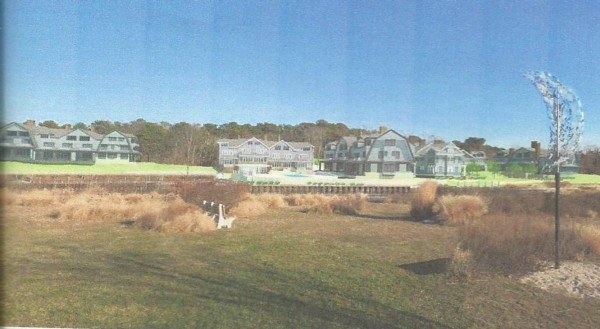

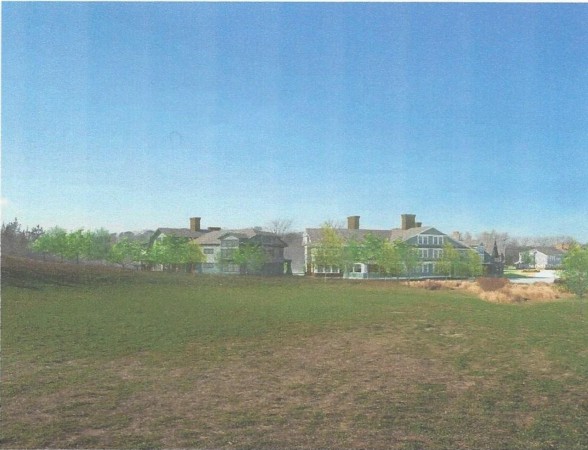
Plans to redevelop the crumbling Canoe Place Inn in Hampton Bays into a conference and catering hall, as well as a commitment from developers to employ cutting-edge septic treatment systems, appears to have trumped the concerns of Southampton Town Board members regarding the related construction of 37 townhouses on the eastern side of the Shinnecock Canal.
A week after the final public hearing on the maritime planned development district was closed, most Town Board members appear positioned to approve the rezoning of the canal’s eastern shoreline to make way for the sprawling residential development. The board is scheduled to vote on the plan, pitched by developers Gregg and Mitchell Rechler, on Tuesday, January 13.
Under the rules of the town’s planned development district legislation, which the Rechlers’ proposal must follow, four of the five board members must sign off on the change of zone. While three of the five said this week that they have not yet made up their minds, all spoke almost exclusively of the perceived positive aspects of the massive undertaking.
Board members said this week that hopes for economic stimulation from the re-purposed CPI, combined with the anticipated diminution of negative impacts on water quality from the targeted properties, outweigh the objections of some residents to the idea of the canal’s eastern shore being converted to private residences.
“Am I jumping up and down about the townhouses? Not particularly,” Town Councilman Brad Bender said. “But if we can get controls that protect the environment … it’s an improvement. If we vote no and go back to the grandfathered septic flow … it does nothing to remove nitrogen from what we put down the pipe.”
The developers, Gregg and Mitchell Rechler of Rechler Equity, have pledged to utilize a Nitrex septic treatment system, which will capture solid waste for removal and filter wastewater, for the townhouse development, and a “permeable reactive barrier” to remove nitrogen from groundwater flowing beneath the CPI building. Water quality advocates have said that the proposed treatment systems appear to be a substantial improvement over current systems that do little to reduce nitrogen loads in wastewater streams, and have been blamed for the explosion of harmful algae blooms in tidal waters in recent decades.
Board members discounted cries at the three public hearings from residents that the townhouse development would end the public’s use of the canal’s eastern shoreline, with the assertion that because the bulk of the access previously was available only by patronizing a restaurant, most recently known as Tide Runners.
“Most of the opposition in the end came from the idea that there is this public access issue,” said Town Councilwoman Christine Scalera, who added that she had yet to make up her mind about the project. “But you have to keep that in the context of the access they had previously, which was through the restaurant.”
Ms. Scalera said she would like to see the loss of the popular restaurant space on the east side of the canal made up for with improvements to the town-owned land on the canal’s western bank. Making that property more inviting for people to “come and sit peacefully,” and the possibility of developing a maritime museum with a concession stand on the property, would fill the gaps in public use of the canal by those other than the fishermen who line Canal Road West.
Town Supervisor Anna Throne-Holst has been open about her support for the project, which she helped spur in seeking to head off previous plans to demolish the CPI building to make way for condominiums on that property. Town Councilwoman Bridget Fleming also said that with concerns about the environmental impacts of the project reconciled, saving the CPI became the overarching component of the project.
“The community came to us when the original proposal was put forward to demolish the CPI and begged us to save it, and I support the rehabilitation of the inn,” Ms. Fleming said on Tuesday. “I think community pressure has had an enormous impact on the proposal and the applicant has adjusted their plans in response to community concerns.
“That, coupled with the economic boon and the rescue of that historic structure, I’m looking at it in a very positive way at this point,” she continued.
Ms. Throne-Holst also pointed to the rehabilitation of the CPI as the linchpin of the project. Though only fragments of the century-old structure remain, the property’s history as an inn and public gathering place is still an important component of the region’s culture, she said.
“You can quibble about how much of the structure retains its historic integrity or not, but even if you take that out of the equation, look at the place in history of that inn, where basically everyone short of George Washington slept,” the supervisor said. “We talk about preserving the character of this community—just discarding that history isn’t acceptable, really.”
Town Councilman Stan Glinka, a former president of the Hampton Bays Chamber of Commerce, said that business owners in Hampton Bays have told him that they think the two-part project will, as a whole, be good for the hamlet in the long run.
“Many of them think this is an opportunity for Hampton Bays to take off,” Mr. Glinka said, though he added that he has not made up his mind on next month’s vote. “They feel that there is no identity to Hampton Bays anymore and that [the CPI redevelopment] could provide the basis for that.”
After public objections and input from town planning staff criticized the initial plans for the townhouse development as too large and not providing enough public access to the canal shoreline, the Rechlers retooled their proposal. They trimmed three townhouses from their original plans, cutting about 20,000 square feet, and lowered the rooftops of the units by 18 inches, though they still exceed the recommendations of town planners. The developers also pledged to create an access driveway and parking area at the southern edge of the property, south of Montauk Highway, connected to a 220-foot-long floating dock in the canal itself.
If the MPDD is rejected, the Rechlers can demolish the Canoe Place Inn and pitch another plan that focuses on residential redevelopment. Current zoning also permits the construction of a motel and restaurant on the property that sits on the eastern bank of the canal. Both properties are owned by the Rechlers.
Nonetheless, opponents pointed to numerous planning studies over the last three decades that called for redevelopment of the canal’s eastern shoreline to be focused on commercial uses that would draw the public to the canal area and Hampton Bays in general. References to Montauk’s bustling Gosman’s Dock were pointed to by residents as the vision of what the canal could become.
But, Ms. Throne-Holst said, that a vision might well as be a chimera. “The notion that someone builds a Gosman’s-type thing, you have to look at the reality of that,” the supervisor said. “Gosman’s is open for five months of the year—that isn’t a viable business model.
“The CPI will be open and vibrant year-round, and will bring business to the downtown area,” she continued. “It will provide a service we don’t have in Southampton Town currently, a destination wedding and conference facility. Being able to attract that kind of business to Hampton Bays will be a very important impact.”


 on Dec 17, 2014