


 1 Photo
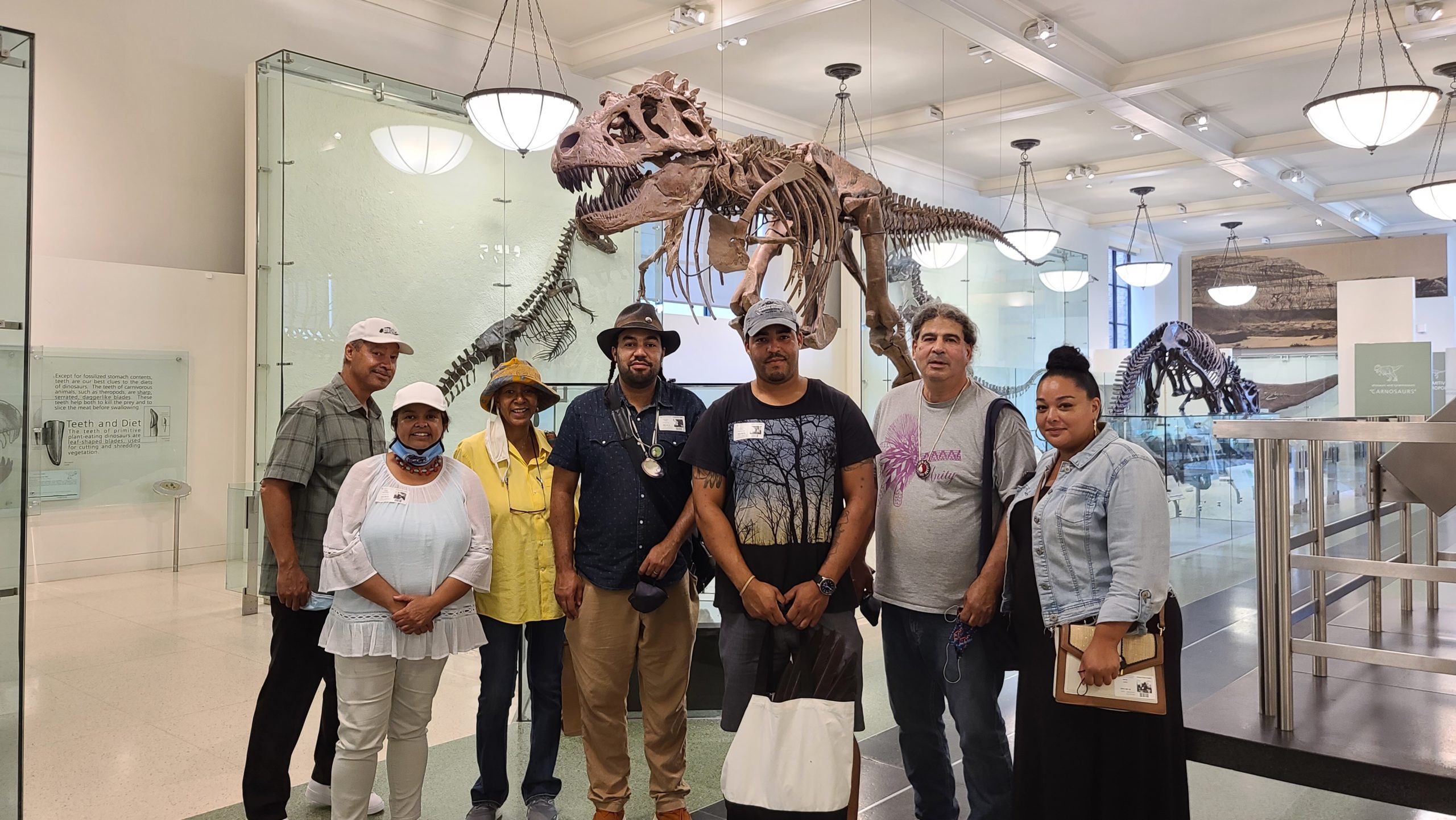
Avery Dennis, Denise Silva-Dennis, Candece Tarpley, Tecumseh Ceasar, Shane Weeks, Harry Wallace, and Bianca Collins of the Shinnecock Nation Graves Protection Warrior Society at the American Museum of Natural History last week. COURTESY SHANE WEEKS
Earlier this month, seven members of the Shinnecock Nation Graves Protection Warrior Society made the trek to the American Museum of Natural History in Manhattan. But unlike countless tourists before them, they weren’t there to learn a little about the wonders of the natural world, but instead to take care of more serious business: preparing to repatriate 19 sets of Shinnecock remains the museum has had in its collection since the turn of the 20th century.
“Museums are returning our ancestors because of our federal recognition,” said Rebecca Genia, a longtime activist for the return of remains and restoration of burial grounds and co-chair of the Graves Protection Warrior Society. “Before that, they didn’t want to hear from us.”
After a long struggle that stretched into the decades, the Shinnecock received federal recognition in 2010. When it did so, it gained status under the Native American Grave Protection and Repatriation Act, federal legislation passed in 1990, that requires museums, universities, and other institutions to turn over remains and funerary objects to federally recognized tribes that make a formal request for them.
Before the Shinnecock received federal recognition, remains taken from the tribe were placed in “a category called ‘culturally unidentifiable,’” said Tela Troge, a tribal attorney and member of the society. “But there is no mystery where these institutions obtained these remains and funerary objects.” Even though most were collected by archaeologists or anthropologists, “there really is no other term for it than grave robbing,” she added.
Since the Graves Protection Warrior Society was established about five years ago, slow, but steady, progress has been made in the effort to bring ancestors home to Shinnecock and rebury them properly, said Shane Weeks, who also serves as co-chair of the society.
Most significant was the return in 2019 of 106 sets of remains that had been in the collection of the Southold Museum.
“It was just really heavy work, getting those remains back and then reburying them,” he said, adding that the museum was at first reluctant to return them despite the federal law requiring it to do so.
Ms. Genia recalled visiting the museum as a child and seeing skeletons on display. “It was absolutely horrible,” she said. Eventually, the remains were moved to basement storage. After the society removed most of them for reburial, the museum contacted it three times to let it know still more remains had been found, she said.
“They are all taken care of and they are now reburied,” Ms. Genia said. The society will not reveal the location for fear that someone may come and steal them again, she said.
Progress has also been made on another front: In fall 2020, the Southampton Town Board passed its own graves protection law, which requires property owners to notify the town if suspected remains are unearthed or face heavy fines. A joint committee made up of representatives of the town and the Shinnecock would then be called in to attempt to trace the lineage of the remains and propose either that they be reburied or moved to a different site.
This summer, the town, in conjunction with the Peconic Land Trust, purchased a parcel at the top of Sugar Loaf, the highest point in Shinnecock Hills and a known burial site, with the plan to demolish a house on the site and restore the property to its natural state.
“We are very thankful for the healing that has begun to occur in the past year,” said Mr. Weeks. “It’s a step toward a better future.”
In the case of the remains and objects in the Museum of Natural History, the tribe learned they had been removed from graves on land that is now known as the National Golf Links of America and the Shinnecock Hills Country Club in 1902 as part of an expedition led by Raymond M. Harrington.
Descriptions of the excavations that were made and objects found in them were contained in “An Ancient Village Site of the Shinnecock Indians,” which was part of a larger report, “Anthropological Papers of the American Museum of Natural History,” published in 1924.
Mr. Weeks, who took part in the recent trip to New York, said the museum has cooperated with the society. “Their staff was very helpful and accommodating,” he said, adding that the museum had removed the remains from storage and placed them in cedar boxes for reburial.
Originally, he said, “they were not stored in a way we would present our deceased.” Although society members had not planned to dress the remains as they would have been at burial, “we felt it was important to not leave them in that state,” he said.
For now, the remains will stay at the museum until a proper burial site is found. “It is our intention to try to rebury them as close to where they came from as possible,” he said. “We would like for the remains to go back to Shinnecock, where they came from.”
That might require discussions with the golf clubs, which are built on land right in the middle of Shinnecock territory. Ms. Troge said the tribe has had some fruitful, initial discussions with the Shinnecock Hills Golf Club but was nowhere near any kind of an agreement as whether it would allow remains to be buried on the club’s property.
That graves were disturbed during the construction of the golf course, which opened in 1891, is common knowledge. The course was designed by champion golfer Willie Dunn. In an article he wrote for the September 1934 edition of “Golf Digest,” Dunn described how members of the tribe were hired to work as laborers. “The place was dotted with Indian burial mounds, and we left some of these as bunkers in front of the holes,” he wrote. “Others we scooped out and made into yawning bunkers and sand traps.”
“It’s time people understand the respect we are asking for,” said Ms. Genia. “This is not something that was for display.”
“Most people aren’t taught what we have gone through, what we have faced,” said Mr. Weeks, adding that Shinnecock cultural history has largely been expunged from the record by first European and then later generations of American settlers. “It wasn’t meant to be known — that was the idea, to erase it.”
“I don’t want any generation after our generation going through this,” said Ms. Troge. “I want our ancestors back in the graves they came from.”


 Stephen J. Kotz on Aug 24, 2021