


 1 Photo
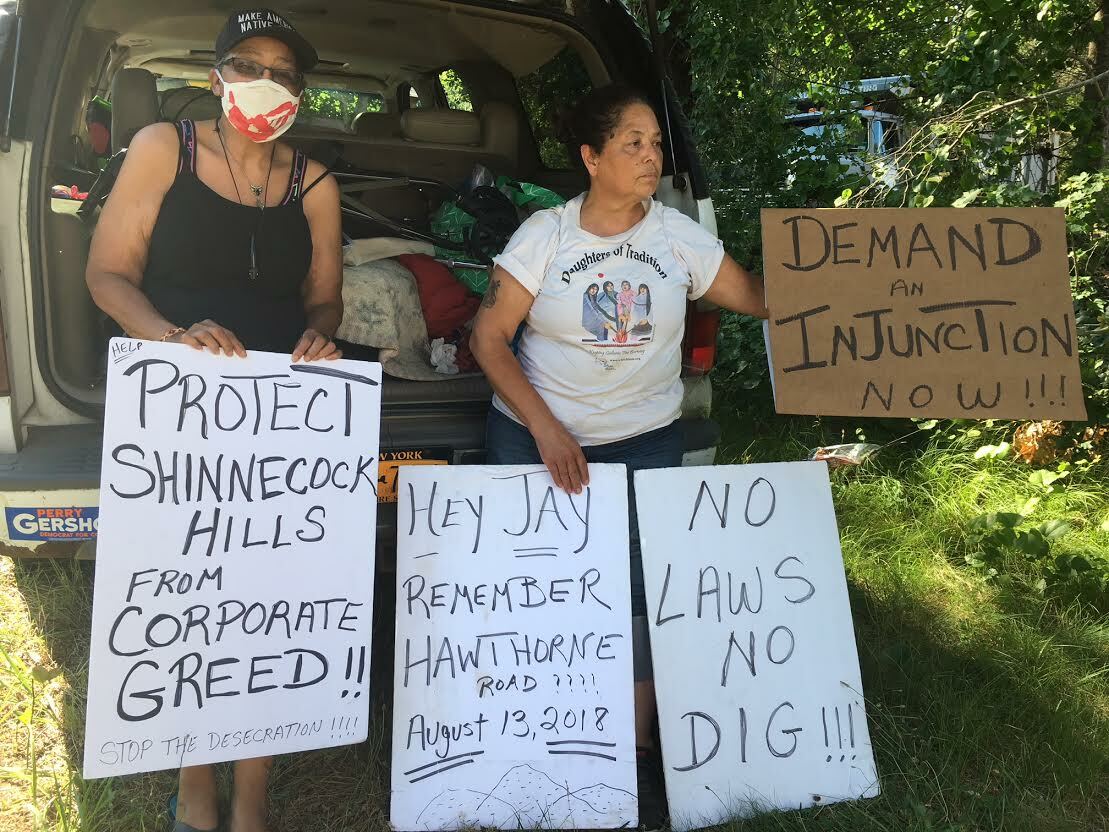
Jennifer Cuffee-WIlson and Rebecca Genia protest a building site. KITTY MERRILL
Members of the Shinnecock Nation protested last week at another Montauk Highway construction site, as legislation designed to protect possible burial grounds — interrupted by the COVID-19 pandemic — await adoption.
Eleven years ago,Southampton Town officials debuted legislation designed to protect unmarked graves and sacred Native American sites. Members of the Shinnecock Nation had been petitioning the Town Board for gravesite protection for four years when a bill debuted in 2009. At the time, tribal member and activist Rebecca Genia said, “Enough is enough.” But the Native American and Colonial Burial Site Protection Law languished, unratified.
The proposal stalled and was eventually shelved, as luxury homes continued to rise on lands that could be ancestral burial grounds. In 2018, ancient remains were unearthed at a Shinnecock Hills construction site. Protesting at still another construction site in the vicinity, Ms. Genia said this week that in 2018 workers found a skull, a leg and an artifact of one of her ancestors and the Nation only learned about it because friends were working at the site.
By December 2019, protests over unchecked development and gravesite desecration ramped up, and by January the Nation used its Sunrise Highway billboard to urge “Stop the Desecration of Shinnecock Hills.”
There was a protest at a site on Montauk Highway in the Sugar Loaf Hill section of Shinnecock Hills in January. Although town officials had agreed to advise Nation members of any digging in targeted sacred lands, they did not. Instead, members spotted the construction site while passing by.
The same thing happened last week at yet another construction site, this one on Scotch Mist Lane just “a stone’s throw” from sites of earlier protests, Ms. Genia reported. Armed with signs that said, “No Laws, No Dig,” “Demand an Injunction Now,” and “Protect Shinnecock Hills from Corporate Greed,” she and Jennifer Cuffee-Wilson took up a position at the site.
A member of the Graves Protection Warrior Society, Ms. Genia said she’d met Southampton Town Attorney Jim Burke at the site, on Monday, July 13. She related that the attorney promised to get the town’s ground penetrating radar device to the site before deep digging began. That didn’t happen, and by July 14 the foundation hole was dug. “I’m so upset,” she said, standing alone near the construction site.
By Monday, July 20, Ms. Genia reported the town was “quiet as a clam.”
“We picked up some stones a couple days ago in hopes of identifying as artifacts,” she said, “but not sure. Next, we watched as the cement truck came in and out. We are being ignored once again in our efforts to preserve what’s left and protect our unmarked burials. So sad Southampton is cruel and neglectful in this matter.”
In March, the Southampton Town Board held a virtual public hearing on a proposed Graves Protection Act. If adopted, it establishes protocols to follow in the event human remains are discovered during construction activities. During the same conference, the board held hearings on building moratoriums on new home construction on possible burial lands within the Fort Hill and the Sugar Loaf areas of Shinnecock Hills without first completing an archaeological review.
The moratorium also affects other large-scale excavation projects in the Sugar Loaf area such as accessory structures and swimming pools. It’s designed to allow time for the town to enact safeguards to prevent the inadvertent desecration of graves and archaeological resources in the sensitive area. The Sugar Loaf Hill Shinnecock Indian Burial Ground region encompasses parcels bounded on the north by Montauk Highway, on the east by Southway Drive, on the south by Shinnecock Bay East and on the west by South Beach Road.
The Fort Hill region encompasses parcels bounded on the north by the Long Island Rail Road, on the east by Ridge Road, on the south by Montauk Highway and on the west by Peconic Road.
Most who weighed in on the hearings via email supported the measures, but Southampton Town Supervisor Jay Schneiderman adjourned the hearing, hoping for its continuation when COVID-19 restrictions are lifted and stakeholders can provide comments in person.
The lot where Ms. Genia protested last week is not within the proposed moratorium area and had an as-of-right building permit issued as part of a previous subdivision from the 1980s, Mr. Burke said. It was the only lot that had not been built on from the subdivision.
The builder started digging the foundation the day after the attorney and activist met “which they had every right to do,” Mr. Burke said. He pointed out the town has been working on the acquisition of a number of properties within the Shinnecock Hills area within the moratorium area.


