


 4 Photos
Chenae Bullock
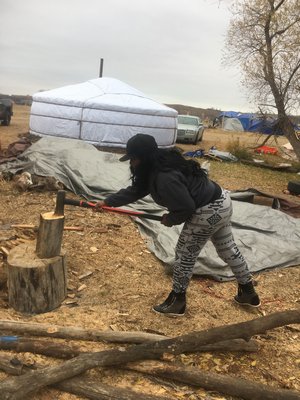
a Shinnecock Indian

has been living at the Oceti Sakowin Camp in North Dakota since September

where protestors over the Dakota Access Pipeline are based.
The Labor Day weekend Powwow on the Shinnecock Indian Reservation in Southampton, one of the Northeast’s largest gatherings of Native American tribes, was abuzz with talk of the other great gathering of Native people that was taking place: the protests against an oil pipeline near the Standing Rock Sioux Tribe reservation in North Dakota. Earlier that weekend, the protests, which began in March, had seen the first aggressive moves by police against increasingly bold protesters—the use of pepper spray and snarling and lunging police dogs to push back protesters.
“On that Saturday, all of us dancers, we saw the pictures and the videos of the dogs attacking Native people trying to protect their land and their water—and we said, ‘We have to go,’” recalled Chenae Bullock, a 28-year-old Shinnecock woman, who spoke by phone from South Dakota while on her way back from participating in the protests over the last three months. “We decided to go right after the Powwow, and we did.”
Ms. Bullock arrived at the Oceti Sakowin Camp, the main camp where as many as 10,000 protesters have been living, in mid-September. The camp was then still mushrooming in size as thousands of Native and non-Native people flooded in from around the country to support the Standing Rock tribal members in their opposition to the 1,200-mile Dakota Access Pipeline, or DAPL, which is being buried underground across four states, between the Bakken oil fields in the far northwestern corner of North Dakota and shipping ports in southern Illinois.
The Standing Rock have claimed that construction of the pipeline is disturbing ancient tribal burial grounds and that the pipeline itself, once operational, could threaten their tribe’s water supply.
The camp and the protest leaders were scrambling to accommodate the exploding population of protesters. Daily truckloads of food, firewood and equipment from toilets to cooking utensils were flooding in from donation centers. But the camp had a sacred fire, a tribal tradition, that burned 24 hours a day, and also community kitchens and a grade school and a surging swell of passion to fight for the cause.
“From March to the end of October, construction was stopped completely,” Ms. Bullock said. “Right now, they are two months behind schedule.”
The pipeline is being built by Energy Transfer Partners, a Texas company, at a cost of $3.8 billion. Rick Perry, the former governor of Texas, two-time presidential candidate and, most recently, Donald Trump’s nominee to be secretary of the U.S. Energy Department, is a member of the company’s board of directors, according to numerous news outlets. The project is more than 85 percent complete, with only the stretch that passes the Standing Rock reservation left to finish.
The protesters won a small moral victory in November, when the U.S. Army Corps of Engineers, which is the permitting agency for the project, said it would explore other routes, options that might not take the pipeline so close to the tribal territory.
The victory, if it does end up changing the route of the pipeline, was hard won.
As the protests became larger and larger, peaking in October and November, they have also been more prone to clashes with the now hundreds of heavily armed police that shadow the protesters’ every move. Protesters say that the company building the pipeline has sent its employees into the camps posing as opponents of the project to inform them of the protesters’ plans and to instigate aggressive or violent moves toward police, in hopes that violence would bring a decisive move from the police to shut down the protest camps.
On Election Day, with the pipeline protests still not a top story in the news, police and protesters clashed over an effort by the protesters to hold a tribal ceremony at an area believed by the tribe to be an ancestral burying ground known as Turtle Hill. As protesters tried to construct a makeshift bridge across a portion of the Cannonball River to reach the hill, police closed in to halt the work.
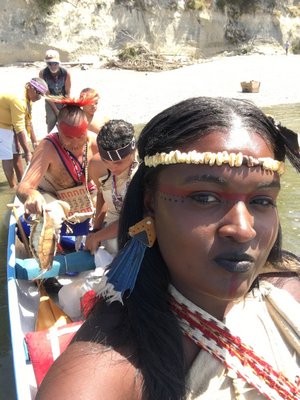
Ms. Bullock, who grew up in New England but spent summers canoing on the bay off Shinnecock Neck, manned a canoe of three protesters who patrolled the river to watch the movements of the police.
“A police boat came up to us, and one of them … he pointed his gun at us,” Ms. Bullock recalled. “I could see that he was really nervous, and I told the others to turn their backs and just keep paddling away. When you’re in a canoe, in a river, you only have just so much control, and the water could have pushed our boat into their boat—and, you don’t know, we could have ended up shot.”
Most of the police, on most days, were calm and controlled and professional, Ms. Bullock said, but on a daily basis there were individual or small groups of officers who would suddenly react impulsively with aggressive or violent strokes.
She said the stress of the daily tensions is clearly wearing on the nerves of those on both sides of the protest line. Protesters, many of them in their early and mid-20s, are living, effectively, under siege.
“People who are 18, 20, 25 years old, they are experiencing an environment for the first time where there are helicopters overhead 24 hours a day, where there is a military, men with guns and big armored trucks, surrounding you everywhere you go,” Ms. Bullock said. “You get out of your tent at night to go to the bathrooms, and there’s a helicopter overhead with a spotlight on you. It’s traumatizing, and people can get very emotional.”
Protesters and police have clashed on several occasions, leading to numerous arrests and what the protesters say are outlandishly aggressive tactics by police outfitted with military-level weapons and armament. On several occasions, protesters have been shot with rubber bullets, sprayed with mace and doused with water from riot-control water cannons. The police have said the water was only used, with temperatures in the mid-20s, because protesters were lighting fires.
Ms. Bullock left the Oceti Sakowin camp earlier this month and will return to the Northeast—she lives in Providence, Rhode Island, and works for the Mashantucket Pequot tribal museum—next week. She plans to return to North Dakota in January but said that in the meantime the effort to spread the protest motto “Take A Stand With Standing Rock” is her role in the effort.
Ms. Bullock has been funding her own time away from work and home with a Kickstarter campaign.
“When the thaw hits in the spring, we’re going to need to be strong again and to get back out there in numbers,” she said. “I would love for more people from the East Coast to come with me.”


 Michael Wright on Dec 14, 2016