


 3 Photos

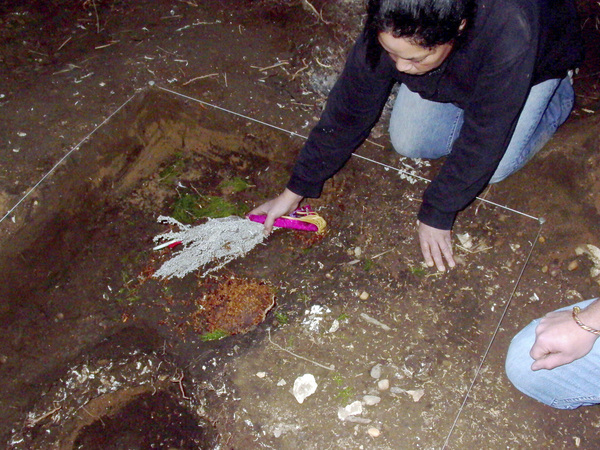
Shinnecock Tribal member Becky Genia makes an offering at the grave site in Water Mill on November 29 before the remains were removed and sent to the Suffolk County Medical Examiners office. BEVERLY JENSEN
A long search by members of the Shinnecock Indian Nation to find burial grounds containing the remains of their ancestors—before developers armed with excavators do—has been largely fruitless, despite years of pleading with Southampton Town officials to help them with the effort.
Shinnecock tribal members asked the Town Board at a work session last month to act fast in approving legislation that would put safeguards in place to protect the graves of their ancestors, as well as those of colonial settlers. But Supervisor Anna Throne-Holst said that a map outlining where potential graves could be located needs to be completed before the Town Board can take any legislative action.
The map, referred to as a cultural resources map, is being compiled based on knowledge of sites that members of the Shinnecock Indian Nation possess, coupled with areas that the town has already identified, according to Sally Spanburgh, the chairwoman of the Southampton Landmarks and Historic Districts Board. Ms. Spanburgh said the map was nearly complete, but the subcommittee that had compiled it has been inactive for the past year to 18 months.
Ms. Throne-Holst pledged to push for the completion of the map. “We definitely fell asleep at the switch here,” she said, “and it’s incumbent on us to get back on it.”
Members of the tribe said time is running out.
“The developers are raping this land,” said Rebecca Genia, a Shinnecock tribal member who has spearheaded the graves preservation effort on behalf of the tribe. “From 1640, we haven’t said a whole lot. We’re not asking for much … We’re asking for a dignified effort here to protect the graves of our ancestors.”
Ms. Genia said that the Shinnecocks have been looking to protect unmarked graves since 1891. Although Ms. Throne-Holst said the map is the key to enacting legislation, Ms. Genia said she thinks that argument is “just another stall tactic in my book to prevent having to actually deal with protecting sacred sites.”
“The developers have the money, and [development] goes on regardless of ancient burials, which mean nothing to them,” she said. “So that’s where the challenge is. Money still rules in Southampton. Sacredness does not.”
The Shinnecocks have reason to be concerned, according to Ms. Genia. In recent years, the graves of tribal ancestors have been unearthed on more than one occasion. In 2006, a 1,000-year-old skull was discovered during a renovation of the former St. James Hotel on Montauk Highway in Water Mill, which was owned by Greg Konner at the time, bringing Mr. Konner’s development of that property to a screeching halt. The town has since purchased the property with money from its Community Preservation Fund.
Still, Ms. Genia said members of the tribe had consistently reminded town officials over the years that the site was a sensitive one and advised them not to allow development to occur on it. “The Shinnecock Nation has said for 30 years, don’t touch that area,” she said.
Along with the discovery of the skull were other artifacts—stones and arrowheads included—which have not yet been returned to the Shinnecocks, Ms. Genia said. There’s a dispute between the town, which is the current owner of the property, and Mr. Konner, who had owned the property at the time, over who is responsible for paying for archeologist Jo-Ann McLean’s services, she said. Ms. McLean provided excavation services that led to the unearthing of the skull, and she is currently in possession of the artifacts, according to Ms. Genia.
Ms. Throne-Holst said the town maintains that Mr. Konner is responsible for the payment of the archeological services. Ms. McLean didn’t return calls seeking comment this month.
Mr. Konner said last month that he had paid Ms. McLean for her services for the time he owned the property and was unaware of any disagreement. “This is news to me,” he said of the payment dispute.
Also, in 2005, remains thought to belong to two or three Native Americans from either the Shinnecock or Yennacock nation were unearthed by a Suffolk County parks official at Indian Island County Park in Riverhead. Experts at the time hypothesized that the remains could date between 800 B.C. and 800 A.D., known as the Early Woodland Period.
The discovery of the skull in Water Mill, the unearthing of a mass grave in 2003 on Shelter Island that Native Americans claimed amounted to a desecration, and the 2005 incident at Indian Island County Park fueled the fire in recent years to get some kind of legislation on the books. Ms. Genia said the mass grave on Shelter Island, which contained remains of about five Native Americans, could have belonged to a number of tribes on Long Island. She said it was a desecration because she believes the property owner at the time “intentionally” bulldozed the remains to build a horse barn on the site.
Attorney George Cochran Stankevich, special counsel to the tribe, said a Southampton Town graves protection ordinance would need two main elements. The first would be an educational component, where builders would be notified if there were possible Shinnecock or colonial graves in the project area they were planning to build within. The second would be guidelines on what to do if remains were unearthed.
The request for a local law that would enhance protection of Shinnecock and colonial graves is not a new one. In 2009, members of the tribe sat before the Town Board asking for the same thing. At the time, former Town Supervisor Linda Kabot was considering codifying a policy that wold preclude property owners from building on burial sites, suggesting a “Shinnecock Overlay District” be drawn up that would encompass the majority of sacred sites in town. If such a district were created, it would delineate geographical areas in which developers would be required to meet specific guidelines to protect potential burial sites before being allowed to build.
Town Councilwoman Bridget Fleming said she would be supportive of creating a Shinnecock Overlay District. She said addressing the issue of graves protection is high on her priority list. Completing a map of the potential areas where the graves are located would be a “good beginning,” she said.
“Obviously, it’s an issue of tremendous importance in my estimation, and it’s extremely important that we move forward to address the concerns of the Shinnecock Nation,” Ms. Fleming said.


 Rohma Abbas on Dec 29, 2011