


 1 Photo
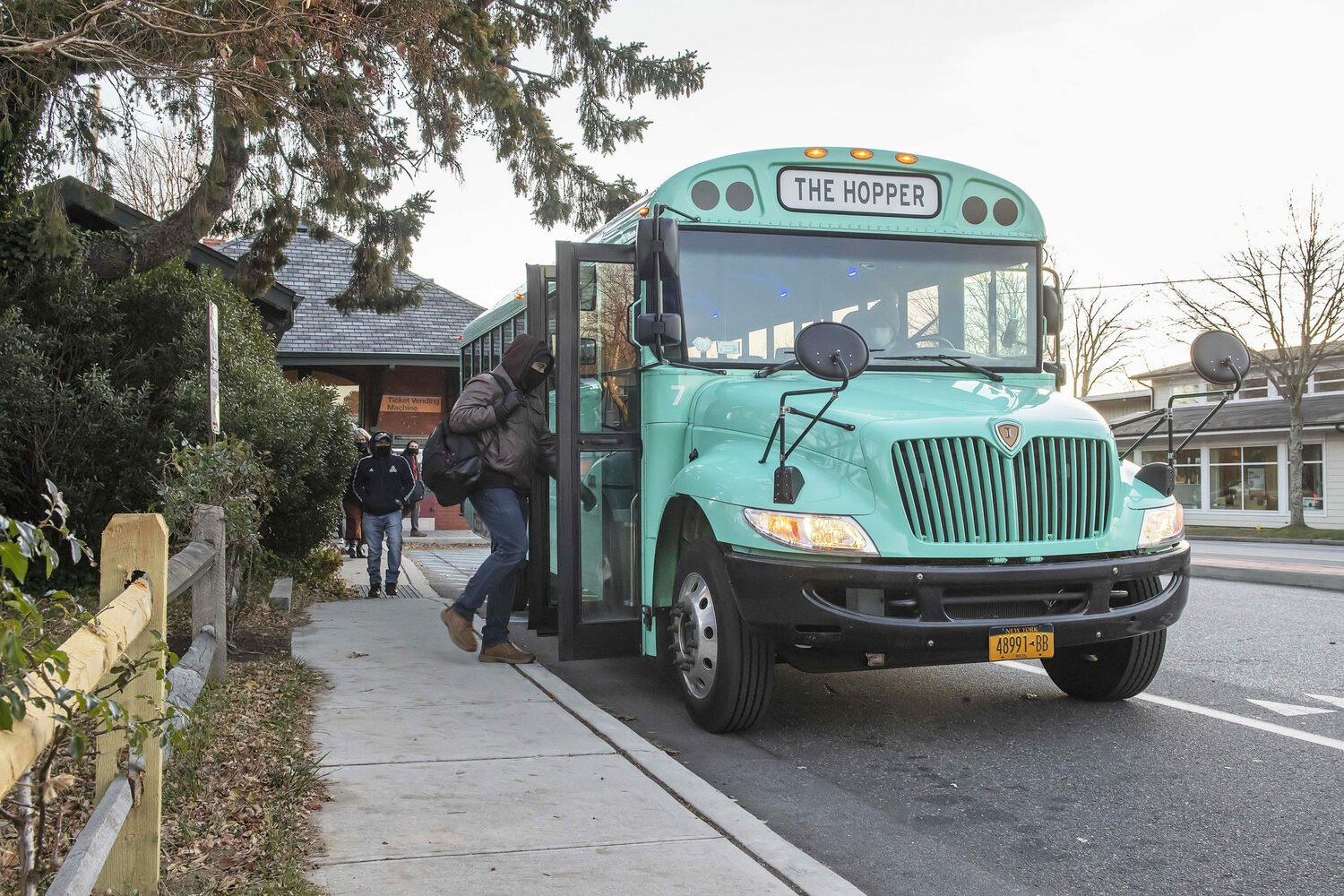
Ridership on the two Hampton Hopper "last mile" busses that meet the South Fork Commuter Connection has grown to more than 100 riders a day on average this spring in East Hampton Town. The company has shifted to larger busses and added a second bus to service two separate routes in response to the growing demand.
Ridership on the South Fork Commuter Connection trains-to-buses system has continued its gradual expansion in 2023, the operators of the Hampton Hopper buses told the East Hampton Town Board this week.
While daily ridership on the SFCC trains is still only in the range of several dozen people a day, it has grown steadily since its conception in late 2019, and the program’s managers and the bus company are trying to find ways to introduce the service to new potential riders and expand offerings in the hope of making mass transit more convenient and appealing.
Overall ridership of the trains and buses is up more than 40 percent this year in the two towns, Hopper executives said.
The buses connecting to the trains arriving and departing in East Hampton Village each morning have grown from 294 riders for the first month of operation in September 2019 to 716 by September 2021, 1,757 in September 2022 and now to more than 2,300 in March 2023 — an average of more than 100 riders per day.
“It’s grown nicely and there’s a continuing trend of growth, so it’s not slowing down,” Derek Kleinow, president of Hampton Hopper said. “We’re not excited to see the traffic getting worse, but we’re excited to see that ridership is growing.”
Since the return of the SFCC following a hiatus during the first six months of the COVID-19 pandemic, the rising ridership has spurred the company to shift first to larger buses to accommodate more riders per run and then to add a second bus to the East Hampton connections. The additional bus allowed the company to split its “last mile” services into two routes for the town, which in turn made the ride shorter and more convenient for riders.
“We’re always trying to create the greatest benefit for the greatest number of riders,” Kleinow said. “We’re looking at it from the rider’s point of view. Nobody wants to be sitting on our bus, they want to be home with their families, so we’re trying to get them there as fast as we can.”
When the afternoon westbound LIRR trains were canceled one day this week, the buses shuttled riders all the way back to their cars in Hampton Bays or Speonk, where the trains pick up riders in the mornings — a service that was not specifically in the bus company’s contract but that the Hopper does because it wants riders to be confident that the service will always be there regardless of hiccups in the system.
Kleinow said that ridership tracking shows that about 70 percent of those who use the trains then get on one of the buses to complete their commute. In East Hampton, he noted, Riverhead Building Supply and the YMCA have regular riders who walk to their jobs from the trains.
Ridership on the East Hampton buses has been much busier than the Southampton routes, the bus company boss said.
The bus company itself is conducting outreach to employers, searching for ways to make the service more viable for more workers who might be able to avoid sitting, and adding to, traffic jams each morning and afternoon.
“The train and bus schedules are rigid, so if employers could build in some flexibly that would go a long way toward promoting use of this program,” Kleinow said.
The best marketing for the service, he added, is for someone from a place of business to start taking the trains one day — and spreading the gospel to their co-workers.
He said the company is in talks with Stony Brook Southampton Hospital, which has struggled to recruit staff as traffic woes have grown in recent years, about potentially setting up a pilot program for a dedicated shuttle just for nurses working 7 a.m. to 7 p.m. shifts.
The LIRR has added a second train car to the service to accommodate the growth in riders and this summer will add a Friday afternoon westbound train to maintain the continuity for users throughout the workweek — whereas in the past no Friday afternoon trains were available because of conflicts with the eastbound “Cannonball” trains. There will be just one Friday afternoon train, however, not two like on other days of the week.
East Hampton Town Councilman David Lys noted that the LIRR has had problems with keeping up the schedules in recent months because of adjustments to its schedules throughout Long Island since the LIRR completed the East Side Access project — it’s largest capital expansion of services in decades — and the addition of Grand Central Station service. Those changes have reverberated all the way to the SFCC routes, causing some delays that have raised conflicts with the bus routes and workers’ on-time arrivals.
Lys said that local lawmakers have also been calling on the LIRR to add “sidings,” where two trains can pass each other, so as not to require the cessation of one line’s service to make way for another and the SFCC continuing to run without being interfered with by other longer-distance trains.
“If we want our workforce out here to be able to work with mass transportation, we need to provide better mass transportation,” Lys said. “We need the LIRR to commit to their promises, which they haven’t done for the Town of East Hampton so far. We need sidings so we can add more trains. People will use it.”


 Michael Wright on May 10, 2023