


 2 Photos
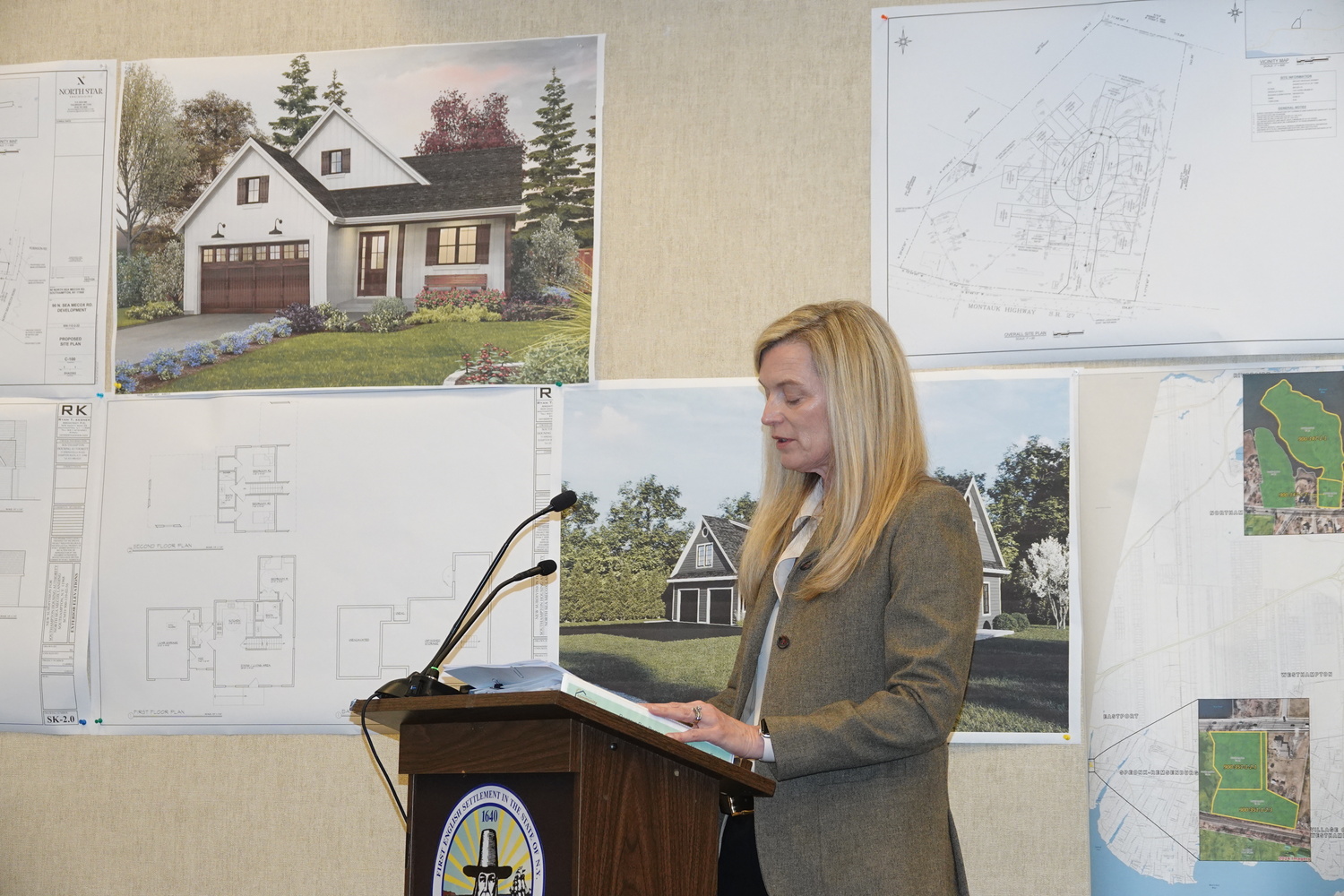
Housing director Kara Bak said that the vast majority of applicants for the town's affordable housing lottery are people who already live or work locally. MICHAEL WRIGHT
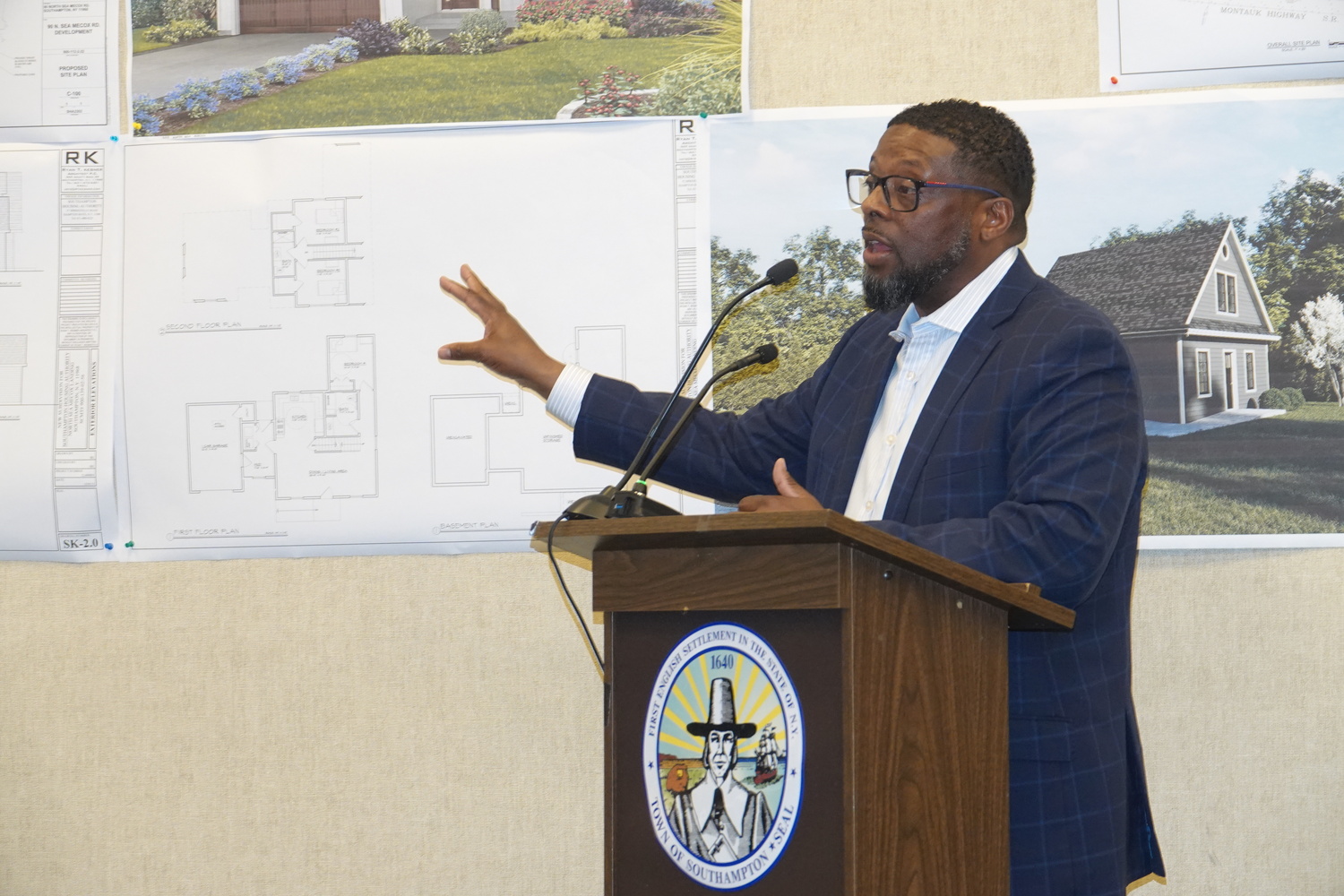
Southampton Housing Authority Director Curtis Highsmith said that public attitudes about subsidized housing developments have changed significantly over the last 10 years. MICHAEL WRIGHT
Southampton Town has been asked to dedicate about $3.5 million from the Community Housing Fund to help build 14 new three-bedroom homes in North Sea, most of which would be sold to buyers chosen by lottery for between $340,000 and $420,000.
The funding from the town’s housing fund would go the Southampton Housing Authority to help pay the cost of buying two neighboring parcels of land off North Sea-Mecox Road that have long been on the town’s radar for redevelopment with below-market houses subsidized by the town and other public funding support.
The Housing Authority says it can build 13 homes on the two parcels, which total about 6 acres, that it will be able to build and sell at rates affordable to buyers earning between $124,000 and $156,000 for a dual-income, family of four, who will be chosen by lottery from the Housing Authority’s application list.
If the projects go forward as planned, nine of the homes will be Cape Cod-style, three-bedroom, two-bath houses of about 1,200 square feet each, arranged along a cul-de-sac running into the approximately 4-acre parcel at 90 North Sea-Mecox Road.
Another four ranch-style homes of similar overall size and amenities, will be clustered on 2 acres at 205 North Sea-Mecox Road.
The 90 North Sea-Mecox project will require the Town Board to grant a change of zone on the property, allowing multifamily development beyond the half-acre minimum lot size under current zoning, which would have allowed the parcel to be subdivided into up to six separate building lots.
A third house would be constructed on Maple Avenue in Flanders that will be constructed specifically to accommodate a tenant with mobility issues, a goal that has been a priority of the Housing Authority and county housing programs.
The house will have an ADA accessible bedroom and bathroom on the ground floor and two upstairs bedrooms, as well as an apartment unit above a two-car garage. Both the main home and the apartment will be rented out by the Housing Authority to qualified candidates from the town’s housing application list. Suffolk County has already pledged $200,000 toward the project to pay for the ADA upgrades to the structure, which the Housing Authority is in the process of designing so that construction can begin later this year.
All of the homes to be sold will be restricted to keep them in the realm of “affordable” housing in the region in perpetuity. To achieve that, the Housing Authority will retain ownership of the underlying land and the owners of the homes will be allowed to earn profits from a future sale restricted to appreciation linked to the consumer price index over the period of ownership.
The homes would also be capped in size to prevent expansion and limited in the sort of improvements that could be made by the owners — restricting the finishing of basements, adding accessory structures, swimming pools or creating rental apartments — preventing the properties from increasing in value beyond what would keep them in the affordable housing realm in perpetuity.
At a meeting with the Town Board on March 11, the Housing Authority’s executive director, Curtis Highsmith, celebrated the power that the new housing fund has given the town in creating affordable living opportunities for a broad cross-section of the local community.
“This is a monumental moment … this is the first time we’ve been able to have a funding partner in the Town of Southampton,” he said of the first partnership between the Housing Authority and the Community Housing Fund, which took in about $20 million last year from the half-percent sales tax on most real estate transactions, which voters approved in 2022.
He also applauded the change in attitudes that has taken place in the community toward the idea of affordable housing developments in the community — something he said has taken his group years of effort to build trust in among neighbors by showing that they are dedicated to building projects that fit into the surrounding community and are maintained as neighbors would expect their neighbors to.
“When I started here in 2014, it was a very different conversation — you couldn’t talk about affordable housing openly and community support was difficult to get because we didn’t have examples,” Highsmith said. “I think we’ve demonstrated that we are responsive and responsible.
“These are my babies,” he said. “I drive by them to make sure the grass is cut, the yards are maintained, that the people who are supposed to be there are there.”
The town’s housing director, Kara Bak, said that the Community Housing Fund advisory committee has 209 units of housing in its pipeline of projects for funding consideration.
“To put that in perspective, the town’s housing plan lists only 425 housing units created in the last 30 years,” Bak said. “The Community Housing Fund is making meaningful progress.”
Bak and Highsmith also defended the process the Housing Authority uses to choose tenants for the units it will build with money from the CHF.
Hampton Bays resident Ray D’Angelo said that the homes and rental apartments built with CHF money should at least in part be prioritized for local volunteers to fire and ambulance companies like those who had just battled the wildfires in Westhampton a few days earlier.
“These are people who are necessary and important to our community, and since they volunteer life and limb to do this, they should be given some consideration,” he said. “If we build affordable housing and we get somebody from Mineola to come here, that doesn’t help us.”
He spotlighted the fact that the housing lotteries are open to essentially anyone who wants to put in an application to get an affordable home.
But Bak and Highsmith noted that very few, if any, people from outside the area are submitting applications, because what qualifies as “affordable” housing on the South Fork, is still almost laughably unaffordable to most people from points west.
While federal fair housing rules preclude housing lotteries from restricting the pool to specific groups, like first responders and volunteers, the town’s goal is to keep local people in the community and goes to great lengths to make sure that volunteers know how to, and are encouraged to, put their names in the lottery.
“We’ve had a number of lotteries now. We’ve had Sandy Hollow, we’ve had Speonk, we’ve done Hampton Bays — nobody is applying from Nassau County,” Highsmith said. “You don’t ever find anyone that doesn’t have a local connection of employment, relationships, history or family. It just doesn’t happen.”
“We did the Hampton Bays lottery — 200 applicants for two homes,” he said. “The two people selected lived in Hampton Bays. They were originally from Hampton Bays, they reside in Hampton Bays and they stayed in Hampton Bays. That was a positive impact for the community of Hampton Bays.”
“It was heartbreaking,” Councilwoman Cyndi McNamara said of the lopsided number of hopefuls to opportunities to purchase two single-family homes at a cost someone earning a blue collar wage could afford. “Most of the faces in the crowd were our employees.”
Bak said that 94 percent of the units that have been awarded through the public lotteries have gone to people who either were Southampton Town residents already, currently work in the town or had been residents previously but had to leave because of the cost of housing.
Highsmith also scoffed at a suggestion that the developers that build the housing units are lining their pockets with public housing funds.
“Anyone who thinks that people who develop affordable housing become rich from it doesn’t understand the process at all,” he said. “Nobody is getting rich — which is why there aren’t very many affordable housing developers.”


 Michael Wright on Mar 19, 2025