



 7 Photos
Stony Brook Southampton Hospital

currently located at 240 Meeting House Lane in Southampton

is planning to move to the Stony Brook Southampton campus in Shinnecock Hills. ANISAH ABDULLAH

Stony Brook Southampton Hospital

currently located at 240 Meeting House Lane in Southampton

is planning to move to the Stony Brook Southampton campus in Shinnecock Hills. ANISAH ABDULLAH
Stony Brook Southampton Hospital
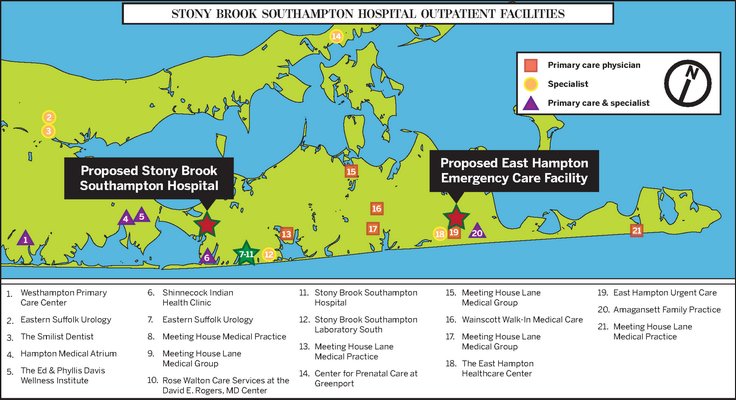
Stony Brook Southampton Hospital officials have begun planning for a new state-of-the-art facility on the Stony Brook Southampton campus in Shinnecock Hills, a $300 million project that will remodel the health care landscape of the East End.
This project is the last stage of the overall merger plan between Stony Brook Medicine and Southampton Hospital that was implemented in July 2017. It also will include a $35 million project to add a satellite facility in East Hampton offering an emergency room and advanced outpatient medical services, with fundraising for both projects to be held simultaneously starting in the first half of 2019, and hopes to have both facilities completed within as short a time as five years after fundraising is completed.
“Our relationship with Stony Brook has been extraordinarily beneficial for us, and will be beneficial for the East End community, because it’s going to allow us to provide a level of care that’s much higher than ever before,” said Steven Bernstein, chief development officer of Stony Brook Southampton Hospital and president of the Southampton Hospital Foundation.
Before launching a capital campaign to fully fund the project, Governor Andrew M. Cuomo must first sign legislation authorizing the university to lease property on the Stony Brook Southampton campus to the Southampton Hospital Association—a bill that was approved by the State Legislature in June.
Although the governor has less than two months to sign the bill before it would automatically be vetoed, officials seem unconcerned by the narrow time frame.
“The governor’s administration has already approved the merger. Thus, there is good reason to be optimistic about its passage,” State Assemblyman Fred W. Thiele Jr. said in an email on October 30. “In the intervening months, we have heard of no concerns from the administration about the bill.”
Robert Chaloner, chief administrative officer of Stony Brook Southampton Hospital, also said he felt confident that the bill would be signed by the end of the year. “We’re not anticipating any issues. It’s just a question of timing,” he said.
Despite the pending status of that legislation, plans for the necessary capital campaign have been well underway.
A Planning and Development Committee was formed to oversee the project, made up of representatives from Stony Brook Southampton Hospital and Stony Brook Medicine. They recruited Howard Lorber, chairman of Douglas Elliman, as well as the Southampton Hospital Foundation, to be chairman of the capital campaign.
They also hired Erdman, a national health care consulting firm, to survey the health care needs of the East End, in an effort to provide sufficient care for the whole community. Erdman presented its findings to the committee on Friday, November 9, and will present the same report to the Southampton Hospital Association Board of Directors on December 15, according to Mr. Bernstein.
Mr. Chaloner and Mr. Bernstein both declined to provide details of the findings before the December meeting with the association’s board takes place.
Mr. Bernstein did note in an earlier interview, however, that the findings should determine “the size of the hospital, the size and scope of the facility that we’re going to build in East Hampton, and other community-based facilities as well.”
Mr. Chaloner noted that hospital officials truly are starting from scratch in designing a new modern hospital to replace the current facility in a century-old building in the middle of the village, retrofitted for its purpose. “We know we don’t want to just rebuild Southampton Hospital. We want to build something that serves the community’s needs for years to come,” he said.
Later, he added, “There are so many cool things we can do.”
He did say the study likely will propose no additional beds for inpatient care, and possibly fewer. But it will significantly increase space for ambulatory and outpatient care, and testing—areas where “we’re bursting at the seams.”
Establishing an emergency room facility in East Hampton to meet the community’s health care needs has been on the Southampton Hospital Association’s agenda long before partnering with Stony Brook. With plans moving forward to relocate the hospital four miles west, from Southampton Village to the campus in Shinnecock Hills, the cry for the East Hampton facility becomes even louder.
Mr. Chaloner, an East Hampton resident himself, expressed the feeling of isolation that comes with living in the town.
“Unless you build two highways to get back and forth, it’s not going to get easier for people in the Town of East Hampton,” he said.
As a result, fundraising efforts for the new hospital were expanded to include raising the $35 million to build the satellite location in East Hampton, at the same time. It will be the first health care facility of its kind on the East End, which will provide more advanced outpatient medical services than what is currently offered east of the hospital.
The new location already received a Certificate of Need approval from the State Department of Health in July.
East Hampton Town gave approval to the Southampton Hospital Association in January to lease a 4-acre property at 400 Pantigo Place, a location that the association has publicly preferred for more than two years. The project has already been awarded a $10 million grant from the state.
Plans for the East Hampton facility prove to be challenging in terms of operating costs, since a bulk of its users would be around only in the summer months. Mr. Chaloner said that they are working through the programming right now, but he remains optimistic that it will be successful because of the supportive feedback from town residents.
Once all parties approve the campaign plan and Gov. Cuomo signs the legislation transferring the campus property to be used for a new facility, the hospital’s next step is to vet architects to design a rendering for the two new locations. Physical renderings are critical to show to potential donors to help get them to agree to contribute.
“People have been saying, ‘Bob, we need this. Come to us with a picture when you have it,’” Mr. Chaloner said of his donors. “The community needs it, and donors want it. We want to do it right. Am I nervous? Yeah. We need to prove we’re worthy of the donations.”
Fundraising is expected to kick off during the first quarter of next year, with a bulk of the funds coming from large donations, Mr. Chaloner said. He estimated that the combined project should take about five years to complete once fundraising begins.
“This is going to be certainly the largest campaign we’ve ever done in our history,” Mr. Bernstein said of the coordinated fundraising plans.
Asked if there were any large donations already in place, Mr. Chaloner replied, “Not in place, but fairly … very interested. Let’s put it that way.”
He added, “We are an amazing community—we should have amazing health care.”
Mr. Chaloner and Barbara-Jo Howard, director of communications and marketing at Stony Brook Southampton Hospital, shared the sentiment that past donors have been pleased with what the hospital has done, giving them a good track record.
“Martin and I are proud to be friends and supporters of Stony Brook Southampton Hospital, and we are excited about their ambitious plans to build a new, state-of-art hospital and lead a new era of high-level health care for our community,” said Audrey Gruss, who helped fund the opening of the Audrey and Martin Gruss Heart and Stroke Center three years ago at the hospital.
Eager officials have already begun conceptualizing designs for the new hospital. In line with the hospital’s Phillips Family Cancer Center, which is slated to open in March 2019 along County Road 39 on the edge of Southampton Village, they want the new location to focus heavily on the interaction between the patient and the interior space.
Ideas include installing large windows to allow for bright, open areas, installing interactive “smart walls,” creating “living areas” instead of waiting rooms, and creating customizable patient rooms—instead of moving a patient around the hospital for necessary testing and treatments, they want to be able to periodically upgrade the room with different monitoring systems to bring those services to the patient.
“It’s not just medicine—the environment is part of the healing process,” Mr. Chaloner said, before noting an idea to build private outdoor patios for patients. “We want to create an indoor-outdoor experience.”
The new hospital will feature modern amenities and state-of-the-art technology, and include either the same or fewer number of its current 125 hospital beds. Mr. Chaloner added that they want to place more focus on infection treatment and observation care.
All Stony Brook educational programs that have been brought to the Stony Brook Southampton Hospital since the merger, like current residency programs and internships, will continue to be offered at the new location, and further links with Stony Brook’s educational resources will be explored.
Since partnering with Stony Brook, Mr. Chaloner said the hospital has been in a much better financial position. He explained that the hospital has cut down on expenses as a result of having access to the university’s resources, and operations are smoother.
Mr. Chaloner noted that the hospital continues to maintain a separate operating budget of $175 million with no subsidies from Stony Brook. “We still stand and thrive on our own, and continue to run effectively,” he said.
As for the existing hospital property and what the plans are for it going forward, Mr. Chaloner noted that he realizes neighbors have pressed for answers—even forming a group to lobby for their interests. Rumors have been flying, including that the property will be used for a state prison, something he dismissed with a laugh as pure fiction.
“What we’ve said to them, which is the absolute truth, is that we don’t know yet,” he said.
He noted that the Southampton Hospital Association retains ownership of the property—not Stony Brook Medicine. It was a key element of the agreement bringing the two entities together, and it will be a similar arrangement on the college campus.
“It’ll be our board’s call on what happens,” he said, referring to the local Southampton Hospital Association board. “They don’t want to do anything to blight the community.”


 Anisah Abdullah on Nov 16, 2018