


 10 Photos

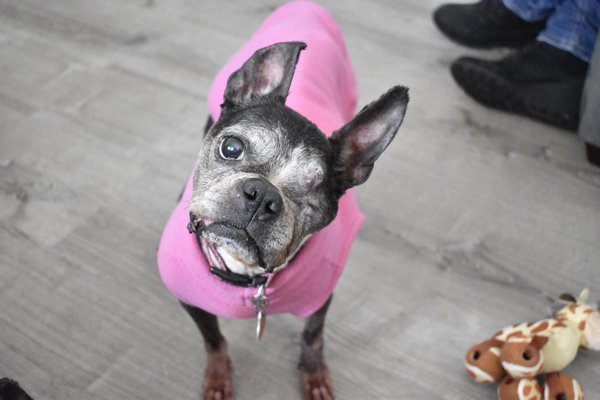



Maggie, an 11-year-old Boston terrier, trots across the gray-brushed hardwood living room floor, brandishing a giraffe squeaky toy, which she drops at her foster mom’s feet. Occasionally, she squeaks it to grab Desiree Shearer Schellinger’s attention, letting her know it’s time to play a little tug-of-war. But Maggie wasn’t always the playful, active dog she is today. Less than six months ago, most of Ms. Schellinger’s friends would’ve sworn that she didn’t even have a dog, as Maggie would often lie motionless in her bed for hours.
“She was almost comatose—she was miserable,” Ms. Schellinger said. “It was really horrible to watch.”
She adopted Maggie last August from the Northeast Boston Terrier Rescue in New York City, where she works as a secretary, knowing full well that her new furry companion suffered from deviated discs in her neck, as well as severe arthritis. Several months later, Maggie also was diagnosed with intestinal cancer and was prescribed round-the-clock pain medication, including tramadol, gabapentin and rimadyl.
It wasn’t helping. “She could barely walk,” she said. “I was calling her ‘dead dog walking.’”
It got to the point where Ms. Schellinger would often wake up in the morning to feed her pup a homemade breakfast and say to herself, “Today is going to be the day—I’m going to put her down.”
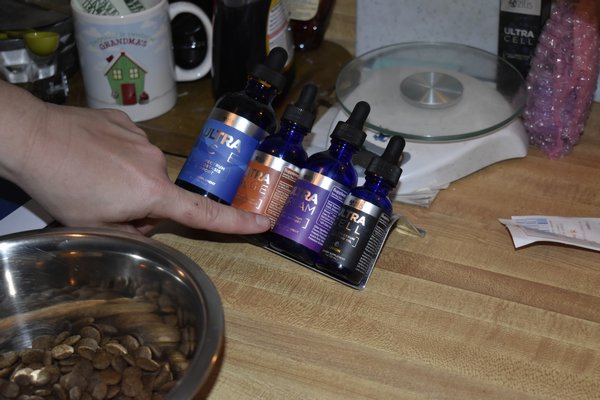
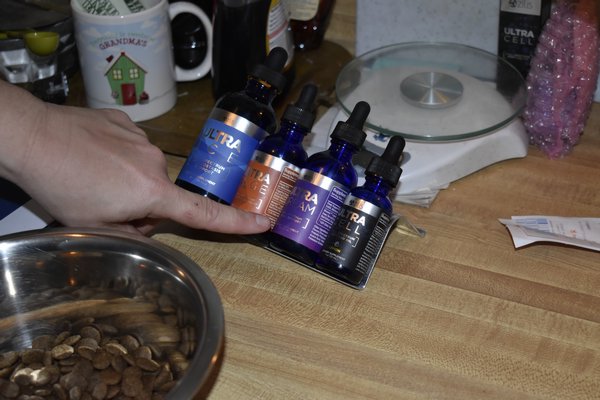
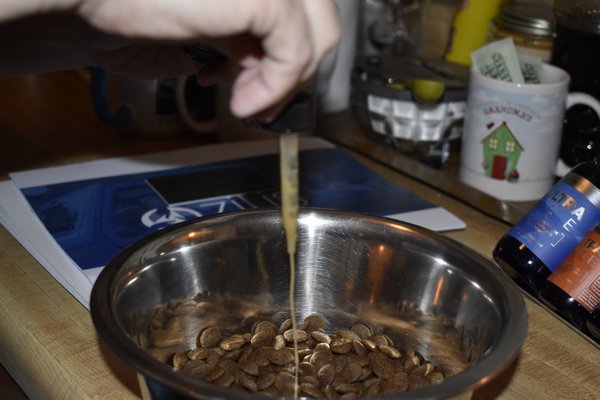
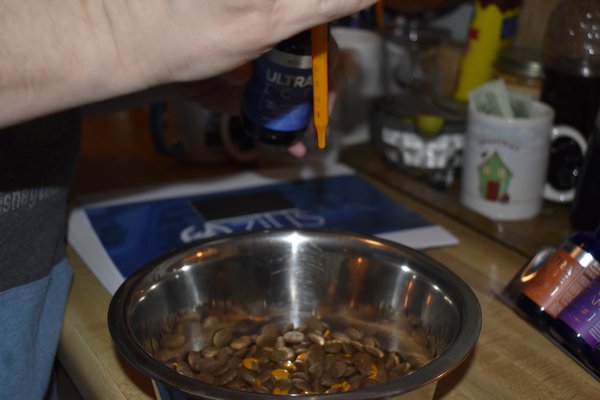
Then she started adding four drops of Ultracell, a hemp-derived cannabidiol, or CBD oil, to Maggie’s food every morning and night.
“Within two weeks, she was just transforming before my eyes,” Ms. Schellinger said.
The Southampton resident started selling and delivering the plant-based supplement locally as an affiliate of a nationwide hemp-based CBD oil distributor: Zilis, The Ultra Company. Through her new venture, she said that she hopes to shed some light on the benefits that CBD oil can provide not just for humans—as it is typically used to treat anxiety and arthritis—but also for canines.
In fact, according to her business partner, Robin Boucher, dogs are more susceptible to the effects of CBD. She explained that canines have more CBD receptors in their bodies than humans do.
She went on to say that every animal with a spinal column has what’s called an endocannabinoid system, or ECS—a chemical communication system between the brain and different sites, such as joints, throughout the body, she said. That system runs off cannabinoids, or chemical compounds, such as those found primarily in cannabis, that trigger those receptors. “It’s the body’s primary tool for homeostasis,” she said.
However, Ms. Boucher explained that CBD oil is not a “cure all.” Rather, it gives the body back its ability to heal itself. She explained that CBD is an adaptogen, meaning it adapts to the body’s condition and works to both regulate hormone levels and balance the body’s adrenal system. “It does whatever the body needs it to do,” she said. “If it needs to increase or decrease the body’s hormone levels, it will do just that. It fills in the void.”
Dr. Joli Jarboe, a veterinarian neurosurgeon—one of only 350 worldwide—who specializes in internal medicine at Bush Veterinary Neurology Service in Virginia, has also spoken on the benefits of CBD oil in canines. In an email, she identified several evidence-based health benefits of CBD oil in canines, including stress reduction, emotional stability, neuroprotection, immunomodulation, and joint health and functionality. Additionally, it helps to reduce cellular degeneration and helps fight against seizures.
Still, there are skeptics, including some who mischaracterize hemp-based CBD as marijuana and question the legality of not only taking it themselves but subjecting their four-legged family members to it. Ms. Schellinger said her goal is to address those misconceptions and demystify CBD.
She pointed to a recent letter addressed to the American Veterinary Medical Association, in which Jonathan Miller, an attorney with Frost Brown Todd Inc. in Lexington, Kentucky, speaks on the legality of hemp-based CBD oil, as well as the differences between hemp and marijuana.
In the letter, dated September 17, 2018, he explained that while hemp and marijuana are both derived from the plant genus cannabis, unlike marijuana, hemp does not produce a psychoactive high.
He went on to say that CBD products containing less than 0.3 percent of tetrahydrocannabinol, or THC, are legal under federal law. According to Zilis’s website, Ultracell has zero traces of THC.
Additionally, unlike most other CBD oils, which are typically only 6 percent water soluble, Ultracell is 96 percent dissolvable, making it easier for canines to digest, Ms. Boucher said.
However, even she admitted that a little over a year ago, she had similar concerns. It wasn’t until her sister, Raynelle Gonce, suffered muscular injuries in a motor vehicle accident and began taking CBD oil for herself, that she saw the benefits of it. She took a chance and started mixing it in Maggie’s food.
“I was a skeptic—a total skeptic,” Ms. Schellinger said. “But it was an amazing transformation.”
Ms. Schellinger’s friend, Beverly Ringhoff, said the difference in Maggie has been nothing short of a miracle. “I think there are some days when Desiree wants to take her off it just to get some rest,” she joked.
In November, Ms. Schellinger opened her home to another foster dog, Bonnie, a 12-year-old Boston terrier with Cushing’s disease—an adrenal and pituitary gland disorder—as well as arthritis and thyroid issues. The disease has caused Bonnie to lose a significant amount of muscle tone, and gaining weight has been a chore. In a last ditch effort, Ms. Schellinger decided to try mixing the oil into Bonnie’s food and, in less than two months, she has gained 2 pounds.
“She’s the happiest dog,” Ms. Schellinger said, noting that Bonnie is scheduled to be adopted on Friday. “We’ve had really good results.”
And she’s not alone. Ms. Boucher has had similar results with her own dog, Duke.
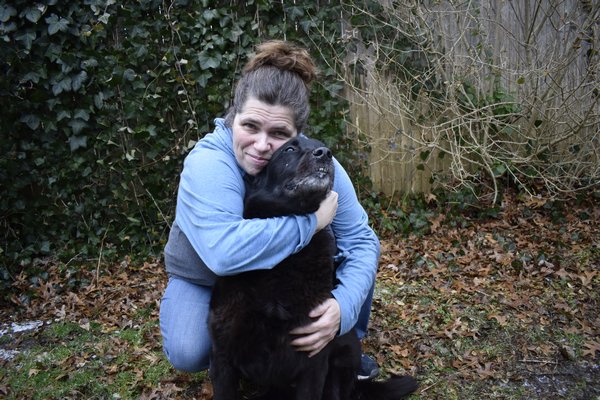
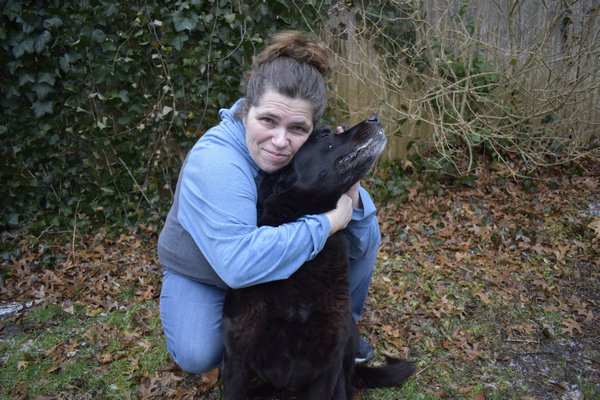
Last week, she explained that her 10-year-old black Labrador retriever mix has suffered for years from severe chronic arthritis. For those same years, he was taking prednisone for the pain, but could barely walk, Ms. Boucher said. Now, after nearly a year of taking Ultracell, Duke is often mistaken for a young dog. “It’s literally life altering,” she said.
In fact, according to Jill Milowski, another local Ultracell distributor, CBD oil is often a safer alternative to prescription medication.
“You can’t get addicted to it. You can’t overdose on it. It’s an all natural supplement,” the Hampton Bays resident said, noting that a lot of her customers inquire about giving it to their pets. “It’s amazing because it can help everybody.”
When Ms. Schellinger lost her Boston terrier, Chloe, to a seizure in 2015, rather than adopt again, she turned to the Boston Terrier rescue to help give forever fosters—dogs that can’t be adopted due to health complications—a better, longer life.
Over the past three years, Ms. Schellinger has given more than 13 elderly Boston terriers a second chance at life. Since she began using CBD oil, she has watched as the supplement has transformed dogs within the rescue. One of them being Bonnie, who was originally thought to be a forever foster.
Sitting in her living room with Bonnie snuggled in the crook of her arm, Ms. Schellinger called the hemp-based oil “truly amazing.”
As she planted a kiss on Bonnie’s brindle-colored head, she said, “She truly is a changed dog.”


 Valerie Gordon on Jan 22, 2019