


 1 Photo
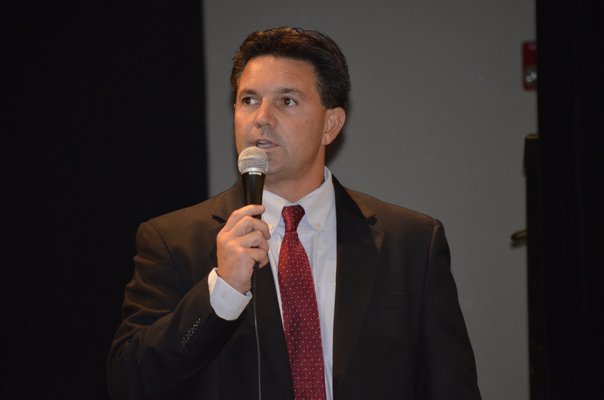
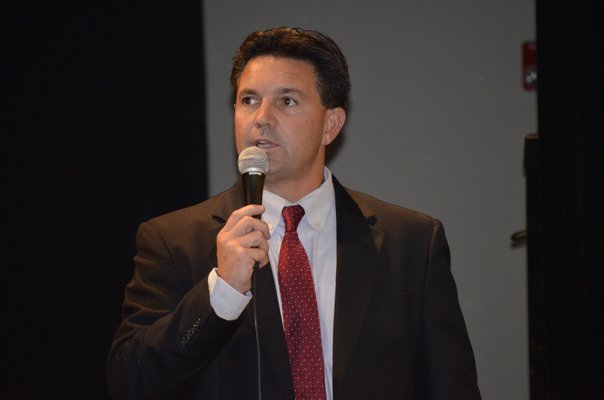
Southampton Superintendent Dr. Scott Farina at a merger community forum on Wednesday night. BY ERIN MCKINLEY
Southampton School District officials continue to say that they will not release the findings of an investigation into unnamed allegations against former Superintendent Dr. Scott Farina.
While district officials and School Board members have said they are prohibited from releasing that information, because it could be a potential “unwarranted invasion of personal privacy,” Robert Freeman, executive director for the State Committee on Open Government, said the district is not prohibited from distributing it. The Freedom of Information Law allows the board to choose to withhold the findings under certain circumstances, he noted, but it still is a choice made by the board.
The district last week denied a Freedom of Information Law request filed by The Press for the findings of an investigation into unspecified allegations made against Dr. Farina, conducted by the Garden City-based firm Jaspan Schlesinger LLP, following his resignation on April 15, for which he will receive a nearly $300,000 payout. In its denial, the district cited “unwarranted invasion of personal privacy” and “other” as the reasons, although the line next to “other” to explain it was left blank. The Press plans to appeal that decision this week.
Similarly, The Press had filed a FOIL request with the Eastport South Manor School District for any complaints made against former Superintendent Mark Nocero during his tenure that may have led to that district’s School Board accepting his abrupt retirement on March 16. In that case, The Press was also denied, nearly a month later, for “unwarranted invasion of personal privacy.”
Mr. Freeman explained that the courts have ruled that FOIL allows public entities to withhold information, but doesn’t mandate that they do so. “When access is governed by the [Freedom of Information Law], that law is permissive—it authorizes an agency to deny access. But ordinarily it doesn’t not require that a government agency withhold it,” he said. “In this instance, I know of no law that would prohibit disclosure … unless that document contains information about a student.”
According to the law, an unwarranted invasion of personal privacy of a public employee includes disclosing records involving medical or credit histories; giving out personal information, such as names, addresses and phone numbers, for solicitation or fundraising purposes; and releasing personal information to an entity or individual in a situation where it is not relevant to the person’s professional position.
Mr. Freeman said that when information that a public entity is withholding is of great interest to its constituents—such as the resignation of a school district superintendent—then the public interest tends to outweigh the need to protect privacy. “Certainly, there’s an interest in knowing how and why public money is being expended. Whether that outweighs the ability or desire to protect privacy, in this case, is open to question,” he said. “However, certainly, school district officials should be taking a second look before they simply say, ‘No.’”
The school district’s attorney, Tom Volz of the Nesconset-based law offices of Thomas M. Volz PLLC, did not return a call seeking comment.


 Alyssa Melillo on Apr 27, 2016