



 2 Photos

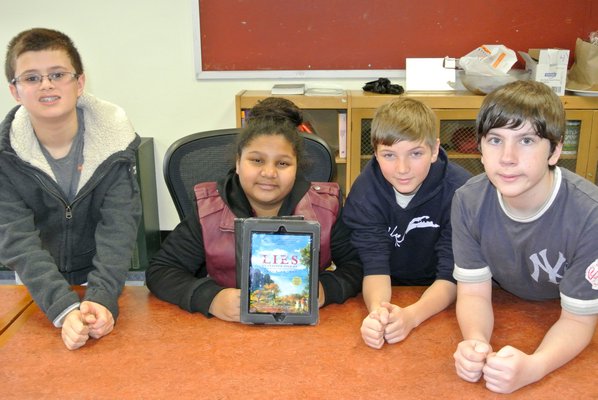
Students David Mahoney, Aidan Wisniewski-Campo, Nashota Williams, and Wayne Moore, along with their seventh-grade social studies class, are petitioning the school district to no longer celebrate Christopher Columbus. BY DANA SHAW
In fourteen hundred and ninety-two, Columbus sailed the ocean blue.But is that worth celebrating?
That is the question seventh-graders have posed to the Southampton School Board. They hope to have the district rename the October school holiday to respect the people Columbus killed after discovering the new world.
For several weeks, the students in Kelly Anderson’s and Ken Sisco’s social studies classes have been studying Christopher Columbus—a study that culminated in a mock trial to argue both sides of the explorer’s “discovering of America.” In the end, while the students decided he was, in fact, the first European to land in South America—not North America, and not what would later become the United States. Columbus’s first landfall was in the Bahamas, and from there he explored South America. The class found his actions were unacceptable, and he was found guilty of murdering thousands of indigenous people.
Columbus Day first became a federal holiday in 1937, although a number of states—including Alaska, Hawaii and Oregon—do not recognize the holiday. According to Southampton School District Superintendent Dr. Scott Farina, the State Education Department forbids the district to have students in school on Columbus Day, but it is unclear whether there is any regulation requiring the district to actually call the holiday Columbus Day.
After spending several weeks studying the famous Italian explorer, 25 Southampton seventh-graders last month wrote
letters to the School Board arguing their point. The students are still waiting to hear back from the board and Dr. Farina said he and board members were happy to hear the students fighting for something they believed in, and that he and the board would look into the legality of changing the name.
“We are hoping to change the name of the day, because of all the horrible things that he did,” 12-year-old David Mahoney said on Tuesday. “We did a mock trial in class, and we found him guilty of his crimes.”
As part of their study, the students were divided into two teams, the prosecution and the defense. Thirteen-year-old Aidan Wisniewski-Campo played the role of Christopher Columbus. “It was hard to make him look innocent,” Aidan said. “I tried, but he was found guilty.”
For Nashota Williams, 12, her class’s focus on Columbus, and the push to change the name of the holiday, has a personal significance. As a member of the Shinnecock Indian Nation, Nashota said she does not see why people would want to celebrate Columbus, who was known for slaughtering countless Native Americans.
“I am Shinnecock, so speaking from the perspective of my people, this is important,” Nashota said. “Most people think that he discovered America, but he did not. He did not even touch America. So why are we celebrating him?”
“Why would we want to celebrate somebody who killed America’s own?” Aidan asked. ‘Why do we have a big statue in Columbus Circle of him, even though he killed our people? The only great thing he did was bring new foods back and forth between the New World and Europe. He came here for greed and money.”
As part of their pitch, 12-year-old Wayne Moore explained that the class researched other schools that have made similar changes. Washington State, for example, does not celebrate the holiday, Wayne said. Some proposed alternative names include Indigenous Peoples Day, Italian-American Day and Heritage Day.


 Erin McKinley on Feb 4, 2015