


 11 Photos

This long-edged garden on Oneck Lane in Westhampton Beach uses a repeat pattern of plantings. ANNE SURCHIN

This long-edged garden on Oneck Lane in Westhampton Beach uses a repeat pattern of plantings. ANNE SURCHIN

Front elevation of the Foster Crampton House, 1909, on the ocean in Westhampton Beach. ANNE SURCHIN



Quogue house on the Quantuck Canal. ANNE SURCHIN


Southampton Town officials are awarding a total of $3.5 million to seven projects across the town, including three villages, using Community Preservation Fund revenues, for the first time utilizing a special provision of the fund approved in 2016 that allows the town to use the CPF for water quality improvements.
In 2016, voters in all five East End towns approved propositions to extend the CPF to allow as much as 20 percent of its future proceeds to be used for water quality improvement.
Money for the CPF is raised through a 2-percent tax on most real estate transactions and is used to purchase and preserve open space, farmland, historic resources and community spaces.
According to Southampton Town Supervisor Jay Schneiderman, the town has nearly $10 million set aside for water quality funding from the CPF. This round of projects accounts for $3,552,073, of which Westhampton Beach is getting $2,368,933. The other $1,183,140 is being split among five other projects.
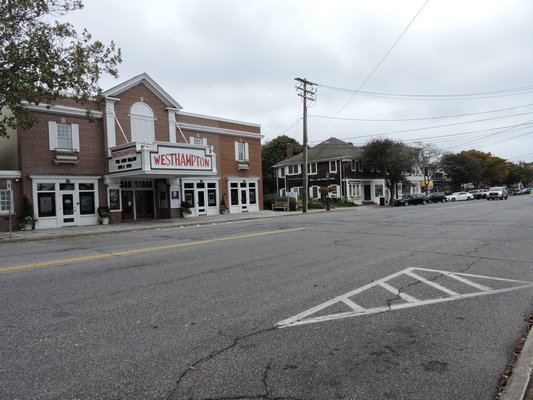
The Village of Westhampton Beach is scooping up the majority of that money, and will use it for two different projects: the main street improvement project, in which the village plans to replace a nearly 100-year-old storm drain system; and a brand new sewer district that will collect and convey 60,000 gallons of wastewater per day generated in the Main Street business district.
The sewer project includes pumping the wastewater to the existing Suffolk County wastewater treatment plant at Francis S. Gabreski Airport.
The village initially requested the full cost of the proposed sewer district, which is $15,068,000, but were awarded a fraction of that, at $1,130,000. Village leaders also requested $1,458,383 for the drainage project, and were awarded $1,238,922.
Both projects are expected to enhance water quality in and around the village—especially in Moniebogue Bay.
“We were elated to learn of the committee’s recommendations,” Westhampton Beach Village Mayor Maria Moore said in an email on Monday. “The amount allocated to the stormwater portion of the Main Street Project represents almost full funding. The amount allocated to the sewer project is just the amount we need to move forward with the next phase of the project, which is the engineering design plans.
“We asked for the full amount because we could be ready to break ground by the end of next year. And, it doesn’t hurt to ask,” she added.
Ms. Moore said that the village has two grant applications pending with the state for help funding the sewer project, and that she and the Village Board members plan to apply for more CPF funds next year, when it comes time to pay for the actual construction.
Since its inception, Ms. Moore said, the Village of Westhampton Beach has paid more than $30 million to the CPF fund and has received approximately $4.5 million in return.
The Town Trustees will be awarded $271,922 to use toward the management of Mecox Bay. In particular, the Trustees are looking to use the money to install real-time water quality monitoring, which in turn, could help them when it comes to determining when to open and close the Mecox Cut.
The Trustees regularly use heavy equipment to dig a trench that connects the bay and pond with the ocean. Opening the cut allows ocean water to flow in and out, flushing the bay and increasing its salinity, while also lowering the water level.
When the cut is closed—either naturally, or manually by the Trustees, using heavy machinery—it can sometimes result in flooded basements following heavy rainfalls in homes along the bay. Others prefer the cut to be actively closed to avoid erosion of the ocean beach in front of their properties. Some boaters, meanwhile, often want the cut closed in the summer to maintain water levels in the bay.
It’s up to the Trustees to balance those concerns; but up until now, nothing has ever been added to the Trustees’ book of rules—known as the “Blue Book”—to outline what they can and cannot do when it comes to opening and closing the cut. It has been done on a case-by-case basis.
The cost to open and close the cut costs the Trustees between $15,000 and $20,000, which is money they do not have in their budget.
Trustee Scott Horowitz was happy to learn that CPF money would be used to help in the Trustees’ efforts to maintain the bay.
“I’m very excited about this,” Mr. Horowitz said last week. “I’ve been pushing and pushing, and sometimes, I’ve felt like a broken record.”
Mr. Horowitz has been advocating for the Trustees to get a sustainable source of money to put toward water quality initiatives. He particularly has been pushing to get money to open and close the Mecox Cut.
Trustee President Ed Warner Jr. thanked the Town Board members at a board meeting on Tuesday afternoon.
“Taking this step and moving forward, I think is a great, great step,” Mr. Warner said, adding that he hopes it takes the politics out of opening and closing the cut.
With the CPF money coming to the Trustees, Mr. Horowitz said, they could then begin using some of their non-CPF revenue for projects like repairing degraded boat ramps that pose a danger to kids who like crabbing at them.
One area that people may take caution when crabbing or fishing in is Lake Agawam in Southampton Village.
The lake has been plagued by blue-green algae, or cyanobacteria, many summers in a row. Just this summer, the lake was deemed the most polluted water body on all of Long Island.
A big portion of that pollution comes from the fact that most of the village storm sewers drain directly into the lake.
In order to help rectify that, the Village of Southampton is slated to get $292,040 of the $3.5 million in CPF revenues to put toward drainage improvements.
The project calls for removing dated catch-basins at Oak Street and replacing them with new catch-basins on either side of the Southampton Village Volunteer Ambulance driveway. Along with that, new curb inlets will be installed along with piping to a steel culvert.
The village also wants to install 19 leaching pools along Jobs Lane, among other things, to accommodate a 2-inch rainfall.
The town’s Water Quality Improvement Advisory Committee, which was tasked with going through all of the applications and determining the amount of CPF money to be awarded, said in its report that “the stormwater infrastructure proposed is consistent with the [Lake Agawam Management Plan, 2009] and are expected to improve water quality conditions in the lake.”
Calculations provided claim the changes could result in a potential reduction of 28.2 pounds-per-year, or 42-percent in nitrogen loading, and a reduction of 4.8 pounds-per year, or 44-percent in phosphorus going into the lake
Another project awarded CPF money is a stormwater mitigation and aquatic habitat restoration at Round Pound in Sag Harbor.
The project calls for creating a stormwater sediment containment chamber system, rain garden with a bubbler system and open vegetated swale, a 12-foot-wide patch to allow for emergency services to access the pond for water rescues, the installation of birdhouses to establish a purple martin colony that will help control the mosquito population, the removal of 92-linear-feet of timber and aluminum bulkheading and the removal of 150-linear feet of paved surface at the west end of Middle Line Highway.
The town is expected to receive $187,000 for these improvements.
Additionally, the Hampton Hills Association is expected to take in $220,841 to install a bulkhead permeable reactive barrier that will assist with removing groundwater nitrogen before the water enters Shinnecock Bay.
The Village of Sag Harbor is also expected to get $264,000 to put toward stormwater collection and nonpoint source abatement and control.
“They all seem like good projects,” Mr. Schneiderman said. “Personally, I think [the committee] did a good job.”
Mr. Schneiderman said after spending $3.5 million on these projects, there will still be money that can be used for the septic system rebate program that allows those who upgrade to a nitrogen-reducing septic system to get money back from the CPF.
“We still haven’t exhausted that 20 percent at all,” he said. “Right now, the projects are recommended for funding. The town doesn’t have to approve them, but they can.“I think the board is likely to fund each project,” he added.


 Greg Wehner on Oct 11, 2018