


 1 Photo
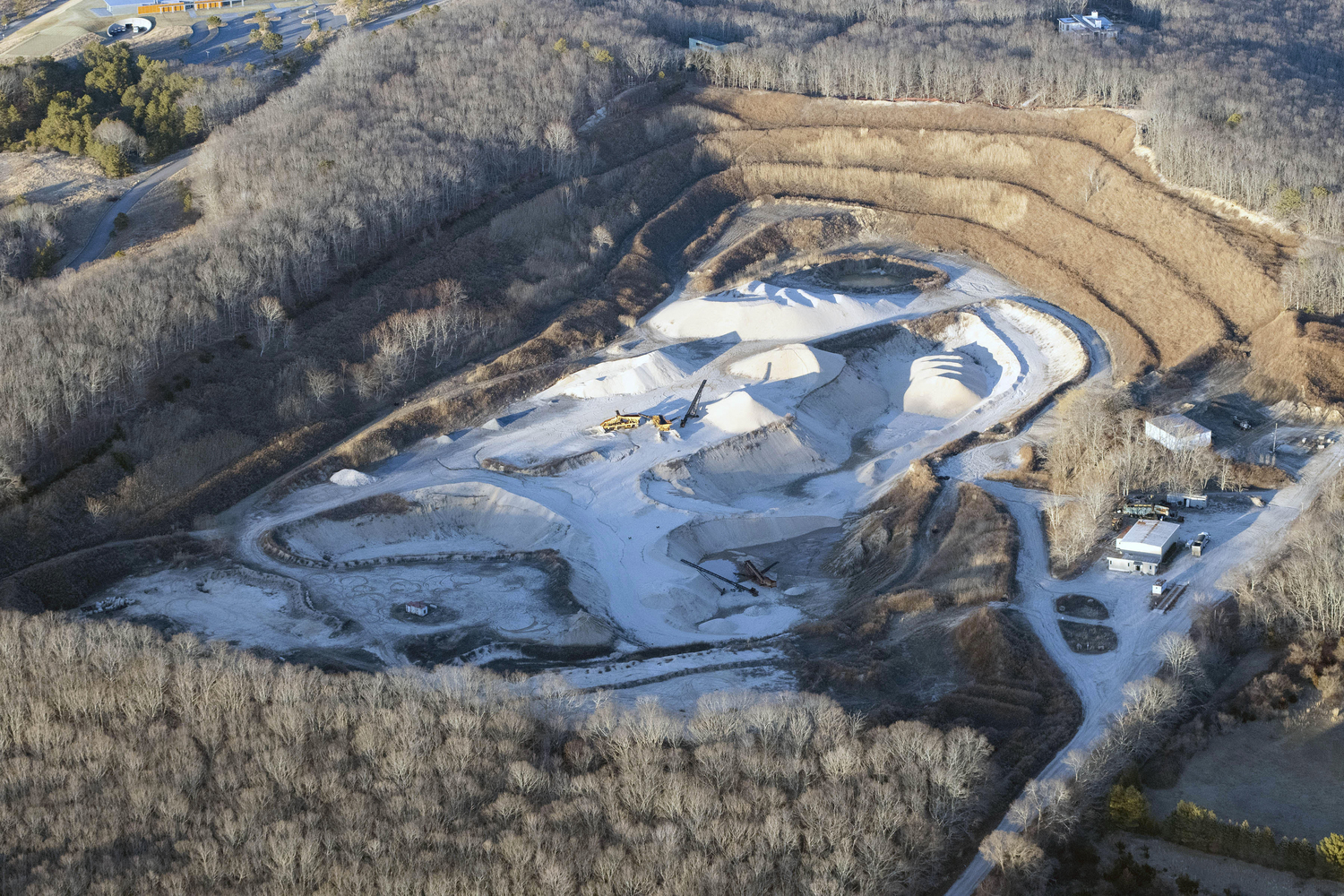
An aerial view of the Sand Land sand mine. DOUG KUNTZ
A measure that will effectively force the closure of sand mines in Southampton Town over the next seven years through an amortization process was passed by the Town Board on Tuesday, April 8, in a split vote.
Councilwoman Cyndi McNamara, who has raised questions about the proposal since it was introduced by Councilman Bill Pell last fall, cast the sole dissenting vote. Councilman Rick Martel, who was sworn in last week, abstained.
Councilman Michael Iasilli joined Supervisor Maria Moore and Pell in voting for the measure.
The legislation will require that mines in most residential zones that have extracted all of the sand allowed by their state mining permits to close within a year. Those that have sand left to mine would be allowed to petition the Town Zoning Board of Appeals for an extension of up to seven years — or longer, if they can prove they still have reserves — to exhaust their allotments.
Town officials have said seven mines would be affected by the ruling, although most of them are either inactive or being converted to other uses already.
Those mines being targeted include Sand Land in Noyac and the active East Coast Mines in East Quogue, which are owned by John Tintle through Wainscott Sand and Gravel. Tintle has battled the town in court for decades over his right to continue mining at Sand Land.
Battle lines were clearly drawn in the amortization debate when the board opened a hearing on the measure in December, with environmentalists and community groups offering support, saying mines pose a serious threat to groundwater supplies, and mine owners and contractors arguing against the law, which they said would unfairly target an essential industry that serves the building needs of the East End.
Even before the board took up the resolution on Tuesday, Elena Loreto, the former president of the Noyac Civic Council, an organization that has long sought the closure of the Sand Land mine, urged the board during the public comment period to adopt the amortization law.
She said the Suffolk County Department of Health Services had put in test wells around Sand Land and recorded elevated levels of pollutants in the groundwater around the mine. Tintle has vigorously rejected those claims for years.
But Loreto described the specter of pollution associated with the mine as a creature “that lives on its own, breathes on its own,” and is in danger of causing widespread harm.
“It’s traveling northwest,” she said of the pollution. “It’s just creeping along nice and slow until eventually it will overtake our aquifer.”
She urged the board to “put your heads together” and pass the law.
Before the vote, Moore said the town had outlawed new mines in 1983 and declared existing mines as nonconforming. “This law will allow us to eliminate nonconforming mine uses over time and bring all into conformity, so that everyone lives by the same rules,” she said.
McNamara, who, has raised objections to the amortization law from the time it was presented and all the way through the hearing process, again spoke out, reading from a lengthy statement that described the town’s slow and deliberate effort to amortize nightclubs starting in 2002 and compared it, to what she said was a rushed and biased effort to shut down mines.
She said when the board first took up the mine amortization law last fall, it didn’t know how many mines it would affect and did not include the town’s planning and development administrator, Janice Scherer, in its discussions.
McNamara faulted the process, saying the town ignored the impact on building trades, incorrectly assumed that mines had failed to submit required groundwater monitoring plans, and reversed course in determining that the law would not have adverse environmental effects, cutting short its review under the State Environmental Quality Review Act.
“Even if I could support this legislation, I could never support the process by which it got here,” McNamara said. “None of the adverse impacts has been studied — we don’t even know how it will impact our own budget. Heck, I can’t even tell you for certain which mines in the town will be affected.”
“Perhaps you told everybody there was going to be an extensive environmental impact review,” Moore responded, “but we said there was going to be a SEQRA review, so I don’t agree with a lot of things you said in your statement.”
Iasilli also differed with McNamara, saying the board makes efforts to collaborate and work through individual members’ concerns about legislation. “I don’t really think there was an issue with this process,” he said, adding that the legislation followed the guidelines of the town’s 1999 comprehensive plan to find new uses for mines. “I look at this as an environmental policy more than anything.”


 Stephen J. Kotz on Apr 9, 2025