


 3 Photos

Hampton Bays sophomore Milan Moraga competed in both the long and triple jumps. DANIELA DETORE

Village Prime Meat Shoppe in East Quogue gets ready for the Christmas season. AMANDA BERNOCCO
In an abrupt change of course, the Southampton Town Board on Tuesday night tabled a resolution that would have deemed the fourth version of a draft environmental impact statement for a proposed East Quogue luxury golf course resort complete.
The decision to hold off on approving the 473-page document, focusing on the potential environmental impact of the development dubbed “The Hills at Southampton,” also means that the first public hearing on the application, tentatively proposed for October 17 at the East Quogue Elementary School, has been pushed back indefinitely.
The board is expected to revisit the resolution at its next meeting on Tuesday, October 11.
Entering Tuesday’s meeting, the Town Board was expected to sign off on the environmental impact statement, which has been tweaked and updated by the developer, Arizona-based Discovery Land Company, over the past few months, in response to feedback from the town. But board members backed off when two members of the public expressed concerns over the document, insisting that it is still missing vital information.
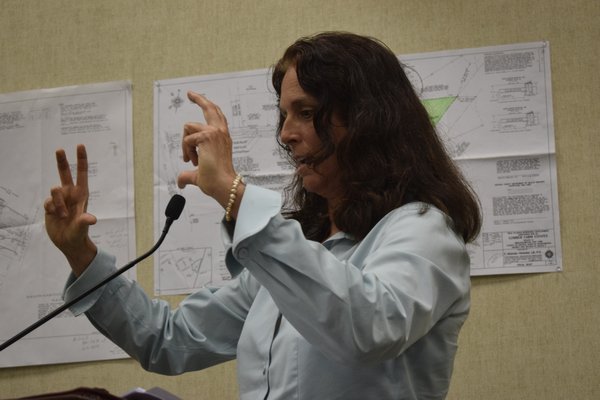
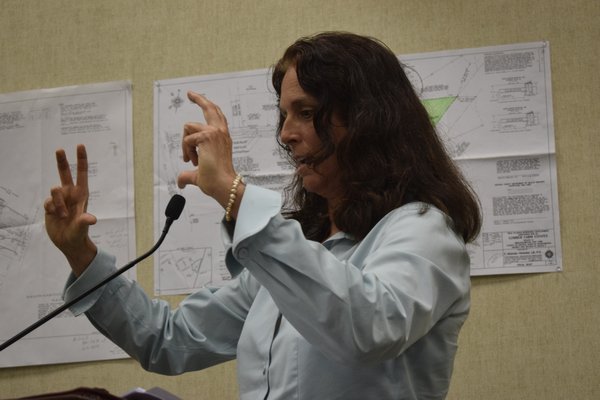
Carolyn Zenk, an environmental attorney from Hampton Bays and a former Town Board member, said the document still lacks required maps and, perhaps most important, does not include what the developer could construct as of right on the property.
While Discovery Land owns nearly 600 acres in East Quogue, most of its proposed development—which includes 118 residential units and an 18-hole golf course—would be centered on 168 acres near Spinney Road in East Quogue. The residential units would include 95 single-family homes, 13 clubhouse cabins and 10 clubhouse condominiums.
In order for the application to be approved, the Town Board would have to approve special zoning, called a planned development district, or PDD, as all of the targeted land is now 5-acre residential zoning—the most restrictive in the municipality.
“It’s missing probably the most critical thing that should be in that statement,” Ms. Zenk said, pointing to the lack of a reduced density alternative. “The town had a scoping document that spelled out what was supposed to be in the impact statement, and it made it very clear that the developer was supposed to provide maps at the same level of detail as the PDD submission.”
She added that having visual maps of zoning, as well as reduced impact and reduced density alternatives, are critical for members of the public to better understand what the developer can construct as of right.
“The maps are missing,” Ms. Zenk added. “Things had to be at the same level of detail as the PDD plan. That’s what you really need to go forward to the hearing … This is unacceptable.”
The Town Board hired AKRF Inc., an environmental, planning and engineering consulting firm out of Bohemia, to review the massive document. In August, when the board deemed the third version of the document incomplete, a report from AKRF stated that the finalized version must offer an alternate development, namely one that would require less grading and, as a result, have less of an impact on the environment. It also requested the inclusion of minor maps, tables and legends, as well as certain wording changes.
Town Supervisor Jay Schneiderman told Ms. Zenk that the town would consider getting more information about the as-of-right alternative.
“You feel, as a representative of an organization that has an interest in this [application], that you don’t have enough information that was submitted,” Mr. Schneiderman said, nodding to her affiliation with the environmental group Citizens for Clean Drinking Water, Clean Air, and Clean Bays, or CLEAN. “We get that. It’s something the board has to consider. We’re obviously going to have to know, with some detail what the as of right is. We appreciate you bringing that to our attention.”
Councilwoman Christine Scalera, meanwhile, said the developer adequately addressed that issue, pointing to plans to cluster all 118 residential units on the property.
“We were looking for what they could do as of right,” Ms. Scalera said. “Those details were, in fact, provided. I don’t know what you have been given access to. It will be on the website tomorrow morning. We did ask for those things to make sure they are in there.”
The town has since delayed the posting of the document since the board tabled the matter Tuesday night.
Mark Hissey, vice president of Discovery Land Company, said on Wednesday that he was surprised to learn that the document had not yet been approved.
“We were told by the town that it was going to be approved last night,” he said. “We were notified by them and they decided to table it for some reason. The reason for that you are going to have to get from the town.”
He later added: “I don’t see how they couldn’t have approved it. It’s mystifying.”
Mr. Hissey also said he expects the board to approve the draft at the meeting on October 11.
William Kearns, an East Quogue resident, took issue with the town originally scheduling the first public hearing for October 17, a scenario that would have given members of the public only two and a half weeks to review the document. “To ask the people of East Quogue to get their acts together in this time is not a level playing field,” he said.
Mr. Schneiderman countered that the town would hold between four and six public hearings on the application prior to voting—an assurance that did little to satisfy Mr. Kearns.
“I think starting it without giving people of the town adequate chance to prepare is not a fair thing to do,” he said.
Ms. Zenk said she was able to review the document’s latest revision on Tuesday after submitting a Freedom of Information Act request to the town clerk’s office. Other people in the community also pointed out this week that they were disappointed that the town was not releasing the document.
Councilman Stan Glinka also appeared perturbed that the resolution had to be tabled. “We’ll make this one provision, but we can’t keep doing this,” he said.
Staff writer Jen Newman contributed reporting to this story.


 Amanda Bernocco on Sep 28, 2016