



 3 Photos

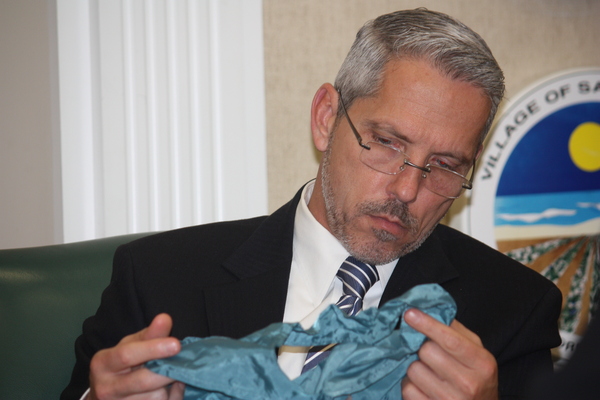
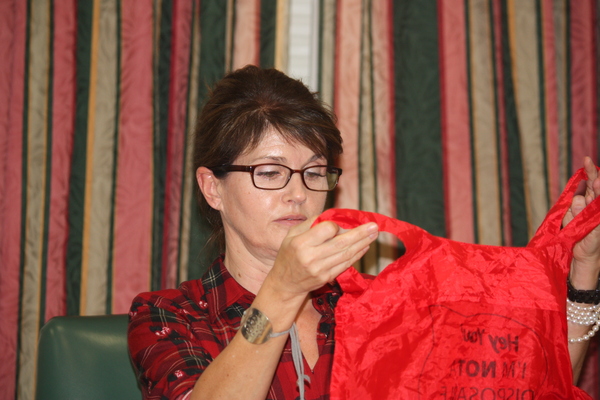
The Southampton Town Board on Tuesday voted down a measure to hold a public hearing on legislation that would ban retailers townwide from distributing most plastic bags at checkout.
The main concern by the majority—Republicans Chris Nuzzi and Nancy Graboski and Conservative Jim Malone—was that they first wanted businesses to pitch in on an educational campaign that would try to broadcast the benefits of using reusable bags before the town became the third South Fork municipality to enact a ban on the use of plastic bags. They said it was something members of the board and representatives of the food industry agreed to do in June at a Town Board work session.
“I thought we had all agreed at that time [that] prior to coming forward with a public hearing on an actual ordinance, we were going to go ahead and test the public education idea with the support of the retail industry—who are directly impacted, obviously, as are consumers,” said Mr. Nuzzi.
But Councilwoman Bridget Fleming, a Democrat, and Independence Party member Supervisor Anna Throne-Holst both said statistics show that educational campaigns on reusable bags don’t yield significant results. They also said the town’s sensitive coastal environment and marine life are at risk—a prime motivator for the ban. Plastic bags are often found trapped in trees or littering waterways, and they can be harmful to marine animals that mistakenly eat them or get tangled in them.
Ms. Throne-Holst said based on her correspondence with representatives from the industry this year, they would be willing to fund an educational campaign only if it meant the town was not going to proceed with a plastic bag ban—terms she was unwilling to accept.
“I’m not going to make that promise to them,” Ms. Throne-Holst said. “I’m not going to say to them, ‘OK, industry, we’ll work with you on an education program, and we’ll never, ever put this ban in place.’ That’s what they’re asking us to do.”
But the majority board members contested the supervisor’s assertion. Based on an email addressed to the Town Board from Patricia Brodhagen, vice president of Public Affairs at the Food Industry Alliance of New York State, the grocery industry is committed to a “collaborative educational pilot program, including data collection so that results can be measured, as an alternative to legislation …” The email was provided by Ms. Graboski.
Ms. Throne-Holst said an educational campaign could be managed by the town six months before a ban would go into effect. During that time, the town’s energy and sustainability coordinator, Lizabeth Plouff, would work on the “nuts and bolts” of the program, including reaching out to retailers, handing out free reusable bags, and broadcasting messages through various media, including SEA-TV, the town’s government access channel.
Board members became ensnared in a lengthy argument about whether to go ahead and schedule a public hearing—often talking over each other—before they finally voted on the resolution.
Southampton Town is the third municipality on the East End to explore banning plastic bags. Southampton Village was the trendsetter, enacting a plastic bag ban in April that went into effect in November. East Hampton Village followed suit shortly after with a vote in July; its ban will go into effect in late January
Town officials have been mulling the initiative since early this summer. The proposed law mirrors Southampton Village’s legislation, mandating that retailers must provide reusable bags and/or recyclable paper bags at checkout. Those in violation of the law would face fines of $100 to $250. There was also a six-month grace period between when the ban is enacted and when it would go into effect.
The measure was the subject of a Town Board work session meeting on Friday afternoon. The chairman of the town’s Sustainable Southampton Green Advisory Committee, Tip Brolin, showed a short video outlining the environmental hazards of plastic bags. The video quoted a number of statistics, noting that the people in United States use 100 billion plastic bags per year, and that more than 100,000 marine animals each year die from discarded bags.
Thomas K. Cullen, vice president of government, industry and public relations for King Kullen Grocery Co. Inc., said his company opposed the proposed legislation. Paper costs more than plastic, he said, and he was worried about the “economic consequences of the bill.” The company owns three stores in Southampton Town.
Residents interviewed on Tuesday morning outside the Waldbaum’s supermarket in Southampton Village were mixed in their opinions on the village ban. Some said they absolutely hated it, while others said they had gotten used to it.
“I think it’s stupid,” said Margie Morris of Southampton Village. “People make it sound like it’s so damaging to our country, but it’s really not.”
Another person described the absence of plastic bags as “awful.” One person said he missed them.
“You can put that in capital letters: miss those plastic bags,” said Jerrold Fuller, who works at the Hamptons Center for Rehabilitation and Nursing in Southampton.
Other residents said they believed in the environmental reasons behind banning plastic bags.
“I love it,” said Gayle Reisig, a Southampton resident. “I used them [reusable bags] before we had to. I think people are just not thinking in the long term.”


 Rohma Abbas on Dec 9, 2011