


 1 Photo
Southampton Town officials have sent a letter to the Suffolk County Planning Commission, asking its members to take action on the revised Tuckahoe Center application beyond simply labeling it as “incomplete.”
A letter dated November 3 from James Burke, the town attorney, was sent to the commission in response to concerns its members raised last month on a proposed change of zone that would allow for a retail shopping plaza, with a supermarket at its center, along County Road 39 in Tuckahoe. The Town Board, which would be charged with granting zoning change, had referred the application to the commission for an opinion first.
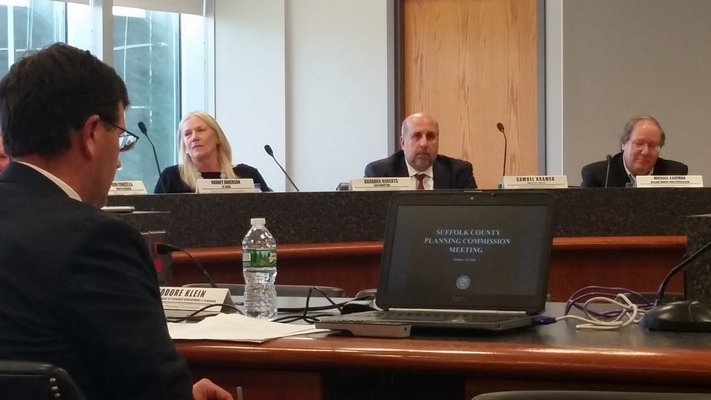
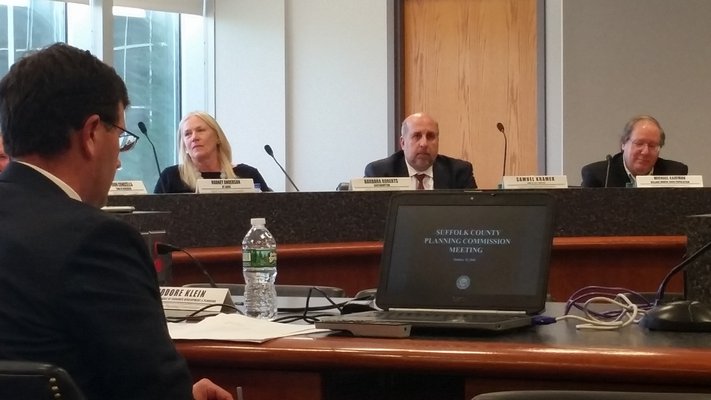
In the letter, Mr. Burke notes that the commission’s authority permits three actions: approval, modification or disapproval. But at their October 11 meeting, commission members deemed the application “incomplete,” concluding that it lacked essential information to allow for a final ruling.
Members said they wanted more information on three points: traffic concerns raised by Southampton Village officials; confusion over the latest application by Southampton Venture LLC and whether it amounts to a revised version of an earlier application, which was rejected by the commission, or a new application; and concerns about litigation filed against the commission by developer Robert Morrow of Southampton Venture, and whether the recent dismissal of that lawsuit would be appealed.
But Southampton Town Supervisor Jay Schneiderman said that Mr. Burke’s recent letter to the commission explains that all three concerns have already been addressed—meaning that there is no reason for the application to be deemed incomplete.
“They said they needed certain things—the town attorney’s office responded,” the supervisor said. “We’re asking [the commission] to do their job, and we’ll deal with it after they do.”
When reached on Monday afternoon, Planning Commission Chairwoman Jennifer Casey declined comment, explaining that she has not yet read the letter from Mr. Burke. She also said she expects her commission to revisit the application at its December meeting.
Mr. Burke’s letter attempted to clarify the three issues red-flagged by the commission. Southampton Village officials spoke at the commission’s October 11 meeting articulating their concerns regarding zoning and traffic, stating that the application would exacerbate already heavy traffic along County Road 39. In his response, Mr. Burke stated that village’s comments should never have been considered because the application falls “more than 500 feet from the municipal boundary,” meaning that it should be in the town’s purview, not the village’s.
Additionally, according to the Suffolk County Planning Commission Guidebook, only materials received directly from the referring municipality—in this case, the town—are permitted as part of a referral, Mr. Burke argues in his letter. He also said that all village concerns should have been conveyed through town officials. “Thus, without the requisite standing, the village’s communication should not have been considered by the commission since it was not forwarded by the town in its capacity as the referring municipality,” Mr. Burke wrote.
He also rejected the idea that there are two active zoning change applications for the property, a 7.26-acre lot on the southeastern side of County Road 39, near the Magee Street intersection, that is actually made up of four adjoining properties. For the application to move forward, the town would have to alter the zoning on three of the lots from highway business to shopping center business zoning, while the fourth lot—a 50 foot buffer zone that adjoins the northeastern side of Magee Street—would have to be changed from residential to shopping center business zoning.
The changes would clear the way for a supermarket and additional commercial space in three buildings. Under his revised plan submitted to the town this summer, Mr. Morrow has agreed to reduce the overall size of his development by about 10 percent and is now looking to build a 38,000-square-foot grocery store and three buildings offering 14,500 square feet of commercial space. The revision also eliminates a proposed drive-through for one of the smaller buildings, increases the landscaped area by 13,000 square feet, and it increases the number of parking spots from 249 to 257.
“There is one change of zone application pending, and no evidence in the record to suggest the contrary,” Mr. Burke wrote.
In December 2015, the Planning Commission rejected an earlier version of the proposal. A revised site plan was submitted in August by Mr. Morrow and that is the one that calls for a 10 percent reduction in total building space, to 52,500 square feet.
Regarding recently dismissed litigation filed by Mr. Morrow, alleging that two of the commission members who rejected his application should have recused themselves due to personal bias, Mr. Burke wrote that the status of that case should have no bearing on the commission’s actions. “Litigation against your body has no impact or consequence on the referral before you,” he wrote. Mr. Morrow has until the middle of November to appeal that ruling if he so chooses.
Mr. Morrow said he agrees with the letter sent by the town, adding that he also does not understand why commission members are reluctant to make a ruling. “We don’t know why the commission took the stance they did on the issues,” he added.
The town has asked the commission to take action within 45 days of receipt of Mr. Burke’s letter dated November 3.
The Town Board, which is tasked with considering the change of zone, would need a supermajority vote—meaning four of five members must sign off on the application—if the commission rejects the application. If the commission signs off, a simple board majority would be needed to alter the zoning, allowing Mr. Morrow to move forward with his plans.
“It comes back to the Town Board one way or another,” Mr. Schneiderman said. “Their decision will impact how high the bar is that has to be jumped over by the applicant. It sounds like they’re kind of at a deadlock over there.”
The supervisor said he is still unsure how he will vote when the application comes before his board, noting he was not a member when the original application was up for consideration. “I’ve never had a single public hearing on it,” he said. “I’m not sure how I would vote. I will reserve judgment until I hear what the public has to say.”
An online petition opposed to the project now being circulated by Group for the East End, an environmental advocacy group, had garnered nearly 130 signatures as of earlier this week.


 on Nov 4, 2016