


 1 Photo

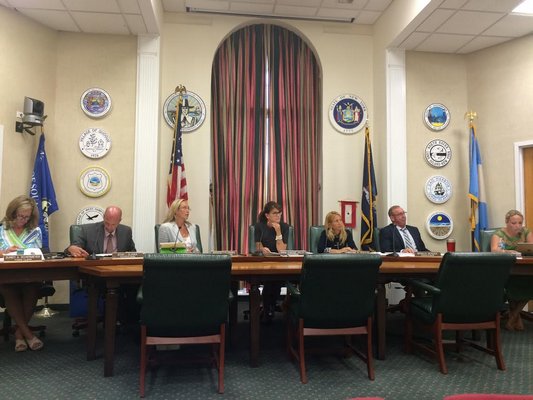
Southampton Town Board listens to Laura Smith, president of the Civil Service Employees Association, regarding the settlement between the union and town. JEN NEWMAN
A reactive barrier could be installed at Iron Point Park in Flanders, if Southampton Town seeks, and wins, a state grant, a potential test case for a way to cut down on nitrogen flowing into local waterways.
If the town decides to move forward, it would join forces with Cornell Cooperative Extension to apply for the grant through the State Water Quality Improvement Project. The grant would partially fund a permeable reactive barrier, made primarily of wood chips, to collect nitrogen flowing underground into the bays.
At a Southampton Town Board meeting last week, Matthew Sclafani and Ron Paulsen of the Cooperative Extension presented basic parameters of the proposal, which would entail installing a roughly 200- to 400-foot-long wall, buried completely in the ground, at an estimated $500,000 cost. The walls would be 4 feet wide, and as deep as 40 feet. Installation would take one or two weeks.
The wood chips in the wall act as a carbon source that creates a bacterial reaction, removing nitrogen. The structure would be used as a research tool so Cornell scientists could determine its effectiveness, with an eye toward the potential for future installations elsewhere on Long Island.
“Nitrogen is a big problem,” Mr. Sclafani said. “It is a primary pollutant of concern, and it is generally agreed that it is a good indicator of the health of the watersheds, but it is a complex issue that requires a high level of understanding and takes a high level of commitment and planning,” he said. “And that is what you are all doing, and I commend everyone here for trying to take a stab at this so early on in the game.”
According to the report given by Mr. Paulsen and Mr. Sclafani, nitrogen is one of the primary pollutants found in the Peconic Estuary, and it is hurting local ecosystems. Increased nitrogen has been linked to hazardous algae blooms and fish die-offs, and without remediation could lead to serious ramifications for both local wildlife and the town’s drinking water supplies.
That is why town officials want to act now. The grant proposal must be submitted by the end of this month, and if approved it would allow for a pilot permeable wall, which is smaller than a typical wall, to be installed at Iron Point Park.
“It is trying to treat the problem at the source,” Town Supervisor Anna Throne-Holst said, “doing something to mitigate it.”
The walls work by acting as a barrier between contaminated groundwater and clean water, but serve to solve only one part of the nitrogen problem. Mr. Sclafani explained to the Town Board that eventually, steps will have to be taken to reduce the amount of nitrogen being introduced to the groundwater, but said it is difficult to do.
Mr. Sclafani said last week that Iron Point Park would be an ideal location for the testing. Surrounding waters have been found to be contaminated with nitrogen, and in June tens of thousands of bunker fish died in Flanders Bay, possibly because of an excess level of nitrogen in the water. Mr. Sclafani also noted that scientists would be able to easily access the area for monitoring, and that it would have little negative impact on the surrounding ecosystem.
The first step of the research process would be to install approximately 26 monitoring wells in Flanders so researchers could record nitrogen levels at different depths and distances from the bay, checking the same levels after installing the wall. Soil samples would also be collected. The initial research would be done in the off-season.
“The data collected from the wells will be used to determine site suitability and provide features to design the reactive barrier,” Mr. Sclafani and Mr. Paulsen wrote to the board. “Cornell will be working with an experienced licensed design and installation professional for the reactive barrier.”
If funding permits, Cornell hopes to install two of the reactive barriers in different parts of Iron Point to observe how the walls affect different levels of nitrogen contamination, and would use a different carbon source in the second wall.
Cornell would monitor the site monthly for the first two years, and then on a regular basis. In other locations, similar walls have remained active and effective for several decades after the initial installation.
At the end of two years, Cornell will provide the town with a study detailing the results so decisions can be made about future installations.
“It is a good funding opportunity and we hope the town will take full advantage of this to help with these remediation efforts,” Mr. Sclafani said.


 Erin McKinley on Jul 8, 2015