



 5 Photos


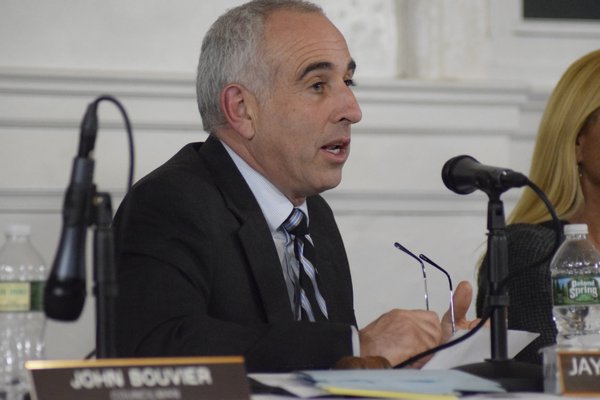


John Moran was hired this week as a safety consultant for Bridgehampton School. AMANDA BERNOCCO
Both Southampton Town’s supervisor and its incoming police chief say it is unlikely there will be any changes to the police department’s policies as far as immigration is concerned.
But Town Supervisor Jay Schneiderman said this week that he intends to discuss formalizing the town’s policy to make its position clearer for the public—including the undocumented immigrants who will be affected most by it.
Both Mr. Schneiderman and incoming Southampton Town Police Chief Steven Skrynecki stressed that they believe maintaining a good relationship with the town’s immigrant community is important—although the supervisor noted that he has no intention of making Southampton a “sanctuary town” that refuses to cooperate with Immigration and Customs Enforcement, or ICE.
“We are going to cooperate with the federal government, but we’re not going to do the federal government’s job,” Mr. Schneiderman said. “Our job is to keep people safe. If they are looking for someone who is a violent criminal, we will cooperate and assist. If someone is on administrative hold, we will inquire as to why and might hold them for an additional hour or two if there is a judicial warrant.”
Earlier this year President Donald Trump directed his administration to enforce the nation’s immigration laws more aggressively to locate, arrest and deport those in the country illegally, regardless of whether they have committed serious crimes, which has sparked concern throughout the country and on the East End of Long Island.
“Everybody is obviously concerned with changes on federal policy and how it will impact us,” said Mr. Skrynecki, who will formally take over as police chief on March 16, and has been serving as a consultant to the Town Police since January. “We want to continue to enjoy a strong relationship with the community—and that intel of people who are undocumented. We want them to feel free to be comfortable reporting a crime. It is very important to us to continue to maintain the level of cooperation and understanding.”
The longtime policy of the police department, according to Mr. Skrynecki, has been to cooperate with ICE agents as much as legally required. He said when officers encounter individuals in a routine circumstance—for instance, when giving a traffic ticket—it is Town Police policy not to inquire about their immigration status. In general, the town has declined to deputize its police force to help enforce federal immigration policy.
However, if a person is under arrest or is a suspect in a “very serious crime,” such as a robbery, rape or murder, Town Police will ask about that person’s immigration status as part of a standard investigative workup, Mr. Skrynecki said. Then, he said, police would inform ICE agents if there is a problem with that status.
The incoming chief noted that if Town Police receive a specific request from ICE to assist in an arrest, they would comply if there was a court-ordered warrant for the individual “in the interest of public safety.” However, he said the town would not take the lead on the investigation.
“We’re duty-bound to take action,” Mr. Skrynecki said. “We have no leeway—we must enforce the warrant.” He later noted that those types of requests from ICE are “infrequent” in Southampton Town.
Depending on the case, if Town Police receive a request from ICE to hold someone the department has arrested, he said, the town would ask ICE officers for details about why and would typically hold the person for only “a few hours,” not 48 hours, which is the maximum time they are federally allowed to be detained.
When asked what he would say to those in the immigrant community in Southampton Town, Mr. Skrynecki urged anyone who does not have legal status to pursue legalization “as fast as they can” and to maintain a clear criminal record, as ICE agents are considerably more active in picking up people with criminal records.
“We want them to understand that we cannot and will not condone unlawful activities,” he said. “It is first our job to enforce the law—and we will.”
Minerva Perez, a Sag Harbor resident and the executive director of Organización Latino Americana, said she is working to schedule a meeting with the supervisor and new police chief to discuss community concerns about the policy. Many residents asked at the last Town Board meeting for the board to make a public statement against Mr. Trump’s deportation policies to ease the concerns of illegal immigrants in the community. Ms. Perez said she sees continued meetings with the town as a step in the right direction.
“Any conversation is a good conversation,” she said. “There is an imperative here. People are really hurting—children are getting sick. They are not going to talk to the press, even with a fake name—even with a bag over their head—because they are so scared.”
The Reverend Stephen Grozio, a North Sea resident and part of the Spanish Apostolate at the Basilica of the Sacred Hearts of Jesus and Mary in Southampton Village, urged the Town Board at a February 28 meeting not to cooperate with ICE agents—noting he has seen fewer cars on the road recently out of fear.
“The Hispanic immigrant population here is a population that has three main values: family, faith and hard work,” Rev. Grozio told the Town Board. “… I know the people well, and I’ve never seen them so afraid as they are now … I ask the board members to stand with our hard workers, our families, our immigrant population, and not to in any way cooperate with the possibility of dividing families and of hurting our people.”
Lucius Ware, a longtime resident of Southampton and the president of the Eastern Long Island chapter of the NAACP, noted that the local, state and national NAACP stood behind the group of residents asking for the board to take action at the February meeting.
“Right now, I want it clearly known that we have not heard enough from this board,” he said. “These are the people that hire the police chief. The police chief does what you want him to do.”


 on Mar 8, 2017