


 1 Photo
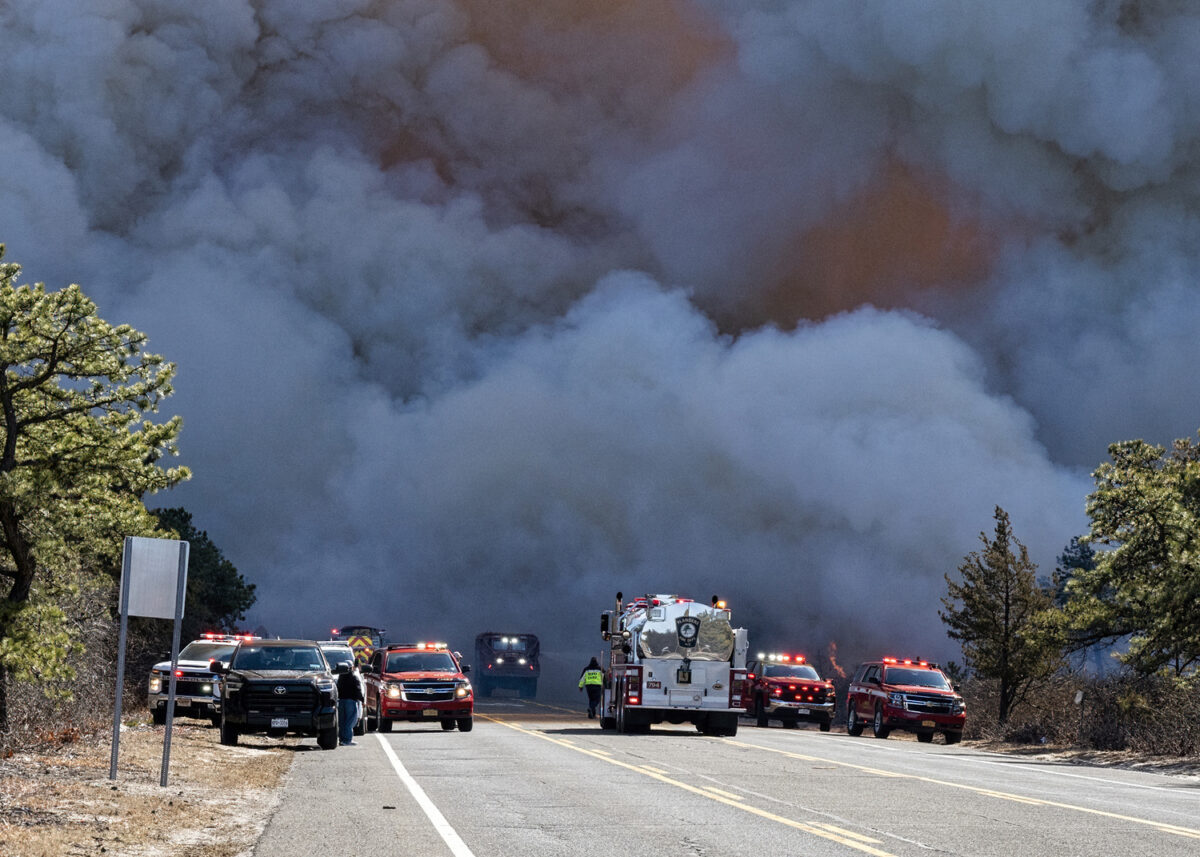
Over 90 fire departments and emergency services agencies battle a wildfire on Saturday in Westhampton Beach. COURTESY WESTHAMPTON BEACH FIRE DEPARTMENT
As with every emergency, Saturday’s wildfire in Westhampton proved to be a learning experience for Southampton Town’s leaders and emergency managers.
Some officials say it has shed light on some relatively simple, and possibly easily improved, steps that could have been taken to better coordinate the massive response and to keep the public informed in such a frightening and rapidly evolving scenario.
Saturday’s events were especially harried and confusing because of the speed with which the emergency situation exploded to urgency, the size of the response and, fortunately, the speed with which it effectively ended as the fire was mostly brought under control by Saturday evening.
But with the Los Angeles wildfires still fresh in many minds, residents of the neighborhoods that could see the billowing black smoke blowing toward their streets were understandably concerned for their personal safety and that of their homes and loved ones.
Residents from East Quogue to Eastport who were scattered about the region for Saturday activities wondered in text message groups and social media threads whether their neighborhoods were being evacuated and whether the fire actually threatened their homes.
No evacuation orders for residential areas were ever issued. But — in what has become the defining hallmark of our hyper-interconnected world — incorrect information spread quickly, leading to moments of confusion and panic.
Some town officials say that they wished the town could have used its Notify Me emergency communications system more frequently and effectively to quell rumors and incorrect information, reassure residents that there was no imminent danger, and let them know that if there was to be an emergency order that applied to them how they would be informed.
“I was at my house — you saw the smoke, you knew it was generally coming toward you, based on the wind direction — but there was nothing coming from the town, there was nothing on the town website, at least about where the fire was,” Town Councilwoman Cyndi McNamara, who lives in East Quogue, said on Monday. “I had people calling and saying they had ashes falling in their backyards and could smell smoke and didn’t know if they should evacuate. I got calls from people in North Sea calling me asking if they needed to be worried.
“They should be able to turn to the town and find out what’s happening right away,” she added. “We can do better. We will do better.”
McNamara, who is the Town Board liaison to the town’s emergency management services, said that an easy change to the town’s alert system would be to give emergency managers who are the boots on the ground in such situations the ability to control the town’s public notification system. Currently alerts from the Notify Me system and posts on the town website have to be made through the Citizens Response Center, which has a staffer on-call on weekends but not necessarily sitting by a phone waiting for immediate instructions 24 hours a day.
“Some people have emergency functions built into their jobs and a lot don’t — so if I need to evacuate a neighborhood at 2 a.m. or on a Saturday, there isn’t necessarily an expectation that someone who works a 9-to-5, Monday to Friday, is going to be available to do that at a moment’s notice,” said Ryan Murphy, the town’s public safety and emergency management administrator. “Someone in my job does have that expectation.”
He said that McNamara’s idea to give the ability to send out alerts to whoever is in his post, or to the top brass of the Southampton Town Police Department, is sound one that will take some figuring out, but should be possible.
Councilman Michael Iasilli echoed McNamara’s desire to see alerts come more frequently, even if they are just to reassure that no immediately action is needed.
“We want to make sure the public is getting information in real time,” he said. “Thank goodness for [the press], who were in touch with Ryan and emergency personnel and able to update the public in this instance, but we need to be able to communicate effectively as well.”
Murphy also said that the hectic scramble to plug-and-play personnel from the 80 individual fire departments and other emergency agencies that flooded into the region to fight the fire led to some moments of confusion about who was where — even as the response proved incredibly effective.
“We’re all on different [radio] frequencies out here, and we need to get into the habit of switching down to the national frequencies,” he said of the federally maintained frequencies that were put in place to allow multiple emergency departments to communicate on the same channels — a system that he noted has to be organized in itself as well. “So we have the helicopters from the 106th dropping water, which was great and was pivotal in getting the fire under control, but we didn’t know who was under them when they were doing that, so we could have had a better handle on that.”
But overall, officials celebrated the response on Saturday.
Town Supervisor Maria Moore said that the town’s communications system had actually worked well beyond a brief period when an announcement about the fire had not loaded correctly and didn’t display in the links sent to Notify Me users. The town website early Saturday had communicated that a state of emergency had been declared and that first responders were tackling the problem.
Evacuations, she noted, are the most dire of steps to take and if the danger had reached that level notifications would have been loud and clear – and at the front doors of every home in danger.
“Now that the emergency is over, we can sit down and look it all over and think about how to improve communication,” she said. “There’s always room for improvement.”


 Michael Wright on Mar 14, 2025