


 1 Photo
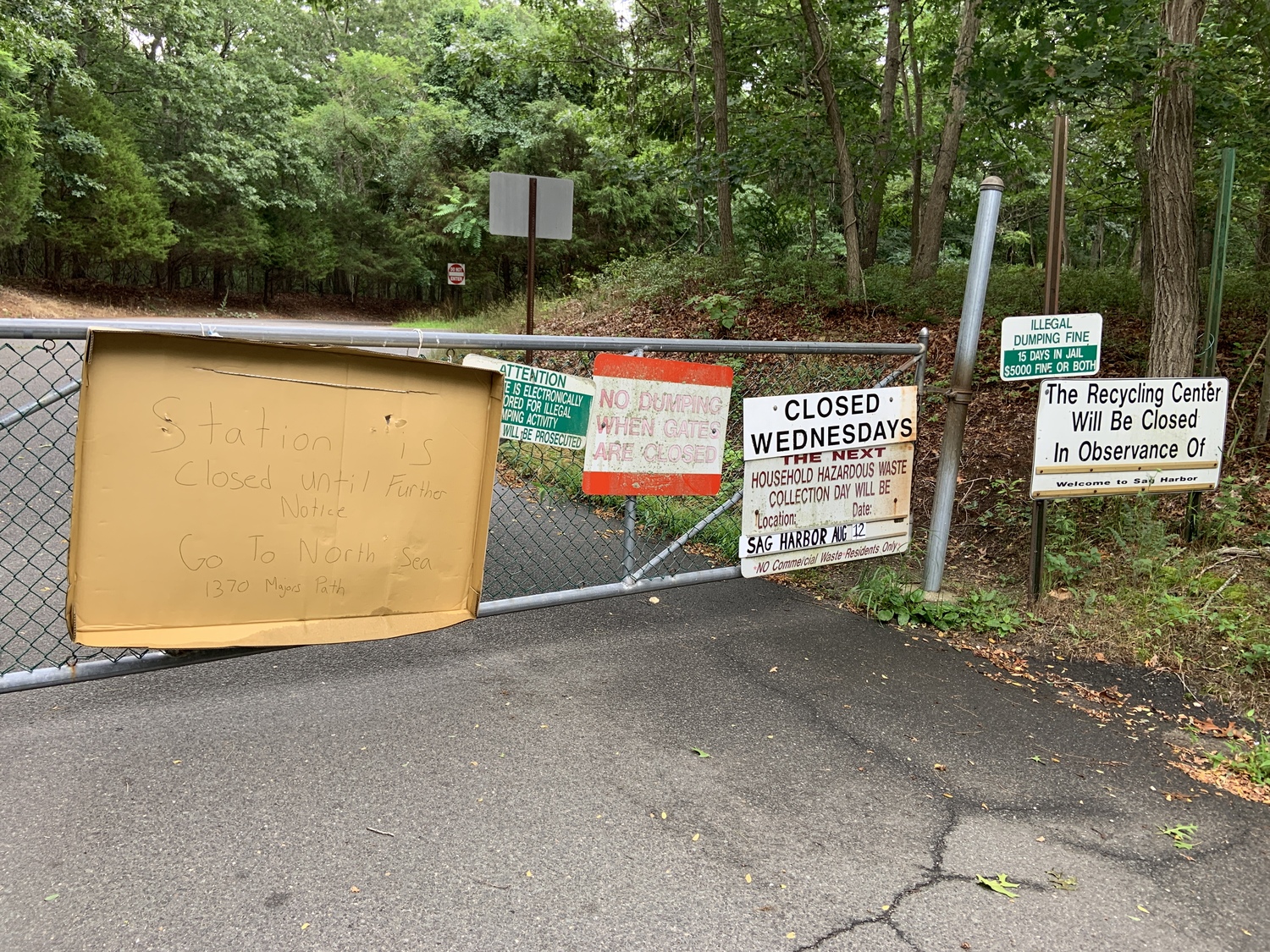
A hand-lettered, cardboard sign at the Sag Harbor transfer station directs self-haulers to North Sea. STEPHEN J. KOTZ
Southampton Town’s transfer stations, most of which were closed over the weekend and early this week due to what officials have called “a perfect storm” of truck breakdowns, have begun to reopen.
Town Engineer Tom Houghton said the Hampton Bays transfer station had reopened on Tuesday, joining North Sea, which remained open during the short crisis.
The Sag Harbor station, which is closed on Wednesdays, will reopen on Thursday, and Westhampton, which was scheduled to be closed most of this week anyway for curb repairs, should be back in business by Friday, Houghton said.
“Never in my wildest dreams did I think we’d lose two trucks in one day,” Houghton said of the backup that began Friday.
One of three semi-tractors the Waste Management Department owns was already in the shop for repairs when the two remaining trucks broke down. The department was already short one semi-tractor, a 2018 Mack, the newest in its fleet, which was destroyed in a fire at the North Sea transfer station in April. A second truck, used to deliver large roll-off containers, also was destroyed in that blaze.
By Saturday morning, when the large trailers used to collect garbage and recyclables were filled — and were unable to be emptied because of the lack of trucks — the transfer stations began to shut down.
In Sag Harbor, an attendant patiently explained to a steady stream of self-haulers that they would have to go to North Sea, and that the Sag Harbor station would be closed until further notice. By Sunday, the attendant was replaced with a handwritten cardboard sign directing residents to head to North Sea.
Some people, who brought their recyclables to North Sea on Sunday, said they were shocked that all waste was being dumped into the bay for bulky items, because all trailers there had been filled.
“That was on Sunday only,” Houghton said. That commingled waste was shipped off as nonrecyclable garbage on an emergency basis, he said.
Supervisor Jay Schneiderman said the situation was beyond the town’s control and not the result, as some people seemed to believe, of the town underestimating the amount of garbage the transfer stations would take in on a busy summer weekend and the amount of manpower required to cart it away.
“I certainly apologize for any inconvenience this has caused,” Schneiderman said on Monday. “It’s unusual to have two vehicles go down together. I inquired to see if it was anything suspicious, or if was just an unfortunate situation.” He said he was told it just seemed to be a case of bad luck.
“I instructed Tom to do whatever it takes to get the garbage hauled away,” Schneiderman said.
By Tuesday, Houghton said he had rented one semi-tractor and was looking for more, so the backup could be cleared.
The Town Board will hold a special meeting at 10:30 a.m. on Thursday morning to authorize more truck rentals.
Councilwoman Cyndi McNamara, who said she learned of the closures on Facebook on Sunday, said the town has money earmarked for new vehicles and trailers.
“We have the money to buy the trucks — it’s sourcing them that’s the issue,” she said on Monday. “This is not like going out and buying a F-150.”
Houghton agreed, but added that since the pandemic, prices have also surged. Large trailers equipped with compactors that once sold for about $90,000 now command about $175,000, he said.
Southampton requires that self-haulers buy green bags for nonrecyclables, which currently cost $17.50 for a five-pack of 33-gallon bags or $9.75 for a five-pack of 13-gallon bags. The cost of those bags roughly cover the cost of disposing of the garbage, Schneiderman said.
The town also collects commingled containers, such as plastic jugs, beer cans, and glass soda bottles, which it ships out separately and pays to recycle, he said. The same is true for cardboard and mixed paper, which are sometimes separated and sometimes shipped out together, depending on market conditions.
Schneiderman said about 10 percent of the town’s residents use the transfer stations, but he added that many use them only to dispose of recyclables. As a result, he said the program, which is supposed to break even, is a money loser.
“We are paying a lot of money to get rid of commingled containers,” he said. “I don’t know how long we can keep doing this.”


 Stephen J. Kotz on Jul 17, 2023