


 3 Photos
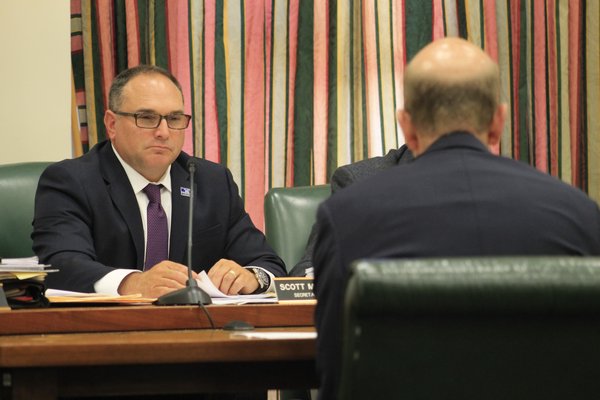
Southampton Town Trustee Scott Horowitz talks to Southampton Town Comptroller Leonard Marchese on Monday afternoon. KYLE CAMPBELL
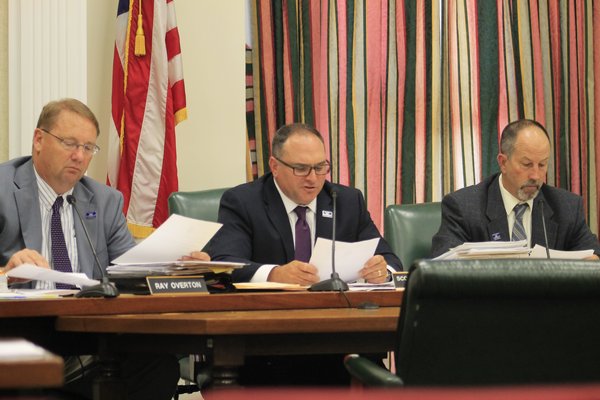
Southampton Town Trustees Roy Overton, left, Scott Horowitz and Ed Warner Jr. during Monday afternoon's meeting. KYLE CAMPBELL
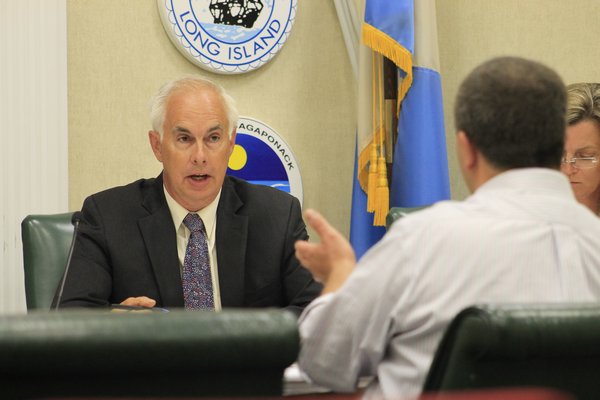
Former Southampton Town Trustee President Eric Shultz earned enough votes during the June 25 primary election, to run on the Democratic Party line for Trustee in November. PRESS FILE
The Southampton Town Trustees on Monday adopted a spending plan for the final five months of the 2015 fiscal year, the first budget in the board’s 329-year history.
The adoption of the $432,171 spending plan, which draws heavily from the board’s fund balance, is intended to underscore the desire of Town Trustees to bring greater transparency regarding their income and expenses, and also improve the oft-strained relationship between them and the Southampton Town Board.
“It’s a really good way to start a conversation with the Town Board when we ask for funds … because they can see our income, our expenditures and why we ask for certain line items that we cannot facilitate as far as funding,” Town Trustees President Ed Warner Jr. said during Monday’s meeting.
“It’s a good conversation starter,” he continued, “and this way everybody in the town gets an understanding of our revenues—how we take them in and spend them.”
Southampton Town Comptroller Leonard Marchese, who is being contracted by the Trustees as per a shared services agreement reached with the town in April, signed off on the budget. He stressed, however, that such a spending plan would not be sustainable in the long run, because the vast majority of the revenue—$361,771 out of $432,171—comes from the board’s reserves, as opposed to new income.
Mr. Marchese pointed out that this six-month spending plan is not indicative of a normal, full-year budget because the vast majority of the Trustees’ revenue comes from fees collected at the beginning of the year. Unlike other governing bodies, the Trustees cannot levy their own taxes.
“It’s not a true reflection of an annual budget because of the seasonality of your collection,” Mr. Marchese said. “I think once we adopt this, we should immediately start the work on next year’s budget and adopt a whole-year budget in November or December. That will be a much better picture.”
The Trustees’s two biggest line items for the remainder of the year are legal fees, for which they set aside $130,000, and contractual obligations to the town, which come in at $115,171. The third biggest expense is $72,000 for outside contracts. Trustee Scott Horowitz, the board’s secretary and treasurer, said the Trustees might have over-budgeted some expenses as a precaution, pointing to legal fees as an area of possible savings.
Mr. Horowitz estimated that the Trustees would have between $600,000 and $650,000 left in their reserves at the end of the year, assuming that they spend the full $361,771 from their fund balance.
Some of that money could be replenished if the town releases funds collected for Trustee-owned roads to the Trustees, a possibility that was discussed by the board and Mr. Marchese on Monday. Mr. Horowitz, who estimated that fund to be at $300,000, said the money would be used to plow and maintain Trustee roads, such as Canoe Place Road in Hampton Bays.
After two rounds of debate—both highlighted by staunch opposition by Trustee Eric Shultz—the Town Trustees unanimously agreed to contract with Automotive Rentals Inc. in New Jersey for fleet management services in an effort to streamline boat repairs.
Automotive Rentals Inc., or ARI, has a contract with New York to manage vehicle fleets for municipalities throughout the state. The Town Board had already agreed to contract with ARI for the town’s land vehicles.
When a boat is damaged, the Town Trustees can now take it to a repair shop, have that vendor provide a repair estimate to ARI, and the company will then let them know if the price is fair. John MacDonald, the town’s purchasing agent, said the agreement would save the Trustees a tremendous amount of time compared to the normal process of seeking bids and eventually selecting the lowest one.
“With ARI, it could be done in under an hour compared to two months to go through the bid process,” Mr. MacDonald said.
Mr. Shultz was skeptical of the agreement, fearing that because no boat repair shops in the town registered with ARI when the idea was first floated in May, the Trustees would be forced to tow disabled boats long distances just to get service. Mr. Shultz said he didn’t want to move forward with a system without knowing how it worked in other municipalities first.
“My fear is us having a vessel being down for a very long time and us having no local vendors sign up for this and the closest vendor is in Bay Shore, so we’d have to spend time and manpower to haul a boat all the way down to Bay Shore to get it fixed,” he said. “I’m not good with going to an untested operation.”
Mr. Horowitz explained that the contract with ARI merely provides an additional option for repairs, noting that the Trustees have the right to refuse an estimate, even if ARI signs off, and then go out to bid instead. “It gives us another tool,” he said.
The town would pay ARI between $18 and $25 per occurrence, depending on the size of the boat. Vendors can register with ARI for free.
After initially voting no, Mr. Shultz changed his vote when he learned that the agreement was valid only through February 2, 2018.
Citing increased overfishing in parts of the town, particularly in Mecox Bay, the Town Trustees on Monday pulled the plug on crabbing permits for non-residents.
The Trustees will now issue shellfishing permits, those featuring the names and photos of the card-holder, to town residents, meaning that renters and other seasonal visitors will no longer be permitted to go crabbing in town waters.
Town residents, however, can bring a guest crabbing with them. Residents must also possess a second valid photo identification.
The Southampton Town Trustees said they support Westhampton Beach Village’s effort to build a pump-out station to handle septic in the village marina, but have not yet pledged any financial support to the project.
The Town Trustees discussed the proposal to collaboratively seek grant funding for the pump-out station during their work session on Monday morning, but did not commit to paying $750 to split the cost of the grant writer’s fee. Town Trustee Ray Overton said the board thinks there is a way to apply for the grant without writing an extensive proposal.
The Trustees will explore those alternatives then make a decision once all the options are clear, Mr. Overton said.


 Kyle Campbell on Aug 4, 2015