


 2 Photos
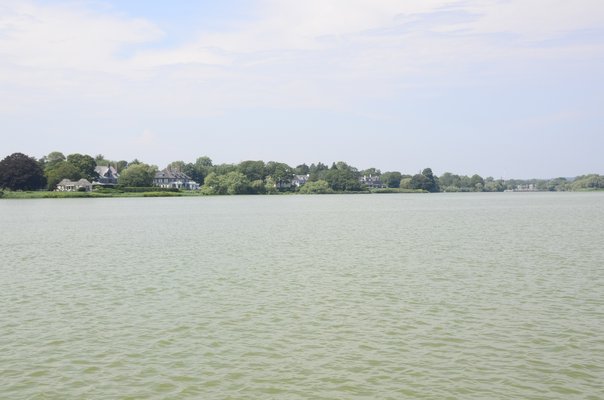
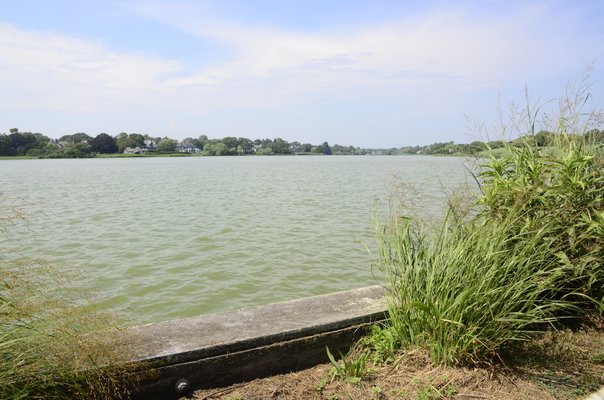
Lake Agawam in Southampton Village is plagued by blue-green algae blooms every summer. GREG WEHNER
Lake Agawam in Southampton Village is plagued by blue-green algae blooms every summer. GREG WEHNER
Simply saying that one wants to help improve the health of Southampton Village’s Lake Agawam—one of the most polluted bodies of water on Long Island—is not enough for newly elected Mayor Jesse Warren, who recently announced the creation of a new organization that will tackle the lake’s issues.
He wants to see some progress.
At a Village Board meeting on July 23, Mr. Warren announced that he is working with homeowners around the lake, along with others from the private sector, to form a new 501(c)(3) organization called The Lake Agawam Conservancy, a not-for-profit group dedicated to the protection and preservation of the lake.
The new group, he said, would not be limited to homeowners but also may include any citizen who is concerned about the condition of Lake Agawam and wants to make it better.
“We are likely going to follow a similar path to the Friends of Georgica Pond group, which has been pretty effective in East Hampton and for Georgica Pond,” Mr. Warren said on Monday, referring to a nonprofit organization that collects private and public funding for water quality improvement projects around the pond.
Since the East Hampton group’s formation in 2016, pond studies have been completed, and projects, including one where a floating tractor was used to skim aquatic plants and scum from the pond in 2016, have been performed to help improve the health of the water body.
“The goal is to work on every aspect of cleaning the lake,” Mr. Warren said of his proposed conservancy group in Southampton Village.
He explained that the group would tackle issues such as nitrogen loading, reducing rain runoff through the use of permeable reactive barriers and buffers, determining which fertilizers are better to use in an aquatic environment, and working with homeowners to see if they would voluntarily choose to not use herbicides and pesticides on nearby properties.
A big role of the organization would be to raise awareness, while also helping to raise money to fund some of the projects.
Residents of the village, he said, especially those who live around the lake, have recently shown a great deal of interest in improving the lake’s health.
“I’m really excited about the renewed interest in this, and I’m hoping that the conservancy group can work both privately and with the village in order to accomplish our goal of cleaning up Lake Agawam, and, potentially, other water bodies,” Mr. Warren said.
But forming a group with an interest in fixing Lake Agawam is nothing new. In fact, the Lake Agawam Conservation Association has been trying to further efforts to restore the lake for years and in 2009 worked with the village to create the Lake Agawam Management Plan.
The organization’s website, www.lakeagawam.com, kept residents up to date on projects that could improve the lake, such as installing drains, and providing a health report.
The site also gives recommendations to fertilize with minimal amounts of fertilizers and pesticides and to not mow over the buffer zones. It also recommends things like picking up after dogs, cleaning up spilled fertilizer or chemicals that fall on hard surfaces and maintaining septic systems through regular maintenance and inspections.
The updates are outdated, with the most recent being posted in 2017.
Mr. Warren said the difference between the conservancy and the association was that the latter was not a nonprofit and was dependent upon the Village of Southampton. While a partnership with the village is important for the conservancy to succeed, it will act completely independent from the village.
“It’s my understanding that the group lost momentum and was frustrated with the lack of progress and just stopped working, because they didn’t get what they were looking for, help-wise,” he said, explaining that the local government was not helping out as a partner. “That was a bit more informal, and we’re going to take this to a new level.
“I’d like for the village to be as helpful as possible with the organization,” he added.
Mr. Warren said the conservancy would be separate from the village, but a crucial part of it being successful is for the village to work “hand in hand” with the organization. He even said that he would love to have a seat on the board.
“I just think that when they know there is a partner in the village that is helping them get this to the finish line, I think that’s something that is valued,” he said.
Currently, Mr. Warren is trying to figure out who to get involved, especially with so many people expressing an interest in the group.
During the Village Board meeting on July 23, nearly every seat was filled and the topics mostly had to do with Lake Agawam—including questions about a plan to dredge the floor of the water body, a discussion regarding alternative pesticides and herbicides homeowners should use, and the drainage pipe from the lake to the ocean.
When levels in the lake reach a certain height, a valve is opened that allows the water to empty into the ocean near the Bathing Corporation, though closer to South Main Beach.
Peconic Baykeeper Peter Topping said he, along with the Surfrider Association’s Blue Water Taskforce, test the water regularly, but they offer only a snapshot of the actual condition of the water because of changing tides and currents.
Mr. Topping said he checks for blue-green algae, or cyanobacteria, which is toxic to humans and animals if ingested. The algae is common in Lake Agawam in the summer, and according to Mr. Topping, the lake showed measurements of 3,000 times the Environmental Protection Agency’s threshold.
His concern, he said, is that the water in the lake is tested before it is emptied into the ocean in the summer, when people are swimming nearby.
“Solving one problem by creating another in adjacent waters is not something our organization is willing to walk away from,” Mr. Topping said.
Nick Goodman, 10, of Southampton Village asked the Village Board members during the meeting to post a sign letting people know when the drain is opened or closed.
Another village resident, Meghan Nadosy Magyar, asked for bigger signs and more transparency when the pipe is opened.
Mr. Warren said on Monday that he was concerned with the blue-green algae and other bacteria going into areas where people swim, because he did not know how long it can remain toxic.
Town Trustee Ann Welker told the Village Board members that she has heard the blue-green algae dies rather quickly when it encounters saltwater, although she did not know how long it takes for it to die completely.
“That’s really not the best quality of water that’s being pumped out there,” Mr. Warren said on Monday. “The health of the lake and what we’re draining into the ocean kind of go hand in hand there.”
He went on to say he would eventually like to see some light dredging in Lake Agawam that would deepen it and allow for more water: “The goal is, ultimately, to never have to open the drain again.”


 Staff Writer on Jul 30, 2019