


 3 Photos
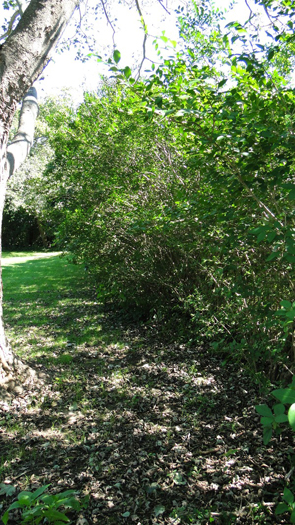
Mary Kosciusko says the hedge that abuts her Anns Lane home backyard has not been trimmed in about five years. COLLEEN REYNOLDS
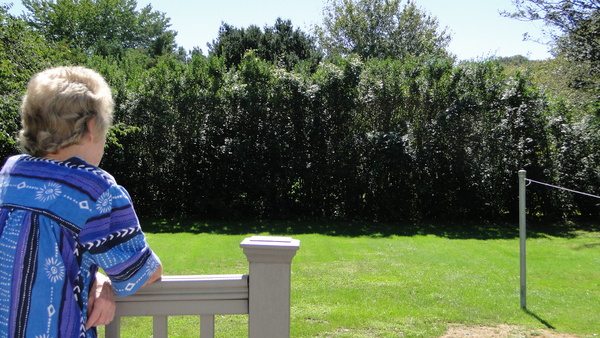
Mary Kosciusko says the hedge that abuts her Anns Lane home backyard has not been trimmed in about five years. COLLEEN REYNOLDS
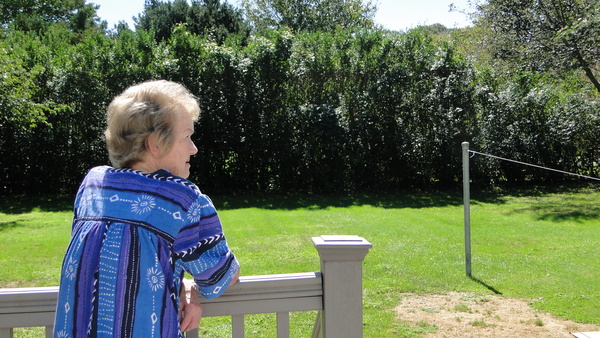
Mary Kosciusko says the hedge that abuts her Anns Lane home backyard has not been trimmed in about five years. COLLEEN REYNOLDS
At 79, Southampton Village resident Mary Kosciusko no longer walks to the rear of her backyard on Anns Lane. But the rear of her yard, or, more specifically, the large hedge that abuts her property, appears to keep creeping closer to her—stray leaves and branches poking out and encroaching onto her land.
The offending hedge, which is owned by a neighbor, has not been trimmed in five years, she said. That is, the side facing her property has not been trimmed in that long—it appears that the other side has.
And Ms. Kosciusko is not alone. In Southampton Village, neighbor disputes over unkempt hedges are not unusual. Lacking ownership of the hedge, and unwilling to shell out the cash to maintain what is not theirs, they sought relief from the Village Board.
In an effort to quell such disputes, the board last Thursday, September 8, established a requirement that all hedges on a property line must be trimmed at least once per year—under threat of fine and even possible imprisonment—while at the same time dictating that property owners must get written permission from their neighbors to trim the sides of hedges facing their neighbors’ yards.
The new legislation, which was approved unanimously by the board, is “pretty unique” when it comes to laws nationwide, according to Village Attorney Richard DePetris.
The new law, which will go into effect sometime next year, mandates that all owners of boundary-line hedges groom the tops and sides of their hedges at least annually—including the oft-neglected side facing neighbors. Neighbors, however, must give written permission for them to enter the property to do the cutting and cleanup. After all, Mr. DePetris explained, the village cannot mandate that a neighbor should trespass onto someone’s lawn.
The law identifies its goal as trying to “prevent such hedges from becoming overgrown and unsightly,” and to mitigate neighbor complaints. But the law does not define the terms “overgrown” or “unsightly”—Mayor Mark Epley said that would be up to the adjoining neighbor’s discretion.
If a hedge owner fails to trim the hedges by July 31 of each year, a neighbor can, under the new law, give notice to the property owner demanding that the hedge be trimmed within 30 days, and granting permission to enter the property. Offenders who do not follow through can be found guilty of violating the ordinance and could face a fine of up to $1,000 and/or imprisonment for no more than 15 days.
Steven Gaines, a Wainscott resident and author of the book “Philistines at the Hedgerow: Passion and Property in the Hamptons,” said he thinks the Southampton law is a good one, albeit unfortunate in that it had to be drafted and that people did not just voluntarily trim their hedges. “It would be as if you only painted the side of your house that faces the street,” he said on Monday.
He also touched on the quirkiness of the new law. “Out here in this unusual community in which we live, we’re confronted with all sorts of terrible problems that people would laugh at in other communities. But they’re very serious to us here,” he said. “So I’m very glad that at least the ‘philistines’ will be looking at well-manicured hedges.” He then amended “hedges” to “hedgerows” to complete the reference to his book’s title.
Ms. Kosciusko, who has lived in her house for 40 years, said that a previous owner of the neighboring property had the hedge manicured about twice a year for more than 30 years. But when the property changed ownership sometime in the past decade, at least half the hedge fell into neglect. Since June, when her husband, Michael, died, she has lived alone with her cat, Shadow—nicknamed “Kitty.”
Her neighbor’s landscaper last cut her side of the hedge in 2006, she said, but she found out later that the landscaper did it at his own expense and would not do it again. She said her neighbor offered to have his landscaper cut the hedge in 2009—but wanted her to pay $600 for the service, which he said was a bargain, as it had an estimated cost of $2,000.
“I don’t care if it’s 50 cents—I’m not paying him anything. It’s not my hedge,” Ms. Kosciusko said.
Instead of wielding a hedge clipper or paying for a landscaper to cut the plant, Ms. Kosciusko wielded a pen. She sent a letter to the neighbor. “He completely ignored me,” she said.
Her neighbor couldn’t be reached for comment this week.
About a half mile away from her property sits Anthony Punnett’s home on Hill Street. His yard is long and narrow and bordered to the east and west by his respective neighbors’ hedges. While the hedge to the east is well maintained, the one to the west is not.
“I have a neighbor who refuses to touch them. He’s a very nice man, but he’d be happy if these hedges grew to reach outer space, I think,” Mr. Punnett said, adding that the offending hedges are so high—at least 25 feet tall—and thin that they no longer serve their screening purpose effectively. But while he can see through the hedge, it is sufficiently thick to block the sun. “It’s such that, because it borders the west side of my property, at 3 p.m. in the middle of the summer the sun sets on my property,” he said.
While Mr. Punnett said he favors the new law, he said he feels it should go further by setting a maximum height for hedges. Several village residents shared similar sentiments.
Jack O’Connell, who lives on South Rosko Drive, said one of his neighbors’ hedges has been planted right against a fence, and that whenever the wind blows, the fence, which encloses a swimming pool, falls over. Mr. O’Connell asked the board if the law could include a setback for hedges. Mr. DePetris replied that setbacks come with another set of problems, such as cutting property owners off from the last several feet of their property, which could then raise questions of whether they actually own that land when it comes time to sell.
The new law does not include height restrictions or setbacks, but village officials said they hope it will give residents an avenue to keep hedges in check.
“All we did was put a process in place, so if there’s a dispute, these are the steps that you take,” Mr. Epley said this week. He found, for example, that a boundary-line hedge on his property that a former neighbor had maintained for years actually turned out to be the mayor’s hedge. He found out when the neighbor moved away and a new neighbor moved in.
“Ninety-nine percent of all the hedges in the village, there’s not a problem with, and the neighbors all work together well,” the mayor said, “but when it’s not working well, it’s an awful situation—and it’s happened several times.”
“It’s a practical matter,” Mr. DePetris explained of the law. “The adjacent neighbor has to either tolerate an expanding, growing hedge overhanging onto his property, or has to cut it himself—or has to go out and hire somebody to cut it himself—and there’s no recourse for getting that expense back from the actual owner of the hedge.”


