


 3 Photos
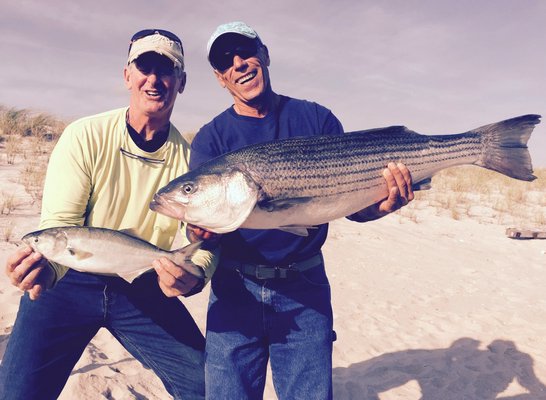
Mark Borucke and Gaspa LaPiana show off their respective first place bluefish and striped bass from the Hampton Surf Club's fall "Gathering of the Anglers" tournament.
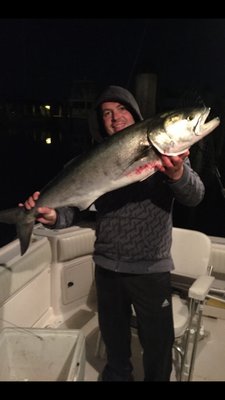
Sloborino bluefish
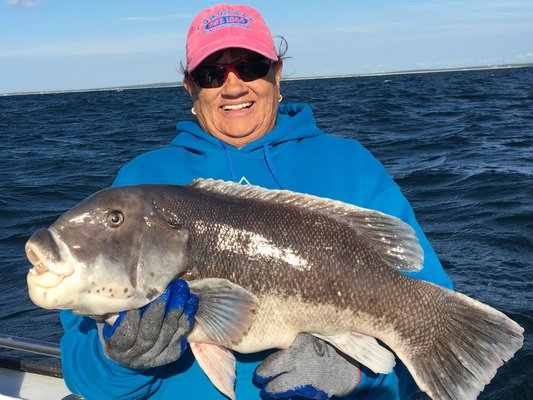
like this 21-pounder caught by Marek Janota
I’ve rarely heard so much anger at gillnetters from the surf fishing community as I have this year. It comes up every October, when the gillnetters set to work along the beaches of the South Fork—but this year the seething from the shore angling crowd is at fever pitch.It may be the proliferation of “up-island” boats from as far away as Atlantic Beach working off our shores this year, which seems to have doubled the number of poly balls bobbing in the surf zone. Or it may be the multiple incidences of hundreds of dead striped bass and bluefish littering the beaches that have occurred in just the last three weeks. (See the video posted with this column on the Sports page of 27east.com.) And the wound is certainly rubbed raw on a daily basis by the galling proximity to the shoreline with which nets are often set.
My several friends who work on gillnet boats have protested to me that their nets, with carefully controlled mesh sizes, are a “clean” fishery that results in very little bycatch of unwanted species and few fish of non-marketable size, and those fish that are entangled are left in shape to swim free if tossed back into the sea. I’ve always taken their claims with an ounce of skepticism, to say the least.
But I’ve also sat on the beach with my binos and watched boats haul their nets, and I will agree, as far as the near-shore fishing for striped bass and bluefish goes, the method does not seem rife with wanton waste like trawl nets.
Yes, I have seen some nets hauled that are choked with dead dogfish and sea robins. That is bycatch and a waste of Mother Nature’s creatures, but few are going to take issue with the deaths of some dogfish. The occasional (or not-so-occasional at times, I’ve been told) entanglements of migrating Atlantic sturgeon, an endangered species, is a darker cloud over the fishery that would get far less sympathy.
In my highly unscientific observation of the hauling of about 10 or 15 gillnets in the last three seasons, the most striped bass I’ve ever seen brought up in a net is about 40 to 45 fish. Most but certainly not all appeared to be marketable fish in the commercial slot between 28 and 38 inches. I have never witnessed a real jumbo come up, though I know it does happen, so I can’t vouch for whether it would appear to be able to released alive, as netters would claim, or not, as anglers often accuse.
I will say this: Many prized fish caught in gillnets that are not valuable to the crew, for whatever reason, are dead and gone to waste other than as a meal for crabs and seagulls. Just last week, I witnessed a Shinnecock gillnet boat throw three stripers overboard, for being undersized, I’m assuming, and all were clearly dead. But it was only three. That would probably equal the number of fish that were “released” but probably mortally wounded from among a handful of surf anglers during a steady pick of stripers from the sand.
Do some boats keep their unmarketable fish and dump them en masse on the way home to protect from prying eyes? It’s possible, I suppose. But I’m not quite that cynical.
We, as anglers, have to be careful to not get on our high horses, just because we release most of the fish we catch and drive a much larger portion of the state economy than commercial fishermen do. We are a blessed few who can say we eat fish we catch ourselves. But that does not entitle us to be the only people who get to eat striped bass.
Commercial harvest of striped bass in New York State is the single most tightly regulated commercial harvest of any wild fish, with the possible exception of horseshoe crabs (which should just be halted altogether). The number of striped bass that legally can be sold each year is limited. It’s a sustainable number that is spread between true commercial fishermen and a host of recreational/charter fishermen who were able to secure tags back in the 1990s, when they were allotted.
There is room for New York State to do some very reasonable tweaking of the rules for harvesting striped bass. First, in commercial fishermen’s interest, the allotment of tags needs to be reconfigured to allow young fishermen (you don’t even have to be all that young to not have tags nowadays) to get tags from those who have dropped out of the fishing ranks.
And there should be some accommodation for anglers, as well, who outnumber commercial fishermen many times over just on the South Fork alone. A limit on how close to shore a gillnet may be anchored is not unreasonable.
There is a chance for New York State’s Department of Environmental Conservation to fine tune a fishery that is among the most economically important on the entire Atlantic Seaboard, and do the fish and the fishermen favors.
Catch ’em up, everyone. See you out there.


 Michael Wright on Oct 18, 2016