


 2 Photos
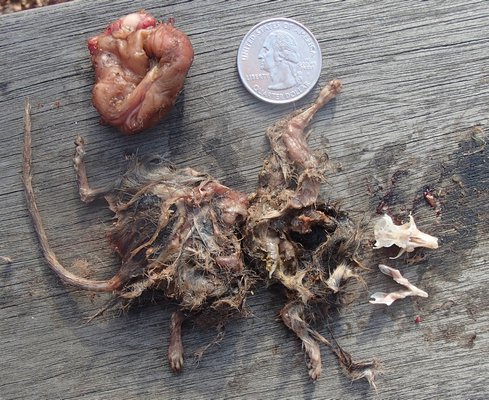
A dissection of the screech owl revealed a mouse packed into its gizzard (upper left). MIKE BOTTINI
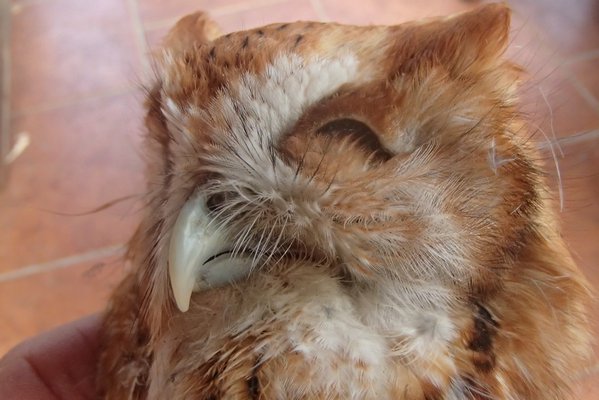
This Eastern screech owl was found on Montauk Highway near Southampton College
My last two columns discussed some aspects of the digestive system of birds and the creation of “pellets” containing indigestible material (e.g. bone, feather and fur) that are regurgitated. Last week, Juliana Duryea retrieved what appeared to be a road-killed Eastern screech owl on Montauk Highway near the Stony Brook Southampton campus, and I decided to dissect it to see what, if anything, might be in the section of its digestive system, called the ventriculus, or gizzard, where pellets are formed.The screech owl’s varied diet includes earthworms, a creature that is most active and most likely found aboveground at night. I had noticed portions of my backyard covered with earthworm castings during a particularly warm spell in late January. My suspicion was that the owl may have been feeding on earthworms along the road shoulder at night and, taking flight as a car approached, was temporarily blinded by the headlights and struck.
That proved not to be true. The muscular gizzard contained a compact mass of fur and bones about the size of a walnut. When I teased out the fur ball, I found the partially digested remains of a white-footed mouse, with the tail, legs, feet and head intact. The photo accompanying this article shows the mouse’s lower jaw and skull after I cleaned them up.
Standing less than 10 inches tall, with a wingspan of 22 inches, the Eastern screech owl is one of our smallest owls, dwarfed only by the Northern saw-whet owl. The latter, a common winter visitor but rare nester here on Long Island, is most known for its tameness, often letting you approach close enough to pick it up from its daytime roost for a close look!
Obviously, the screech owl in hand had managed to swallow whole its prey, measuring 4 inches long, excluding the tail. Owls’ beaks are relatively wide at the base, and they can spread their upper and lower mandibles quite far in order to swallow most prey whole. This owl specimen’s bill opening measured 1 inch wide and 1.5 inches tall, certainly enough of an opening to get a fat mouse or vole down the hatch.
I noticed a couple of other interesting things while dissecting the owl. One was that its left and right ear openings were located in the same relative position on either side of the head, as opposed to the asymmetrical openings of most owl species that enable them to triangulate and pinpoint the exact location of prey by sound. Researching this, I learned that screech owls use sight more than sound to hunt prey.
I could not find any grit—sand or small stones—in the gizzard to assist in grinding up food items. It’s possible that grit is more beneficial for birds that eat hard-shelled seeds, while birds of prey don’t require that digestive aid. I’ll have to look into that.
And, finally, there are two color phases or morphs of screech owls: the red and the gray. We have both on Long Island, but the red phase (the specimen found in Shinnecock Hills) is more common.


