


 2 Photos
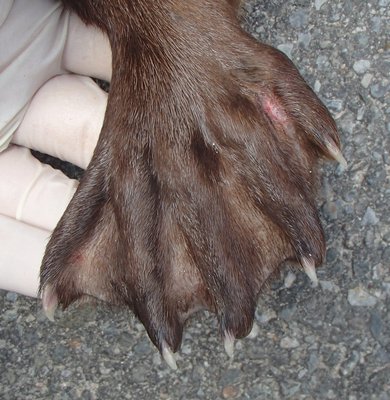
Among the otter’s adaptations for swimming are its webbed feet (right hind shown) and unusual tail. MIKE BOTTINI
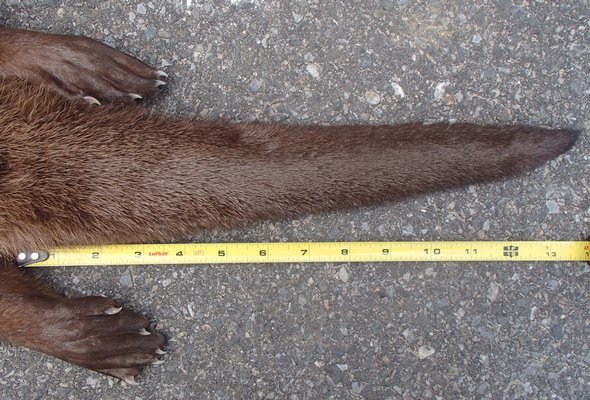
Among the otter’s adaptations for swimming are its webbed feet (right hind shown) and unusual tail. MIKE BOTTINI
Last Tuesday, I received a phone call from Sean Keenan. Early that morning, while driving west on Route 58 (aka Old Country Road) en route to work in Riverhead, Sean noticed a fairly large dead animal in the middle turning lane that he recognized as a river otter.I’m guessing that his training as a volunteer with Riverhead Foundation some years ago may have played a part in his decision to stop and retrieve the carcass, as he knew that someone might be interested in examining this species, rarely seen on Long Island.
He was correct. The State Department of Environmental Conservation sent someone to pick up the otter and deliver it to a veterinarian for a necropsy.
I arrived at Sean’s worksite in time to examine the otter for myself: an otherwise healthy-looking male, 40 inches in length overall, with its unusual tail comprising 14 inches (or 35 percent) of that total, and weighing 13 pounds. Male otters are generally larger than females and can reach over 50 inches in length and weigh over 30 pounds, so this individual is most likely a sub-adult, perhaps 2 or 3 years old.
The only obvious signs, on the otter, of the collision were around the mouth and nose, but I’ve learned from past experience with otter roadkills that their tough skin often hides serious internal injuries in other parts of the body. That was the case with this otter.
I was able to observe the necropsy, and once the internal organs were exposed it was clear that the otter had a crushed pelvis and crushed rib cage, most likely the result of being run over several times while it lay in the road. It’s digestive system was full of fish remains.
I was curious to figure out where this animal was headed and where it had come from. Route 58 is a densely developed strip of highway with a series of malls, shopping centers and car dealerships spanning most of its three-mile length between the eastern terminus of the Long Island Expressway and the Northville Turnpike.
Three-quarters of a mile south of the roadkill site is the Peconic River, which otters colonized and established home ranges in sometime over the last decade. On the north side of Route 58, a stone’s throw from the roadkill site, is a small freshwater pond, one of four small ponds in a string extending north and east and separated from one another by 200 to 600 feet of woods and, in the case of the farthest pond, paved road.
The otter must have been heading to or coming from those ponds. So I set out to see if I could find any otter sign along the edges of the ponds. Was this a case of a young otter dispersing and looking for a suitable place to establish a home range? Or was this an animal that had established a home range that included a portion of the Peconic River and the freshwater ponds, thereby overlapping Route 58?
River otters have relatively large home ranges that are measured in linear miles of waterfront, and, based on radio telemetry studies of otters in coastal habitat, their home ranges are at least 12 linear miles.
The ponds farthest from Route 58, a quarter mile away and within earshot of the busy road, had eight separate otter scent stations, or latrine sites, with more than 40 piles of scat, consisting of fish remains. That’s a lot of otter “sign,” leading me to wonder if the male that got killed was traveling with a buddy. Male otters often travel in small groups, and it’s possible that the buddy made it across the road safely.
If so, these ponds are part of a home range that will be revisited once every couple of weeks. A remote camera set up there can verify that.
But what to do to prevent future otter mortality on Route 58?
In the otter’s favor is its habit of moving around its home range in the middle of the night, when traffic is lightest. Some have suggested looking into installing a culvert, or large-diameter pipe, under the road to allow safe passage from one side to the other.
This would be expensive, and complicated in terms of permits and “red tape,” but worth exploring.


