


 2 Photos
Yes
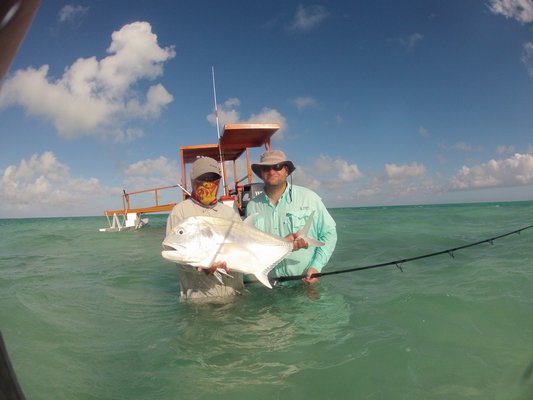
Bryce Poyer does get out from behind the counter of White Water Outfitters long enough to catch a fish on occasion. This big giant trevally hit a plug in Christmas Island. Lisa Poyer

Applause, for a moment, for the New York State Department of Environmental Conservation and the other states that pledged to adopt a one-fish striped bass bag limit for 2015 (and probably at least the next three years).They went against the recommendations of the industry-led advisory committee and there are some business owners who are not thrilled about it, sure, but if we want to see striped bass bounce back as soon as possible, this was a good call.
I’m not going to go as far as to say they got it exactly right, for a change, but it definitely took guts and a clear dedication to helping striped bass stocks bounce back to make such a call.
Mark this day, or this week, in history. It is the first time that striped bass regulations in New York have been tightened since 1991.
Striped bass, in New York and elsewhere, have one of, if not the most storied timelines in the relatively short history of fisheries regulation. Until recently, they were the marquis for successful protection and rebuilding of a fish stock through harvest regulation. Sure, Mother Nature deserved the biggest pat on the back for that recovery but it’s hard to argue that their numbers would have ever recovered to the great heights they did without the curtailing of some of the more aggressive fishing methods.
It may be hard for anyone under the age of 50 to fathom the thought of a 16-inch striped bass being a “keeper” or that there would be basically no limit to the number of fish someone could take home when the fishing was good, or that there was no “season.” But that was the case with striped bass until 1983, two years after the horrid realization that striper stocks were declining precipitously. That year the minimum length of striper was increased to 18 inches, the next year it was upped to 24 inches and the year after that the first ever bag limit, two fish per person for recreational fishermen, was put in place. The year after that, 1986, the fishery was closed entirely—due to concerns about PCB levels in the fishes’ meat, not because of harvest controls, but the closure is widely seen as a crucial step in the recovery process.
The closure spotlighted the battle for the recovery of striped bass and when it was lifted in 1987, the need for strict controls on the fish was a widely accepted reality. Limits opened back up at one fish per man at 33 inches minimum, then upped to 36 inches minimum in 1988 and to 38 inches in 1990. That was the apex of the battle and the victories won have allowed, or spurred anyway, liberalization ever since. In 1991 the minimum was dropped to 36 inches, where it remained for five years before the 1996 reduction to the current 28 inch minimum size.
In 2004, perhaps driven by an egotistical overconfidence in the role of regulation and fishery management in the recovery of the fish, New York and many other states started allowing anglers to keep two fish, the second one being a “trophy” fish over 40 inches. That direction in policy was fateful, for two reasons.
First of all, it came, we now know, shortly after the end of a great run of spawning success by striped bass. A decade of poor spawning was just getting started that would mean a long period of declining striper numbers no matter what was done. We are about two steps from the rim of that crater now, just getting a glimpse of its depth.
Second of all, the “trophy” allowance aged into what was effectively a two-fish limit for all fishermen, as the millions of fish born in the highly successful spawning years of the 1990s and early 2001 grew into large schools of big striped bass. For several years, catching a 40-inch striper was sometimes more common than catching one too small to keep.
The “trophy” fish rule was also bastardized by a failure of focus by fishery managers and enforcement officers. The rule, as written in the state’s fishery codes, said that an angler could keep one striped bass of at least 28 inches but no more than 40 inches and a second fish, over 40 inches. But poor wording in some state rule-writing led many to read that as one fish of at least 28 inches and a second fish of at least 40 inches—which meant an angler could keep two fish over 40 inches. It was not a wholly unreasonable interpretation, considering how the rule was introduced, but it was wrong nonetheless and had disastrous consequences when schools of big fish would be set upon by large numbers of anglers.
So, we enjoyed a new heyday of striper fishing. It never quite got to the glory days of the 1950s and 1960s in terms of the numbers of big fish, but it was a glorious stretch. Now we will suffer our just desserts and hope that they are finished off quickly.
Catch ’em up. See you out there.
More Posts from Michael Wright


