


 7 Photos

Commercial fishermen from throughout the South Fork last week pored over nautical charts showing the broad swaths of ocean south of Long Island being considered for future wind energy development by New York State—and saw a lot of the area where they harvest a living.
But the state officials who hosted two open-house discussions with fishermen last week, one at Shinnecock Inlet and the other in Montauk, said that is exactly what they wanted the fishermen to point out to them—so they can work to reduce the impact.
The New York State Energy Research and Development Authority, or NYSERDA, is nearing the end of the research phase of its offshore wind master plan, due to be released next year. The state’s experts say they wanted to hear from fishermen which areas are most critical to their industry, and how the development of offshore wind farms could be coordinated to have the least impact on the fishing industry as possible.
“What we’re trying to understand from the fishermen is where they fish in these areas, how often they fish in what spots, what type of fishing they do in each area, and … we want to understand how the gear works,” said Greg Matzat, a wind energy expert for the Research and Development Authority. “If we can find areas where there is no fishing, or less fishing, happening, that’s where we want to go. If it makes sense that we would align the turbines along a depth contour, so that fishermen can fish alongside them and don’t have to criss-cross through them, we can do that, too.”
Governor Andrew Cuomo last year set a goal for the state to draw half of its energy supply from renewable sources by the year 2030. A large portion of that is expected to come from offshore wind developments—some 2,400 megawatts from 250 wind turbines, enough to power more than one million homes.
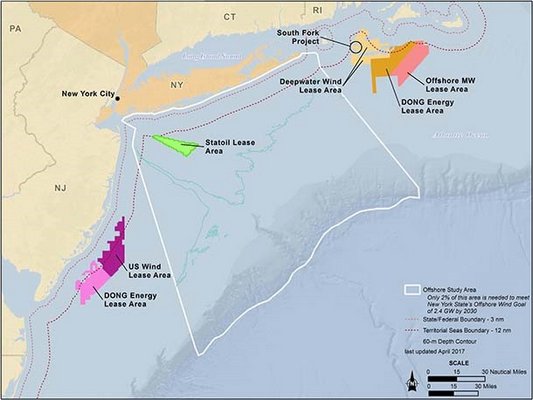
As part of its master plan development, the state is looking at more than 16,000 square miles of ocean, from the full length of Long Island coastline out to the continental shelf, to find the conditions right for potential development sites for offshore wind farms.
But a variety of factors, from shipping lanes to Federal Aviation Administration clearance concerns to water depth, have cleaved the areas that could possibly be developed down to a handful of chunks of sea floor between 12 miles and 25 miles offshore.
One of the focus areas extends from the eastern end of Fire Island to Montauk Point, as close as 12 miles to shore.
Within those areas lie gargantuan stocks of valuable sea scallops, roaming schools of squid miles across, and scuttling migrations of monkfish, all of which stock seafood shops and restaurants up and down the East Coast and sustain a multimillion-dollar industry—and thousands of jobs.
“Scallopers, they fish everywhere,” said John Maniscalco, the chief of marine fisheries for the State Department of Environmental Conservation, at an open house on the commercial docks in Hampton Bays on Wednesday, August 16. “Ideally, we would not develop prime fishing zones. Obviously, there’s somebody fishing almost everywhere at some point, so it’s a matter of how much intensity, are there other places to catch the same species, and can we arrange the turbines in such a way that you’ll be able to fish among them.”
Mr. Maniscalco nodded to the broad nautical charts laid out on tables—he and his state colleagues on one side, a group of commercial fishermen on the other—that depicted the areas under consideration, overlaid with shipping lanes and other obstructions to development, and with circles drawn by fishermen to mark the areas they fish the most.
A large oval, drawn in orange marker, encompassed nearly the entire area south of Long Island to the undersea mouth of the Hudson River, with “Scallops” written in the middle of it.
“We fish here, and all through here, and over here,” fisherman Mark Lofstad said, running his finger along the chart’s lines, depicting bottom contours from south of Shinnecock Inlet west toward New Jersey, showing where he takes his boat, Oceanfresh, to drag for squid. “If you have to be 15 miles offshore, you would be in the middle of the day boat scallopers.”
The fishermen—about a dozen offered input last week in Hampton Bays, but just three in Montauk the next day—voiced concerns about the windmills being an obstruction while they fished, about fishing areas being closed during construction, and about the faint electronic hum emanating from electrical cables that can drive fish away from key fishing areas.
The state officials said that fishermen would be compensated for any fishing area closures during construction—which would likely not start until 2024 at the earliest—and that once the windmills were in place there would be no clearance requirement for boats fishing next to them. “You can get as close to them as you are comfortable with,” Mr. Maniscalco said.
The effects of electromagnetic impulses on migrating fish remains a large unknown, thanks to a lack of detailed study, state officials and fishermen agreed.
“We’ve never had this kind of thing, so we don’t know what’s going to happen,” Hampton Bays scalloper Michael Baughs said in response to the claim by the state officials that what studies have been done were either inconclusive or showed that the pulses had no effect on fish.
“I think the main concern is that fishermen don’t want to lose any fishing ground,” said Bruce Beckwith, a Montauk draggerman. “For me, I would rather not see anything in the ocean—just leave it the way it is. I have eight grandsons. They might want to go fishing someday. I don’t want to see them be shut out.”
Mr. Lofstad suggested that the best course of action would be to place the windmills in long lines, perhaps single-file, running east-west just outside the 12-mile nautical boundary of U.S. territorial seas. That would put them offshore of the best fishing for squid, and inshore of the best scalloping.
While there may be some conflicts still, “we all have to work together here,” the fisherman said with a resigned shrug.
Mr. Matzat told the Shinnecock fishermen that NYSERDA hopes to be nearing the point of decision about what areas it will pinpoint for wind farm development. The state would then have to seek to have leases created for those areas by the federal Bureau of Ocean Energy Management, and then put the leases up for bidding by offshore wind development companies.
Two such leases have already been awarded for wind farm development to serve New York—including the bottomlands targeted for the 12 to 15 planned turbines of the Deepwater Wind wind farm, slated off Montauk, which will send 90 megawatts of power to the South Fork.
“Everything is up in the air still, but in the next month or so we’re hoping to wrap stuff up,” Mr. Matzat said. “We have literally 20 studies that are finishing right now, so the more input we can get now, the better.
“We’re very purposefully trying not to predetermine anything until we have all the data and information, so don’t just look at one data set and say, ‘Oh, let’s go here,’” he added. “If we take these maps and do all the overlays with all the environmental data, and the information we get here, and everything else … hopefully, we come up with some little gaps,” he said, where turbines could be placed with minimal disruption.
Mr. Beckwith said he also worries about the hazards to boats of turbines spaced just a mile apart, which will force more ocean traffic into smaller areas.
“When you’re offshore in the wintertime and it’s cold and windy and icy, it’s one more thing you have to deal with,” he said.
Others saw some glimmers of hope in the state’s plan—which most said they saw as an inevitable future, given the governor’s forceful embrace of offshore wind as a key to the state’s future energy supply.
“It seems a lot bigger than we are,” said John Berglin, a Hampton Bays fisherman. “I guess there will be a lot of job opportunities from it, so I don’t think it’s a terrible thing.
“And if you are fighting too hard against it, I think you are like Don Quixote. Literally. Tilting at windmills.”


 on Aug 22, 2017