


 1 Photo
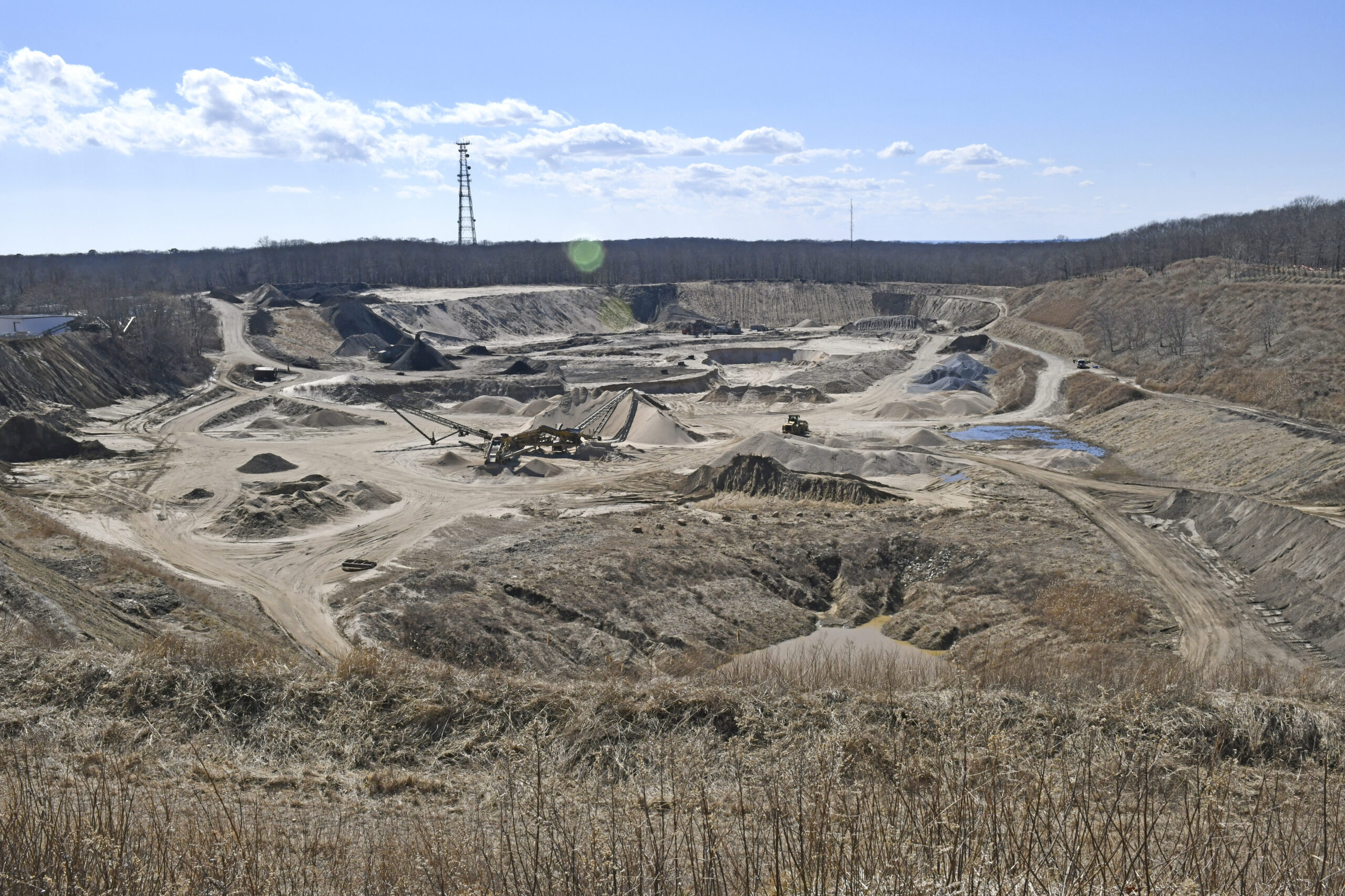
The Sand Land mine in Noyac.
New York State’s highest court on Thursday, February 9, delivered a major blow to the Sand Land Corporation’s effort to continue sand mining operations at a 50-acre site off Millstone Road in Noyac.
The Court of Appeals annulled the company’s Department of Environmental Conservation permit and ordered the DEC to again ask Southampton Town to weigh in on the legality of the operation.
If the town were to affirm its prior opinion — that Sand Land’s long-running effort to extend its mining permit would constitute an illegal expansion of a nonconforming use — the mining operation would presumably be required to close.
Southampton Town Attorney James Burke praised the decision.
“It’s good to see that the court affirmed the Appellate Division decision in revoking the permit,” he said by email. “The court also made clear that the burden of establishing the appropriate basis for the issuance of any future permit for mining at the site in conformance [with state environmental conservation law] is clearly on the applicant, and the DEC may not issue any future mining permit unless that burden has been met.”
But both he and State Assemblyman Fred W. Thiele Jr., who has joined with the town, neighbors and environmental organizations in a long-running legal battle to close the facility, which is owned by John Tintle’s Wainscott Sand and Gravel, conceded that the long legal battle is not necessarily over.
“Potentially, I can see this coming back to the [Zoning Board of Appeals],” Burke said, “to see if their most recent application is a preexisting use.”
Thiele said the Court of Appeals ruled that lower courts had never satisfactorily answered whether Sand Land’s request to expand its mining operation was a permitted extension of a preexisting, nonconforming use or a new application. “I’m sure that will engender further litigation from Sand Land,” he said.
Brian Matthews, an East Hampton attorney who represents Sand Land, said on Monday that he was still reviewing the case and the company’s options and would have no further comment.
In 2012, the Southampton Town ZBA ruled that the mining operation was a preexisting, nonconforming use. But since 2014, the town has fought Sand Land’s effort to obtain a permit to expand the area of the mine by up to 5 acres and dig 40 feet deeper over fears it could contaminate the aquifer, the region’s sole source of drinking water.
“We’ve been at it with Sand Land for quite a while over several administrations,” said Councilman Tommy John Schiavoni, who has worked with neighbors to close Sand Land. “This is a victory for water quality and, really, the public.”
For now, Thiele said it was important to point out that the Court of Appeals had annulled Sand Land’s mining permit. “They have to stop mining,” he said, “and the DEC has to enforce that decision.”
Bob DeLuca, the president of the environmental organization the Group for the East End, also praised the decision, saying it put the burden on Sand Land “to make the case there wasn’t a fixed bottom to that mine.”
But DeLuca said it was troubling that the DEC seems to be ignoring state law when it comes to mining regulations. He said via email on Monday that the agency had yet to close the operation.
“The DEC has a bifurcated responsibility to both promote and regulate mining,” he said, “and it has lurched to the dark side. Everything they have done is predicated on approving mining, and that’s not good policy.”
The court ruling pointed out that state mining law provides broad authority to the DEC to regulate mining — but that in a 1991 amendment to that law, the State Legislature had given towns in counties where the population exceeds 1 million, and that draw their drinking water from sole-source aquifers, the authority to overrule the DEC, provided they have zoning laws on their books outlawing mining. Only towns in Suffolk and Nassau counties could meet that threshold — and Southampton Town has such a law on its books.
However, the court did rule against Sand Land’s position that it had “the right to mine all the way to the middle of the Earth,” Thiele said.
Ever since the town challenged the company’s bid to extend its permit in 2014, a series of contradictory decisions have ensued, as the DEC first denied the permit and later approved it. In the meantime, the town and neighbors raised concerns about the mining operation posing a threat to drinking water. Even after Suffolk County Health Department tests seemed to bear out that concern when contaminants were found in wells at and near the site, Sand Land continued to fight, producing its own findings that showed no threat.
The town and Thiele were optimistic that they had finally won when an Appellate Division court ruled in their favor, but a year ago, the Court of Appeals agreed to hear the Sand Land case.


 Stephen J. Kotz on Feb 9, 2023