


 1 Photo
East Hampton's Riley Duchemin DREW BUDD
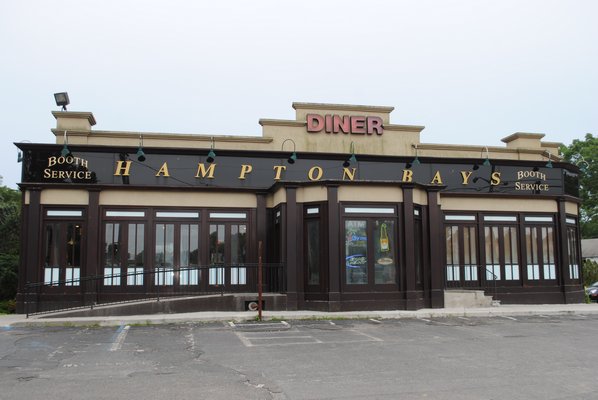
A buyer for the shuttered Hampton Bays Diner building remains elusive more than a year after its former operators were ordered by a bankruptcy court to close the iconic West Montauk Highway restaurant.
Frank and Maria Vlahadamis of Hampton Bays, who ran the diner for 32 years, were forced to close in July 2015 after filing for bankruptcy. The court then demanded that they sell the building—the Vlahadamises own the structure but not the 1.9-acre property on which their diner once stood—in order to settle their debts, which amounted to $1.3 million at the time of their filing.
The building has since been put on the market by Paul Fetscher, president of Great American Brokerage in Long Beach, with an asking price of $1.25 million. Though several businesses, including CVS Pharmacy and the Moriches Bay Diner, have expressed an interest in buying the building, it has not yet been sold, according to Andrew J. Campanelli, of Campanelli and Associates in Merrick, the attorney representing the Vlahadamises.
Real estate experts said they are not surprised that the old diner building has not found a new owner yet, explaining that it is difficult to be successful in the restaurant business in the Hamptons, noting the seasonal nature of the area. But they also point to the unusual circumstances with this particular property, namely how the Vlahadamises own the building but not the land itself, meaning that the future buyer would have to invest $1.25 million in the building and then still pay more than $10,000 a month in rent to a landlord, Thomas Charos of Charos Properties Ltd. in Riverhead.
As part of a unique arrangement when they ran the diner, the Vlahadamises agreed to pay $10,000 a month in rent and also cover 78 percent of the annual property taxes on the property which, six years go, totaled about $17,500. However, that figure more than tripled to $60,000 in 2010—around the same time that the Vlahadamises stopped paying their taxes. According to town records, taxes on the property now total $64,000 per year.
The latest listing for the old diner notes that the buyer of the building can expect to pay “approximately $150,000 net per year” in rent to Mr. Charos—a posting that suggests that the new owner could also be expected to pay a fair share of the escalating property taxes.
Mr. Charos did not return calls seeking comment over the past two weeks.
Tony Cerio, an associate broker at Brown Harris Stevens of the Hamptons in Bridgehampton, said he has never heard of a commercial business being set up this way.
“I’ve heard of that with houses,” said Mr. Cerio, referring to the fact that the owners of the building would still have to pay rent and, possibly, taxes. “But I never heard of it with a commercial property. That’s new to me.”
Mr. Cerio explained that he knows of certain instances in East Hampton Town where a waterfront home might have been built on land that is owned by the town. Still, he said that such arrangements are uncommon, especially with commercial buildings, because the individual owning the building must put a lot at risk.
“Unless you have a really long-term lease, it would be crazy,” Mr. Cerio said of the Hampton Bays Diner situation.
Hal Zwick, a real estate salesman for Town & Country Hamptons in East Hampton Village and who specializes in commercial real estate, also labeled the arrangement between the Vlahadamises and Mr. Charos as odd. In most instances, Mr. Zwick explained, a landlord owns both the land and whatever structure is built on it—and the tenant pays rent. “Usually,” he said, “the land and the building are owned by one person.”
Mr. Cerio also speculated that another reason why the diner building has not been sold yet is because the Vlahadamises are not using a local real estate agent.
“That’s a big mistake that a lot of people do out here,” Mr. Cerio said. “It would be to their benefit to give it to a local agency. Number one, we have the availability to show it. If you think someone is going to come from 100 miles away to show a diner, you are mistaken.”
Great American Brokerage is located about 60 miles west of Hampton Bays and Mr. Fetscher, the company’s president, did not return calls seeking comment this week.
The sudden spike in property taxes could also be to blame for the lack of interest in the property. Mr. Campanelli, the lawyer representing the Vlahadamises, said his clients believe that the town “deliberately” tried to close down the diner by raising taxes on the land, knowing that the Vlahadamises would be asked to cover the difference. He said the town targeted the diner after it started offering a “Hispanic Night” promotion to attract Latinos; town officials counter that the Vlahadamises were cited for illegally transforming their diner into a nightclub without the proper permits.
“The moment they started ‘Hispanic Night’ the town issued violations for everything they could possibly find,” Mr. Campanelli said.
The exchange prompted the Vlahadamises to sue the town in 2008, alleging that it was trying to push them out of business by unfairly raising taxes and issuing unnecessary violations. They are seeking between $6 million and $8 million in damages. A decision on that lawsuit, however, has been stayed until the building is sold and the bankruptcy proceedings closed.
Enzo Morabito, a broker at Douglas Elliman Real Estate in Westhampton Beach, noted that it is harder to sell a restaurant on the East End than any other commercial business, mostly because operators know of the inherent risks that come with opening in a seasonal community.
“It takes a special kind of restaurant to be successful on a year-round basis,” Mr. Morabito said, nodding to the seasonal nature of the East End, where many restaurants still close their doors during the winter months.
“Restaurants are in demand out here, but you need to be more careful because everyone wants to be in the restaurant business in the Hamptons,” Mr. Zwick added. “But half the people don’t have the experience or the finances to do it.”
Although the building has operated as a diner for decades, the future buyer does not have to operate a restaurant from the site. The land is zoned Hampton Bays Highway Business, which allows banks and retail shops in addition to restaurants. The zoning also permits churches, libraries and offices for state-recognized nonprofits.
The property’s prime location—it sits where Flanders Road and Montauk Highway bisect in the hamlet, and a stone’s throw from Sunrise Highway—prompted plenty of interest immediately following the closing of the diner last summer. In the first two months nearly four dozen people visited the site to inspect the property.
But interest has since waned in the building, most likely due to the unusual arrangement. Another obstacle is finding a qualified buyer, according to real estate experts. Mr. Zwick explained that part of his job is to vet potential tenants to make sure they have the experience and finances to survive the first two years as a restaurant, when they will most likely be struggling to survive.
“Everyone has a dream while sitting on their deck and having drinks in July and they say, ‘I want to open a restaurant,’” Mr. Zwick said. “But I always tell them to come back here on a Tuesday in February.”
Still, some still think that a restaurant will eventually replace the Hampton Bays Diner. They note that the hamlet has a good number of restaurants that are open year-round, suggesting that there could be a strong enough following to support a new eatery.
“That’s a perfect example of a town that’s picked up the ball,” Mr. Morabito said of Hampton Bays. “They have more of a year-round population than they do in Westhampton Beach.”
Others remain hopeful that the Vlahadamises will find a buyer soon.
“It’s a shame because that was a really cool landmark,” Mr. Morabito said of the old diner building. “Growing up, whenever you went to the Hamptons, you would stop at the diner.”


 Amanda Bernocco on Aug 17, 2016