


 1 Photo
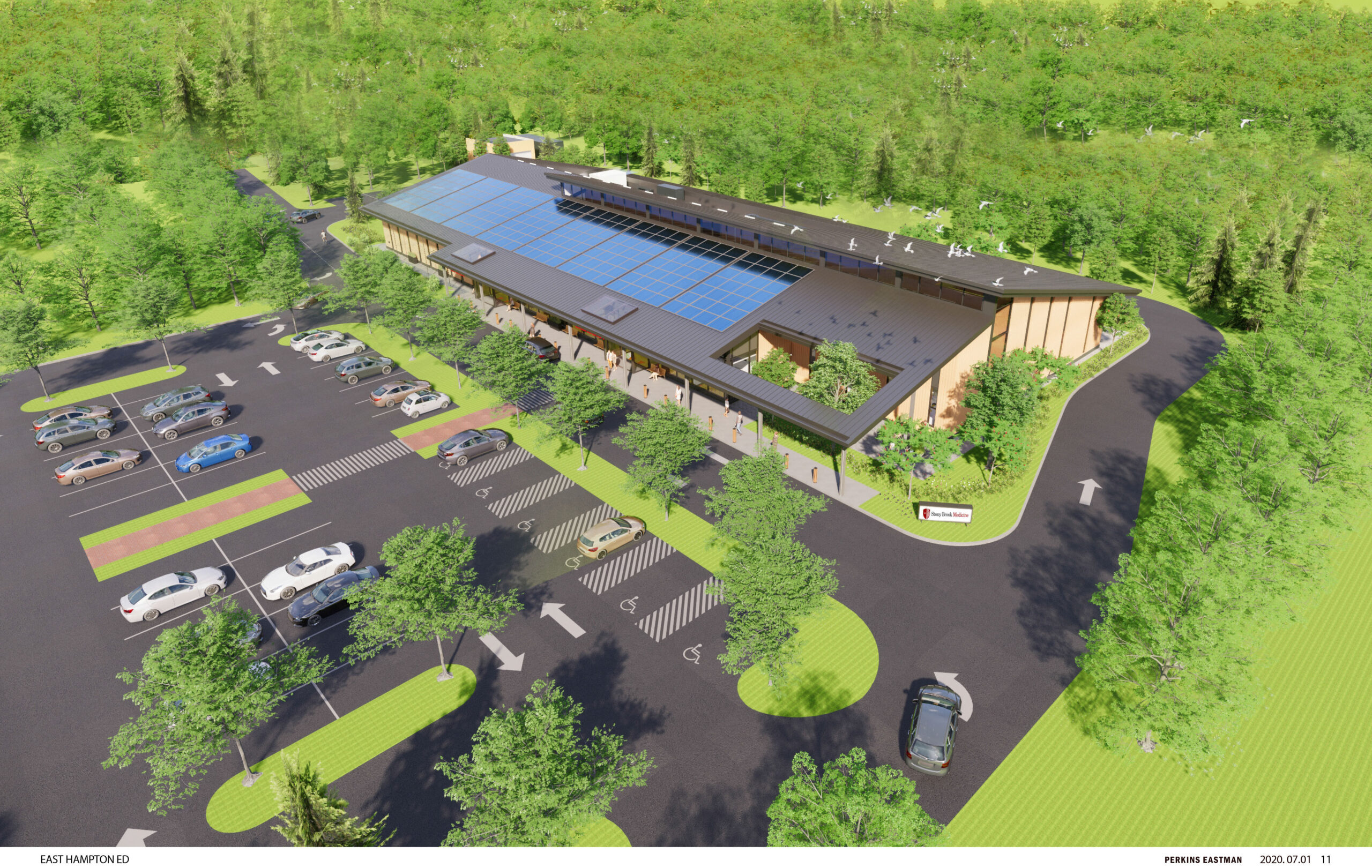
A rendering of the planned new Stony Brook Southampton Hospital satellite emergency room facility in East Hampton.
Prior to the outbreak of the COVID-19 pandemic, Stony Brook Southampton Hospital had big, multi-million-dollar plans that would have changed the landscape of East End health care for good.
According to Robert Chaloner, the hospital’s chief administrative officer, it still does. They were simply delayed, he said — but now, they’re back on track.
“There’s a lot of exciting things to come,” he said. “We’ve got some really tremendous new opportunities. I hope we stay past COVID, we don’t see another pandemic and we can stay focused on accomplishing our dreams for health care for the East End, which I think we’ll do.”
The first is a new East Hampton emergency department, which was slated to open in late 2023. “We’re still hoping,” Chaloner said, “but realistically, it’s probably gonna be early 2024.”
Operating under the Stony Brook Medicine health care system — which includes Stony Brook Southampton Hospital, Stony Brook University Hospital, Stony Brook Children’s Hospital and Stony Brook Eastern Long Island Hospital — the approximately 22,000-square-foot facility will provide a full array of emergency treatment and diagnostic capabilities, including CT scans, MRIs and X-rays, a trauma room, and blood laboratories.
It will also offer fast-track treatment rooms for general, pediatric, obstetrics/gynecology and ophthalmology patients, an on-site ambulance for hospital transport, two isolation rooms, and a resuscitation room.
“One of the things we’ll do in this facility is every treatment bay has hard walls around it — there’s no curtains — so that patients could be isolated in each one of those rooms,” Chaloner said. “If we had an outbreak of something again, we could utilize this facility out there and not overwhelm the central facility. I think that’s going to be very important to us.”
Every exam room will have cardiac monitoring capability and there will be dedicated rooms for advanced imaging, as well. To reduce environmental impact, the facility will have rooftop solar panels, a rain-catch garden and native plantings.
When the project was unveiled in 2016, the hospital had estimated that it would cost about $30 million to build. It received a $10 million grant from New York State and had planned to raise the bulk of the remainder through private fundraising. In May, the hospital reported raising $38 million in gifts thus far.
As the hospital is currently putting out bids to builders, that price tag may change, Chaloner said, though he still expects to break ground in January.
“From a fundraising perspective, we’ve exceeded our initial targets,” he said. “We’re gonna keep fundraising because we haven’t gotten the bids yet and our initial cost projections were before COVID, certainly, so we expect that there’ll be inflationary cost increases, so we’re going to continue to fundraise for it.
“We certainly are well positioned to launch it,” he continued. “It’s just been a question now of getting a project manager, which we have in place, and now selecting the builder — and that’ll all happen. We expect first quarter we’ll see work progressing on the site, so we’re excited about that.”
The second initiative is a relocation of Stony Brook Southampton Hospital altogether — from its current Meeting House Lane site to 15 acres on Stony Brook University’s Southampton campus — a project that, in 2019, was estimated to cost $305 million.
“That project’s alive and well,” Chaloner said. “We’ve got an initial design that we’ve worked with architects on. We’re pleased with that and where we’re at with it, at this point, is in the quiet phase of our fundraising. We’re out speaking to our donor community and our friends, and we have a target for fundraising.”
The chief administrative officer estimates about two years of fundraising, starting now, will precede another two years of additional planning and seeking approvals — which is “a four- to five-year horizon from this point forward, assuming no pandemics,” he said with a light laugh.
“We’ve had very, very good meetings and some very positive, early results,” he added. “We’ve delayed a lot of that because of COVID, so we’ve just reinitiated the fundraising — and I’m hoping by the middle of next year, I can announce some really exciting fundraising results.”
As for the future of the current hospital, Chaloner declined to comment: “We’re not even getting into that until we know for certain that we’re moving,” he said.
If and when the hospital moves to the Shinnecock Hills property, Chaloner said it would open up opportunities for partnership with the college’s new health care programs — including physician assistant and physical therapy programs, speech-language pathology, and applied health informatics — as well as potential to recruit and retain staff.
“In terms of the future of health care, I think it opens up so many new synergies that we can collaborate together on,” Chaloner said. “How that campus develops, the university has a lot of thoughts and plans in the future — it’s creating a base for, it could really go just about anywhere — but it’s a very exciting prospect, from my perspective. My focus is the hospital, obviously.”
Additionally, Peconic Bay Medical Center recently received a milestone $5 million donation that will help fund a new 6,600-square-foot expansion of the hospital’s emergency services department, which will cost a total of $15 million. This includes a dual-bay trauma unit and additional cardiac response services, a dedicated pediatric treatment area, enhanced patient privacy, and advanced radiology capabilities.
“We will be breaking ground on this expansion in early 2023,” according to Amy Loeb, executive director of Peconic Bay Medical Center. “Our emergency department treats more than 36,000 patients every year, including a recent spike in more severe cases, such as traumas, heart attack or stroke. This leadership contribution will help pave the way to increase critical care capacity by more than 75 percent.”


 Michelle Trauring on Nov 10, 2022