


 2 Photos
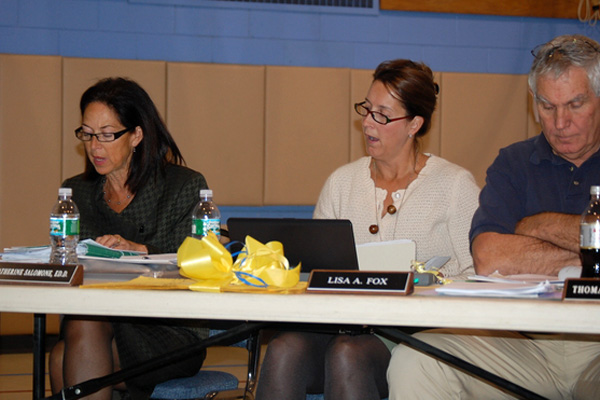
Superintendent Dr. Katherine Salomone, and School Board Vice President Lisa Fox
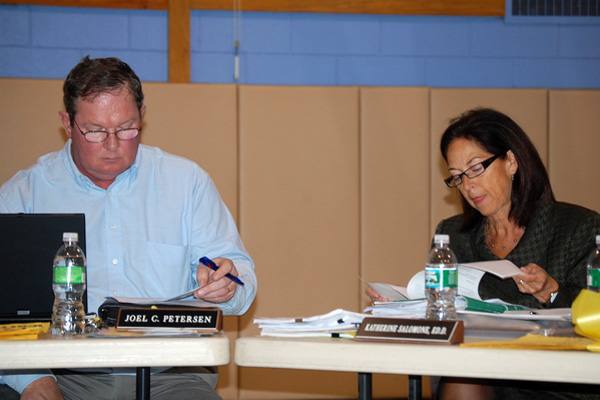
School Board member Joel Petersen and Superintendent Dr. Katherine Salomone
The Remsenburg/Speonk School Board included an addendum to its long-range planning study, which estimates that the elementary school would need approximately five more classrooms over the next 10 years if it reduced its maximum class size from 30 to 25 students.
The addendum explains that if class sizes were reduced to that level, the district would need to either construct the new classrooms or rent portable units sometime in the next decade.
“The district would not have enough room to accommodate [students],” Remsenburg/Speonk Superintendent Katherine Salomone said during the monthly school board meeting on Monday night.
If class sizes at the school remain capped at 30 students, the study, which was conducted by the Western Suffolk Board of Cooperative Educational Services (BOCES), states that the school would need at least one additional classroom within 10 years. The study also notes that, if class size remains unchanged, additional space will still be needed for meetings of small groups and teacher preparation areas.
The school currently has 10 general purpose classrooms and classroom sizes are capped at 30 students. However, district officials explained that the school now tries to cap enrollment at 25 students per classroom.
The entire BOCES study, which began in May 2006, cost the district about $7,700 to complete. The addendum did not cost any additional money, school officials said.
The addendum also states that the school’s art and music classrooms could possibly be converted into extra classrooms, but that would leave the building with no large group meeting space.
“Since there are only three rooms that could possibly be recaptured—leaving the building with no large group instructional rooms for art, music or computer instruction—there would be a need for additional classroom space,” the addendum states.
School Board President Thomas Kerr explained on Tuesday afternoon that his board asked BOCES for the additional report because, at the current time, the school tries to cap its enrollment at 25 students per class. He said the district rarely has classrooms that have more than 25 students. The smallest class at the elementary school has 14 students while the largest has 25 students.
The School Board also agreed that it was in best interest of students to keep class sizes at that level.
“I could not find an article that said class size should be above 25,” said board member Joel Petersen.
Additionally, the BOCES study calls for the district to address the issue of the school’s gymnasium, which doubles as a cafeteria. The school’s lunch tables are covered with mats during gym periods, which some have said could pose potential dangers to children.
The district’s taxpayers overwhelmingly rejected the School Board’s proposed $14.9 million expansion project, a plan that would have doubled the size of the Mill Road elementary school and increased school taxes. That plan was rejected in December 2008 by more than 80 percent of taxpayers.
Mr. Kerr said before the close of Monday night’s meeting that the board has not yet determined a time line for a revised expansion project proposal, and could not say when it would have one.
“We’re still working on it,” Mr. Kerr told audience members. “You’ll know as soon as we know.”


 Bryan Finlayson on Oct 21, 2009