


 1 Photo
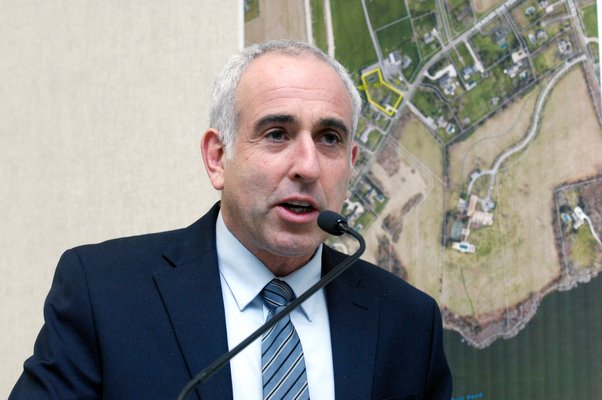
Southampton Town Supervisor Jay Schneiderman
Southampton Town Supervisor Jay Schneiderman will propose a two-year freeze on property assessments to give a new committee of “experts” a chance to review the town’s policy of adjusting the values annually in response to market trends.
His proposed legislation, to be introduced next week, comes on the heels of a 10-percent jump in the town’s overall assessed value this year. Notices recently went out to owners of nearly 34,000 of the town’s 52,000 parcels announcing increases in assessments—meaning almost two-thirds of property owners saw their property value rise for taxation purposes.
On Monday, Mr. Schneiderman noted that his legislation—which will be co-sponsored, he said, by all five Town Board members—comes after he’s heard of individual property owners seeing increases this year of up to 50 percent in their assessed property value. “A lot of those people are retired people,” he added.
An increase in an individual property’s assessment does not guarantee a comparable rise in the tax bill—or possibly any increase at all. When the town-wide assessment rises, tax rates are generally adjusted down to balance out the impact. But significant increases can mean higher tax bills.
“We don’t want to force them to have to sell their homes,” he said on Monday.
Southampton is one of only two towns on Long Island that uses a system of full valuation to determine each property’s percentage of the total tax collection. The town, in 2004, after a sweeping town-wide reassessment, began conducting ongoing updates to property values each year. Every four years the town conducts a full reassessment of the 52 neighborhoods in the town to ensure that every property is assessed based on its true market value. In between, market trends are used to make smaller adjustments: As comparable properties nearby sell, the value of a house can rise or fall based on those transactions.
The current tax year is one that involved a full reassessment, and rising property values sent the tax base up by 10 percent, after rising 5 percent last year via trend analysis.
Mr. Schneiderman wants the temporary freeze on property values to study whether Southampton Town should consider changes to its system, which adjusts property value not just based on improvements but also on changes in the local real estate market, “so you don’t have the broad unpredictability.”
He noted that a homeowner who makes no changes to a property for decades can still see the house’s assessed value steadily climb as the surrounding neighborhood becomes more desirable, including for vacation and part-time home buyers.
As an extreme example, he suggested a tiny fisherman’s cottage on a bayfront property, where a bayman has lived for more than 40 years. “The value of the land under that shanty, under that shack, is going through the roof,” he said—and the tax bill follows. “I don’t want you to get reassessed just because your neighbor’s property gets more valuable.”
The town’s assessment is used to set tax bills with lines for various taxing authorities other than the town: primarily school districts, but also fire departments, ambulances and other special districts.
If the board follows through with the proposal, the resolution would not affect 2019 tax bills but would start the freeze with the next assessment cycle, which begins shortly. Improvements to a property would still impact assessments during the freeze. And while the assessments could not rise, a property’s owner who believes its value has fallen still can file a grievance that can reduce the value. “We won’t have the ability to increase them,” Mr. Schneiderman said. “We would lock ourselves out—but we would not lock the public out.”
In a press release on Monday, Southampton Town Board member John Bouvier backed the proposal: “I think it is clear that our assessment procedures need to be re-evaluated. Our current system assesses taxes based on a 100 percent market rate valuation that creates an undue burden on some residents as a result. I welcome this review.”
The committee to study the application of market trend analysis, and the use of 100 percent full valuation for tax purposes, would include the supervisor, the tax assessor, comptroller, town attorney, a representative from the real estate community, and a real property appraisal expert. It would have until the end of 2020 to deliver its recommendations.
On Monday, Mr. Schneiderman said the committee also will look at mechanisms that might protect those with low or fixed incomes in particular.
The resolution will be introduced at the next regular Town Board meeting on Tuesday, May 14, at 1 p.m.


 Joseph Shaw, Executive Editor on May 6, 2019