


 1 Photo
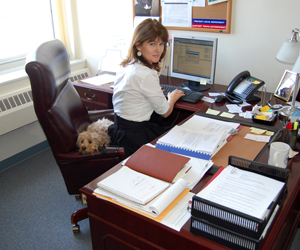
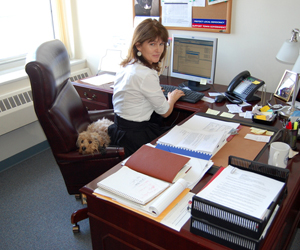
Mounting tension between two potential political rivals has spilled over from debate over capital budgets and financial restructuring to the issue of a 12-pound dog.
After last week’s contentious Southampton Town Board meeting, during which a proposal to reorganize the town’s finance department was shot down, Town Supervisor Linda Kabot suggested that the proposal’s initiator, Councilwoman Anna Throne-Holst, was violating town policy by regularly bringing her dog to Town Hall.
Ms. Throne-Holst said she had no idea that anyone was upset with her for bringing Frankie, her dachshund/poodle mix, to work, and had she known she would have stopped, which is what she said she is going to do now.
“I apologize if I offended anyone,” she said. “No one has ever said a thing to me. But I’m sorry and will never let him step another paw inside Town Hall again.”
After originally pointing out last week that Ms. Throne-Holst was bringing her dog to Town Hall, Ms. Kabot said Tuesday that she did not want to discuss the issue.
“I really don’t want to get involved with it as this will be considered petty at this point with the other bickering going on,” Ms. Kabot said. “There is no need to create more tension and dysfunction in town government.”
Ms. Throne-Holst said she began bringing Frankie to work when her youngest son went away to school and after Christine Russell, the town’s assistant animal shelter supervisor, suggested that he be trained as a therapy dog for senior citizens. Ms. Russell said she suggested Frankie as a therapy dog after her boxer, which she had been using for that purpose, died. Ms. Russell said the size and temperament of the councilwoman’s dog made him well suited for senior citizen therapy and that many of the town’s shelter dogs are not adequately socialized for such work.
“I rarely get home before 9 or so in the evening, with community meetings and the like, and I was worried about the little guy being left alone for so many hours,” Ms. Throne-Holst said. “He usually hangs out with me in my office and greets people when they walk in. In fact, when I don’t bring him, people ask about him.”
Although Ms. Throne-Holst said Frankie is in the process of being certified as a therapy dog, and bringing him to Town Hall is part of that training, that has not stopped some of her colleagues from voicing displeasure with the councilwoman’s canine companion.
“It’s a matter of common courtesy,” said Town Councilwoman Nancy Graboski, whose office is next door to Ms. Throne-Holst. “The sign on the door reads ‘no dogs, except service dogs.’ So we have a town councilperson who feels she can do whatever she wants. It certainly raises questions and concerns.”
But Ms. Throne-Holst rejected that characterization and said in no way does she feel entitled or privileged.
“I wouldn’t mind anyone else bringing their dog to work, so long as that dog was friendly and not a nuisance,” she said. “The supervisor, nor anyone else for that matter, has ever complained or said a word to me about Frankie.”
“The conduct of an elected official is really under self-policing, and not my responsibility,” Ms. Kabot said. “I am not my sister’s keeper.”
Ms. Graboski said town employees are afraid to say anything for fear of losing their jobs.
“That’s ridiculous,” Ms. Throne-Holst countered, adding that her colleagues on the board, including the supervisor, are not fearful of such reprisal and have never confronted her.
Ms. Graboski said she has never mentioned the issue to her fellow councilwoman for fear of it affecting town business. “I stay away from personal issues,” Ms. Graboski said. “I assume she would tell me, ‘Who are you, the dog police?’”
Ms. Throne-Holst said she never got the impression Ms. Graboski felt that way and would not have responded the way her colleague assumed. “Had she, or anyone else, told me she had an issue with him, I certainly would have respected that, as I’m doing now.”
The other board members, Chris Nuzzi and Sally Pope, whose offices are also adjacent to Ms. Throne-Holst’s, said they are not bothered by their colleague’s pet and have not received any complaints.
“I can’t believe we’re even having this discussion,” Mr. Nuzzi said when asked about the dog. “Right now we have much more important things to focus on, and I do not wish to be sidetracked, or even comment on, the desire of a town council member to bring her dog to work with her.”
Ms. Pope said Frankie makes the Town Board office a happier place and enjoys him being there. “This may sound funny, but he humanizes the office,” she said. “He comes up and loves you. And sometimes, he’s the only one to do that.”
Former Town Councilman Dan Russo, however, was more blunt about the controversy, saying it was purely political.
“When I was in the town council office, I hardly knew Frankie was there and never once heard any complaints about him,” Mr. Russo said. “I find it suspect that she’s being criticized about this now. I’ve been on the opposite side of the supervisor’s personal attacks, and this is what happens when you start asking the tough questions.”
The supervisor said her office gets about one complaint a week, mostly from town employees, about the dog, though Ms. Kabot declined to identify who has filed them.
Ms. Throne-Holst said she did not realize that bringing her dog was problematic because she recalled coming to Town Hall when she was the director of the Bridgehampton Child Care Center and seeing Marietta Seaman, town clerk from 1994-2006, with her dogs. Ms. Seaman used to train guide dogs and would bring them to work as part of that training.
According to Town Attorney Dan Adams, the “No Dogs” signs Ms. Graboski referred to reflect town policy, not town code. As Mr. Adams explained, town policy is less formal than town code, which carries charges, fines and possible jail time for violations.
“Town policy does not carry the same weight as town code,” Mr. Adams said. “Policies do not set fines or punishment, and the adherence to them can be debated among town officials.”
The town attorney also said that there is no overarching state or county law that dictates town policy toward dogs inside Town Hall.
“We have the power to determine that policy,” he said. “At the end of the day, this is something that is going to have to be revisited by the Town Board.”


 Brian Bossetta on Mar 4, 2009