


 2 Photos
Inside the Howell Homestead in Westhampton Beach. MICHELLE TRAURING
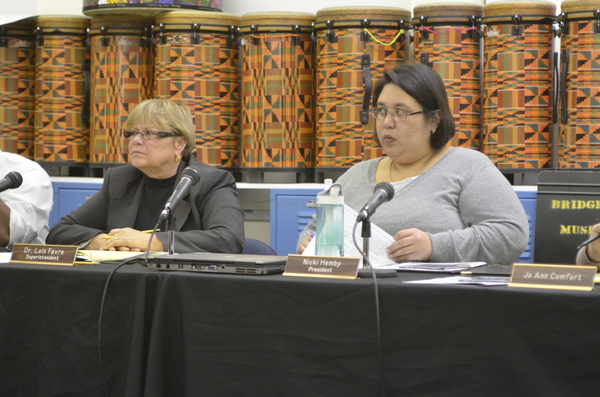
Bridgehampton School Board members approved a resolution last Wednesday to freeze the salaries of all non-teacher staff members for the 2012-13 school year. SHAYE WEAVER
Twenty-three non-teacher employees of the Bridgehampton School District will see no salary increases for the 2012-13 school year.
The resolution for the salary freeze was approved by the Board of Education late last month, saving the district thousands of dollars as it grapples with the state-imposed 2 percent tax levy cap.
In February, School Superintendent Dr. Lois Favre unveiled a preliminary $10.9 million budget for the 2012-13 school year, a plan that increases overall spending by nearly $335,000, or 3.1 percent, over the current year’s $10.5 million budget. Dr. Favre said her spending plan does not pierce the tax cap, meaning that, if it is adopted as is, a simple majority vote among taxpayers will be enough to pass it in May. If the district opts to exceed the cap, at least 60 percent of taxpayers—known as a supermajority—must approve the spending plan as per the new state rules.
Dr. Favre said she could not provide an estimated tax levy increase, noting that the figures are still shifting.
While no programs will be eliminated under her spending plan, Dr. Favre said she expects to cut spending by about 15 percent across the board on most budget lines. Also, one full-time non-teacher post will be eliminated and the district will not replace a guidance director or a clerk who is set to retire at the end of the school year.
As the district continues to tighten its belt, teachers and staff members have already pitched in by agreeing to a salary freeze. The recent concession from its support staff, which includes custodians, administrators and guidance counselors, comes after members of the district’s teachers union agreed to forgo raises and step increases for the 2012-13 school year. Those two concessions are expected to save the district nearly $93,000, according to Dr. Favre.
At the end of last week’s board meeting, Dr. Favre said the district is still working on the requirements for the Annual Professional Performance Review—a new state mandate requiring that school districts develop a new system of evaluating teachers—before it can finalize the details of the agreement with district’s 38 teachers.
“I am proud that our team—Civil Service Employees Association, the Bridgehampton Teachers Association and administration—came together, across the board, to take a zero-increase to assist the district with meeting the tax levy limitations this year,” Dr. Favre said.
An old and unused mini-school bus that currently sits in the school’s parking lot might soon meet its maker. The district’s business department has finally been given the green light by the Board of Education to look into selling the vehicle for scrap metal.
The bus, which was purchased in 1990, doesn’t pass the more rigorous New York State Department of Transportation inspection, according to Dr. Favre.
The school’s business office has tried finding a buyer by placing legal ads in newspapers, but has only received one offer, for $150, which was declined. Dr. Favre said it will cost the district at least $35,000 to buy a new one and that selling the old vehicle for scrap metal is the most viable option to recoup some money.
School Business Administrator Robert Hauser said the McCoy Bus Company in Bridgehampton received $1,500 from a salvage yard in Flanders for a 60-passenger bus that was 20 years old. He said he hopes to get a similar amount for the mini-bus.
Board members exchanged jokes about how their old bus could be used if they cannot get rid of it, with one suggesting that it be transformed into a Partridge Family-like tour bus. Others suggested that it could be used for the school’s ongoing collection of supplies for an impoverished community in Fiji.
“We still have not received any other offers,” Mr. Hauser said, joking aside. “It’s not a safe bus.”


 Shaye Weaver on Apr 4, 2012